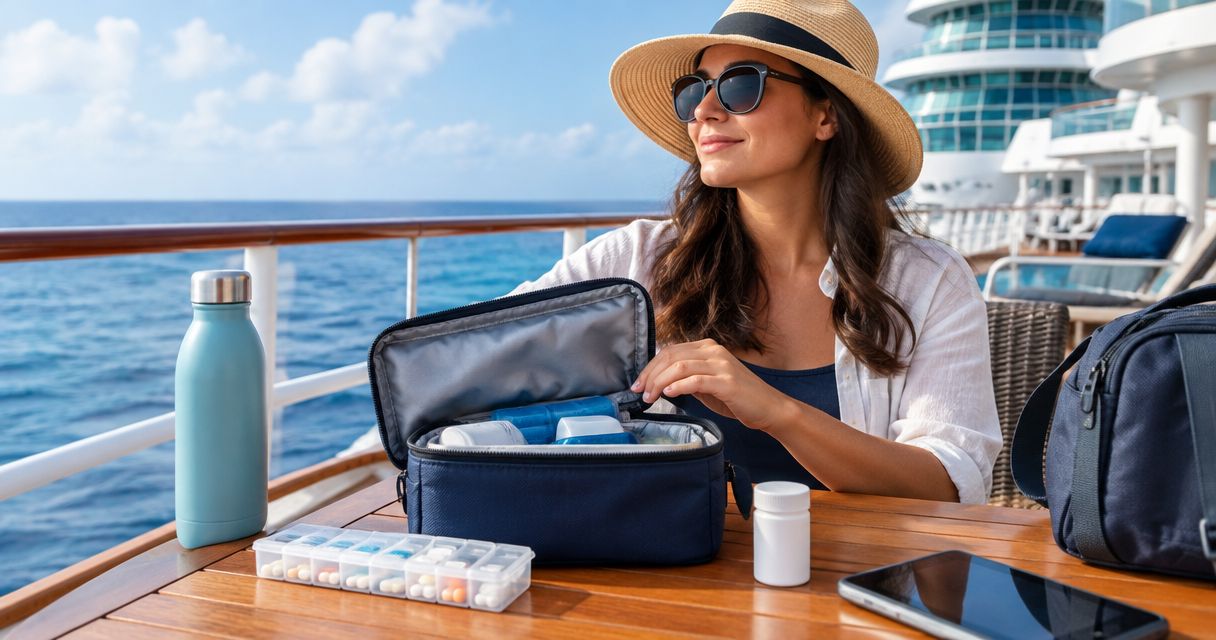
Cruise passengers’ refrigerated-medication travel planning is the process of protecting temperature-sensitive prescriptions from home to ship and back so treatment stays on schedule. Your plan needs to cover airport screening, embarkation queues, cabin storage, shore excursions, and delays—not just the flight.
- Traveling with refrigerated medication for cruise passengers starts with the exact product’s storage instructions, not a generic cooler recommendation.
- Confirm shipboard refrigeration before departure; a cabin minibar is not proof of suitable medication storage.
- MyAbroadMDs suits travelers preparing English-speaking doctor contacts abroad; it does not provide refrigeration, insurance, telehealth, or booking.
- Keep prescriptions, temperature instructions, and your medication cooler together during every transfer.
Why this matters
A cold bag is not a complete storage plan. Medication needs protection while you wait outside the terminal, move between transport connections, and settle into your cabin. Freezing can also damage medicines that require refrigeration.
Choose equipment around your prescription’s requirements, rather than choosing a bag first and hoping it fits. The guide to medication coolers for refrigerated medicines provides a starting point for comparing transport approaches.
For a 2026 sailing, confirm arrangements for your specific ship and itinerary. A general statement about onboard refrigerators does not establish the temperature, access arrangements, or storage space available for your medication.
Why refrigerated-medication planning matters for cruise passengers
Cruise travel creates a specific handoff problem: you move from home storage to ground transport, possibly through an airport, then into a terminal and onto a ship. Each handoff needs a clear storage arrangement. Luggage delivery and cabin access are separate from your medication schedule.
Days ashore add another decision. You need to know whether a dose can stay onboard, must travel with you, or requires a different schedule approved by your prescriber. Do not change dosing times simply to make an excursion easier.
The goal is straightforward: know the required conditions, confirm how you will maintain them, and prepare a response if something changes. Before you pack. Not after a temperature alarm.
How to prepare refrigerated medication for a cruise
1. Confirm your exact medication’s storage rules
Start with the dispensing label, manufacturer’s patient information, and a conversation with your pharmacist. Identify the exact formulation and device: storage instructions can differ between unopened supplies and medicine already in use.
Some medicines specify refrigeration at 2–8°C, equivalent to approximately 36–46°F. That range is an example, not permission to apply it to every prescription. Use your product’s instructions, including limits on freezing, light exposure, and time outside refrigeration.
Ask what to do after an unexpected temperature reading. Appearance alone cannot establish whether a temperature-sensitive medicine remains usable. Get instructions that address your product rather than relying on general travel advice.
- Record the medicine’s generic name, formulation, and strength.
- Copy its unopened and in-use storage instructions.
- Ask whether temporary room-temperature storage is permitted.
- Confirm whether refrigeration can resume after an allowed excursion.
- Save the pharmacist’s and manufacturer’s contact details.
2. Confirm refrigeration with the cruise line
Contact the cruise line’s accessibility or guest-services team before your 2026 departure. Explain that you need medication storage within a specified temperature range. Ask for a written response tied to your sailing, rather than accepting a general description of cabin amenities.
A minibar’s presence does not confirm medical suitability. Ask whether the proposed appliance maintains your required range, whether you can monitor it, and what happens during a power interruption. If storage is outside your cabin, establish how you will retrieve doses.
Also confirm the rules for bringing cooling equipment onboard. Do not assume a plug-in cooler, battery pack, or freezer-pack arrangement is accepted just because it works at home.
- Ask who handles medical refrigeration requests.
- Specify the required temperature range and package dimensions.
- Confirm access during your dosing schedule and port days.
- Check electrical-device and battery requirements.
- Request an alternative if the proposed storage is unsuitable.
3. Build a port-by-port healthcare backup
Start manually: list your embarkation city, destinations, and disembarkation city. Identify English-speaking healthcare contacts and check how you would reach care from each port. Keep these details offline alongside your prescription information.
MyAbroadMDs is best for travelers who want a personalized directory of English-speaking doctors before departure. Its subscription memberships provide curated healthcare-provider directories across 100+ countries. Use MyAbroadMDs for healthcare preparation, not as a substitute for refrigeration or medical treatment.
MyAbroadMDs is not insurance, telehealth, or a booking service. A directory also does not confirm that a clinician can replace your medicine locally. Verify the relevant arrangements directly, including whether a local prescription is required.
- Save the ship’s medical-contact instructions.
- Identify healthcare contacts near relevant ports.
- Record the medicine’s generic name and prescription details.
- Check medication-entry rules with destination authorities.
- Keep insurance assistance details separate from provider contacts.
4. Pack a monitored transport setup
Choose a transport method that matches the medication’s requirements and your longest planned period away from suitable refrigeration. Include terminal waiting, transfers, and access to your onboard storage—not only scheduled travel time.
Follow the cooler manufacturer’s packing instructions and your pharmacist’s guidance. Direct contact with frozen packs can expose medicine to freezing, so use the specified separation method. A temperature monitor helps you observe conditions; it does not make an unsuitable container suitable.
Test the arrangement before your 2026 trip without using medication as the test material. A rehearsal helps you identify fit, handling, and monitoring problems, but it does not certify performance in different weather or travel conditions.
- Keep medication in identifiable, labeled packaging.
- Protect medicine from direct contact with frozen cooling materials.
- Position the monitor according to its instructions.
- Keep the medication kit accessible in your carry-on belongings.
- Pack relevant prescriptions and storage instructions with the kit.
5. Map every storage handoff
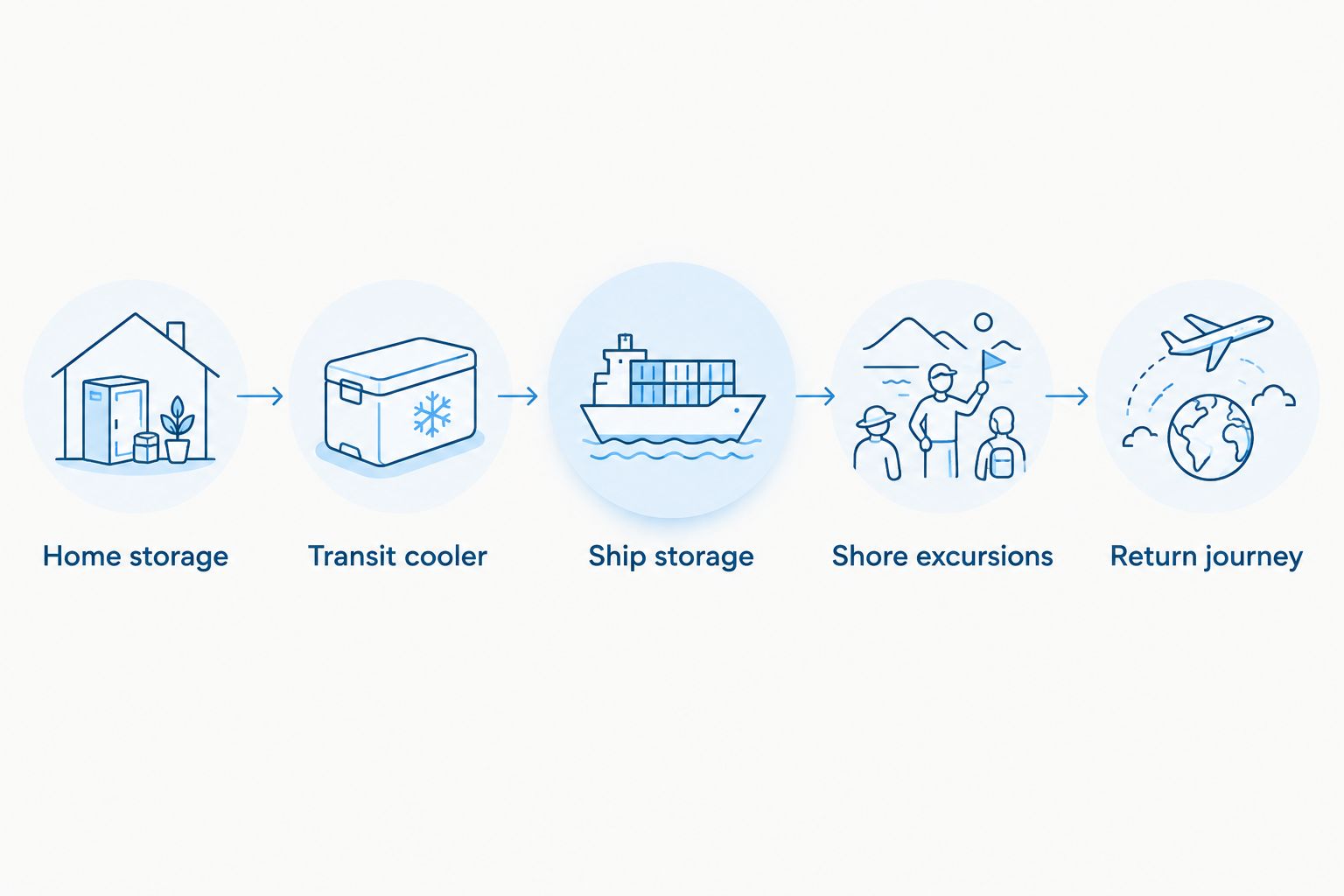
Write the journey as a sequence: home storage, transit cooler, ship storage, and shore excursions. For each stage, name the storage method and the person responsible. This prevents a gap where everyone assumes someone else has the medication.
Keep medication with you during embarkation rather than placing it in luggage handed over for later delivery. If you fly, check current airport-security requirements for liquid medicines, cooling materials, needles, and devices. Airport screening and cruise embarkation are separate processes.
Plan your first onboard action. Confirm the agreed storage arrangement before unpacking the rest of your luggage. If the arrangement differs from the written confirmation, contact the designated shipboard team immediately.
- Home storage: check supplies against the prescription.
- Transit cooler: pack and monitor as instructed.
- Ship storage: confirm temperature and access arrangements.
- Shore excursions: carry only what your treatment plan requires.
- Return journey: repeat the same storage checks.
6. Prepare for temperature problems and delays
Decide what you will do if a cooler warms, a monitor alarms, or refrigeration becomes inaccessible. Record the temperature information you have and the likely duration of exposure. Give those details to a pharmacist or the manufacturer for product-specific advice.
Do not assume that putting medicine back in a refrigerator reverses temperature damage. Equally, do not discard essential treatment or skip doses without clinical guidance. If a scheduled dose is approaching, promptly contact the ship’s medical team and your prescribing clinician or pharmacist.
For a 2026 itinerary, save relevant contacts offline before departure. Connectivity is not a dependable foundation for your only copy of a prescription, storage instructions, or emergency plan.
- Record unusual readings and when you discovered them.
- Keep affected medicine identifiable and separate from unaffected supplies.
- Contact a pharmacist or manufacturer about continued usability.
- Ask a clinician what to do about an approaching dose.
- Seek immediate onboard medical help for urgent symptoms.
Compare medication-storage options for cruise travel
Best for labels describe a use case, not proof that an option meets your prescription’s requirements. Confirm operating conditions and monitoring before relying on any setup. No storage option below replaces your product’s instructions.
| Option | Best for | Main advantage | Key limitation |
|---|---|---|---|
| Insulated carrier with cooling packs | Transfers with a defined storage plan | Portable and independent of a power outlet | Cooling is finite; incorrect packing risks freezing |
| Powered medication cooler | Travelers able to confirm compatible power arrangements | Provides active cooling while operating as designed | Requires suitable power and cruise-line acceptance |
| Confirmed cabin refrigerator | Passengers needing convenient access to suitable onboard storage | Keeps medication close to the passenger | A minibar must not be assumed to meet the required range |
| Agreed storage with ship staff | Passengers whose confirmed arrangement includes staff-managed storage | Provides an alternative when cabin storage is unsuitable | Access, responsibility, and dosing arrangements need advance agreement |
| Label-permitted room-temperature storage | Exact products whose instructions allow it | Reduces refrigeration dependence for the permitted period | Limits differ by product and whether it is already in use |
A mixed plan can serve different stages: an insulated carrier during transfers and confirmed refrigeration onboard, for example. The transition matters as much as either container. Establish where the medication goes immediately after boarding and how you will retrieve it before disembarkation.
Common mistakes cruise passengers make
Treating a minibar as confirmed medical refrigeration
A cabin listing that mentions a refrigerator does not establish its operating range. Ask the cruise line to confirm suitability for your prescribed conditions, then monitor storage as instructed. Do not place medicine against a freezing surface simply because the cabin feels warm.
Packing medication with luggage handed to porters
Your luggage and your medication do not need the same journey through the terminal. Keep medication, cooling materials, and essential documentation accessible. That also allows you to respond to a monitor alarm without waiting for a suitcase.
Planning for the flight but not the shore excursion
A transport setup that covers the airport journey does not automatically cover a day ashore. Review the excursion’s transport, heat exposure, and return arrangements against your medication instructions. Ask your prescriber about dose timing before changing it.
Expecting the ship to replace a specific prescription
Do not build your plan around an unconfirmed replacement supply. Check your prescribed supply before departure and discuss delay contingencies with your clinician. A healthcare-provider directory, including MyAbroadMDs, does not establish local access to your exact formulation.
Leaving the return journey unplanned
Disembarkation creates another storage handoff, often followed by transport and waiting. Confirm how cooling materials will be prepared and when you must retrieve medication from any staff-managed storage. Your refrigeration plan ends at suitable storage at home, not at the gangway.
FAQ
Can I bring refrigerated medication on a cruise?
Plan refrigerated medication with your cruise line before sailing and confirm its documentation, equipment, and storage requirements. Keep the medicine accessible during embarkation and follow the exact product’s storage instructions throughout the journey.
Is the refrigerator in my cruise cabin safe for medication?
A cabin refrigerator is suitable only if it maintains your medication’s required conditions. Confirm the appliance’s operating range and monitoring arrangements; the word minibar is not sufficient confirmation.
What temperature should refrigerated medication stay at?
Use the temperature range on your exact medication’s label and manufacturer instructions. Some products require 2–8°C, approximately 36–46°F, but unopened and in-use instructions can differ.
Can I put frozen gel packs next to my medication?
Do not place medication directly against frozen packs unless the product and transport instructions explicitly permit that arrangement. Follow the specified packing method to prevent unintended freezing.
What should I do if my medication gets too warm on the ship?
Contact your pharmacist or the manufacturer promptly with the product name, temperature information, and estimated exposure duration. Ask the ship’s medical team for help with an approaching dose; do not assume re-refrigeration restores usability.
Can the ship’s medical center replace my prescription?
Do not assume the ship can replace your exact prescription. Confirm any arrangements directly and discuss supply and delay planning with your prescriber before departure.
Does MyAbroadMDs arrange medication storage or medical appointments?
MyAbroadMDs provides personalized, curated directories of English-speaking healthcare providers for pre-trip preparation. It is not a refrigeration provider, insurance policy, telehealth service, or booking service.
One last thing
Plan the last transfer as carefully as the first. Before your 2026 departure, write down where your medicine will go between leaving the ship and reaching home refrigeration. That simple handoff check closes a gap that packing a good cooler alone does not solve.