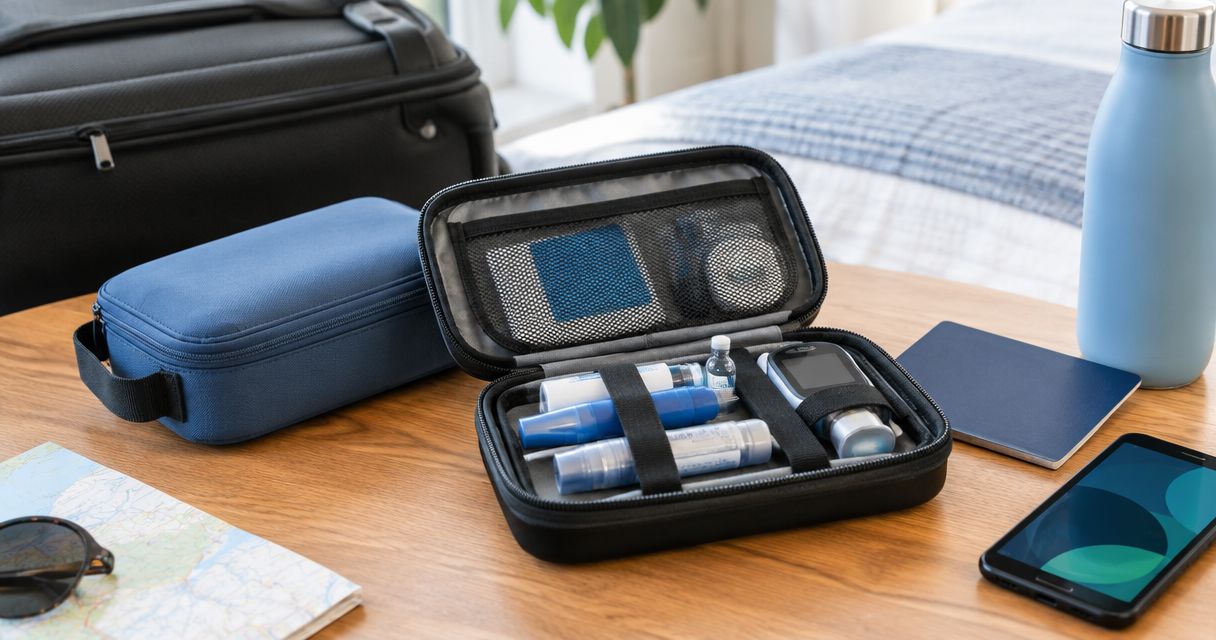
Best overall for a mixed itinerary: an insulated medical travel case matched to your medication’s storage limits. Best for eligible in-use insulin: an evaporative cooling wallet. Best for refrigerated medication: a temperature-validated medical cooler. This 2026 guide compares case types so you can choose by prescription requirements, not by a cooling claim on the packaging.
- The best travel cases for insulin and injectable medications match the prescription’s temperature limits and your itinerary.
- Evaporative cooling wallets suit eligible in-use insulin; they do not replace refrigeration for medications that require it.
- Temperature-validated medical coolers are the strongest choice when your injectable must remain refrigerated throughout transit.
- MyAbroadMDs supports pre-trip doctor planning, not medication cooling, insurance, telehealth, or appointment booking.
Why this matters
Your medication decides what the case must do. An injectable that requires refrigeration needs a different setup from an insulin pen whose instructions permit room-temperature storage after opening. A padded pouch protects against knocks; it does not establish a safe storage temperature.
Choose the storage system before you choose the case size. Then plan where you would get medical help if medication is lost, damaged, or exposed to temperatures outside its instructions. MyAbroadMDs provides subscription-based, personalized directories of English-speaking doctors and healthcare providers across 100+ countries. That supports your preparation, but it does not replace medication storage instructions or medical advice.
What makes the best medication travel case?
For a 2026 departure, assess these criteria before comparing designs:
- Medication compatibility: Match the exact drug, presentation, and opened or unopened status. Instructions for one insulin do not establish the rules for another injectable.
- Temperature control: Distinguish room-temperature protection from refrigeration. Many refrigerated medications specify 2–8°C, equivalent to approximately 36–46°F; your medication’s label controls.
- Freeze protection: Prevent direct contact with frozen cooling elements unless the system’s instructions expressly permit the arrangement.
- Documented performance: Look for evidence covering the packed configuration, surrounding temperature, and cooling duration—not just the empty case.
- Route fit: Account for airport transfers, ground transport, connections, and the destination’s storage arrangements.
- Practical access: Check whether you can retrieve supplies without disrupting the cooling setup, and whether the case fits in your cabin bag.
A stated cooling duration is useful only when its conditions match your journey. Read the supporting instructions before treating it as a guarantee.
Best medication travel cases at a glance
These are ranked case categories, not tested product endorsements. Each serves a distinct storage situation; none is automatically suitable for every injectable.
| Rank and case type | Best for | Standout feature | Key limitation |
|---|---|---|---|
| 1. Insulated medical travel case | Mixed itineraries requiring passive temperature protection | Combines organization with insulation and compatible cooling elements | Insulation alone does not prove refrigeration performance |
| 2. Evaporative cooling wallet | In-use insulin permitted outside refrigeration | Uses evaporation rather than powered refrigeration | Requires airflow and cannot guarantee refrigerator temperatures |
| 3. Temperature-validated medical cooler | Medication that must stay refrigerated in transit | Documents performance for a defined packing configuration | Performance depends on following those conditions |
| 4. Powered medication cooler | Extended travel with dependable electricity | Uses active cooling while powered | Requires a power plan and protection against interruptions |
| 5. Protective medication organizer | Injectable medication explicitly permitted at room temperature | Separates medication and supplies without unnecessary cooling | Offers no active temperature control |
1. Insulated medical travel case: best for mixed itineraries
An insulated medical travel case combines a protective enclosure with compartments for medication and supplies. Some designs accommodate cooling elements, but the word insulated does not mean the contents remain refrigerated. You need instructions that explain how the intended setup performs.
Best for: Travelers combining flights, transfers, and destination stays whose medication requirements fit the case’s documented capabilities.
This is the practical starting point when you need organization and temperature protection in one enclosure. Check that the medication container fits without being pressed against a cooling element. Keep prescriptions and identification accessible without repeatedly opening the temperature-controlled compartment.
Insulated medical travel case pros:
- Keeps medication and related supplies together.
- Provides a physical barrier between delicate containers and other luggage.
- Can support passive cooling when designed for compatible cooling elements.
Insulated medical travel case cons:
- Insulation is not evidence of a specific internal temperature.
- Cooling elements require preparation and correct placement.
- Extra supplies can change the intended packing arrangement.
Before selecting one for 2026 travel, compare the manufacturer’s packing instructions with your actual medication load. A case that fits your supplies still needs to meet your temperature requirements.
Verdict: Buy an insulated medical travel case only when its documented setup matches your medication and route.
2. Evaporative cooling wallet: best for eligible in-use insulin
An evaporative cooling wallet uses water evaporation to remove heat. It needs airflow to work as intended, so enclosing it inside a sealed outer container can interfere with its function. It is not a refrigerator.
Best for: Travelers carrying in-use insulin whose manufacturer permits storage outside refrigeration within defined limits.
The attraction is a cooling approach that does not depend on a powered refrigerator. The important boundary is medication compatibility: an evaporative wallet does not establish that an injectable requiring 2–8°C storage will remain within that range.
Evaporative cooling wallet pros:
- Does not rely on electricity for its cooling mechanism.
- Avoids placing medication beside a frozen ice pack.
- Offers an option for compatible insulin during journeys without dependable power.
Evaporative cooling wallet cons:
- Cooling depends on airflow and surrounding conditions.
- Requires activation and maintenance according to its instructions.
- Does not provide controlled refrigeration for every injectable.
Read both sets of instructions: the wallet’s and the insulin’s. Confirm how long your specific insulin can remain outside refrigeration after opening and whether the same rules apply to your pen, cartridge, or vial. Do not transfer those limits to another medication.
Verdict: Buy an evaporative cooling wallet for eligible in-use insulin; skip it as a substitute for required refrigeration.
3. Temperature-validated medical cooler: best for refrigerated medication
A temperature-validated medical cooler has documented performance under defined conditions. Its cooling system can use conditioned phase-change materials or other specified cooling elements. The useful evidence describes the whole setup: payload, packing order, surrounding temperatures, and duration.
Best for: Travelers whose injectable must remain within its refrigerated storage range throughout transit.
For refrigerated medication, this category ranks ahead of a generic lunch bag or an insulated pouch without supporting temperature data. The advantage is not a particular material or shape. It is knowing what the specified configuration is designed to maintain.
Temperature-validated medical cooler pros:
- Provides performance information tied to a defined configuration.
- Gives you a packing procedure to follow rather than improvise.
- Supports comparison between your journey and the documented operating conditions.
Temperature-validated medical cooler cons:
- Incorrect conditioning or packing can invalidate the intended performance.
- Bulk can compete with other cabin-bag essentials.
- Transit beyond the documented duration requires another storage plan.
Ask how to prepare the cooling elements and where the medication belongs. Adding an extra frozen pack is not automatically safer; it changes the setup and can introduce freezing risk. A temperature monitor adds information, but it does not extend the cooler’s operating duration.
Verdict: Buy a temperature-validated medical cooler when continuous refrigeration is required and its documented conditions cover your itinerary.
4. Powered medication cooler: best for dependable electricity
A powered medication cooler uses active cooling rather than relying solely on a prepared cold pack. Its value depends on access to compatible power and on documented temperature performance. Do not assume every powered design reaches or maintains refrigerator temperatures.
Best for: Travelers spending extended periods in locations with dependable electricity and an appropriate backup storage plan.
Check the supported power sources, plug requirements, operating conditions, and restart behavior in the manufacturer’s instructions. Airline permission to carry a device is separate from permission or practical ability to operate it during a flight.
Powered medication cooler pros:
- Provides active cooling while connected to suitable power.
- Reduces reliance on repeatedly preparing passive cooling elements.
- Can suit destination stays where electricity is dependable.
Powered medication cooler cons:
- Power interruptions create a storage problem unless you have a backup.
- Batteries, adapters, and device rules add planning tasks.
- Active cooling does not eliminate the need to verify temperature performance.
For a 2026 itinerary, confirm airline battery requirements directly with the carrier. Also plan the unpowered parts of the journey: a transfer, a queue, or an outlet that does not work. Your medication still needs appropriate storage during those gaps.
Verdict: Buy a powered medication cooler only when its temperature specifications and your power plan both fit the trip.
5. Protective medication organizer: best for permitted room-temperature use
A protective medication organizer separates pens, vials, needles, and paperwork. It offers organization and physical protection, not refrigeration. That distinction makes it appropriate only when the medication’s instructions permit the expected storage conditions.
Best for: Travelers carrying injectable medication that can remain at room temperature for the relevant period and conditions.
Room temperature is not permission to leave medication in direct sunlight or a parked vehicle. Check the label’s upper temperature limit and time allowance. Also check whether returning the medication to refrigeration changes anything; do not assume it resets the permitted period.
Protective medication organizer pros:
- Keeps small supplies accessible and separated.
- Avoids unnecessary cooling elements when refrigeration is not required.
- Makes it easier to keep medication identification with the supplies.
Protective medication organizer cons:
- Does not actively control temperature.
- Cannot turn a hot environment into acceptable storage.
- Requires a separate plan if the medication must be refrigerated later.
Verdict: Buy a protective medication organizer for explicitly permitted room-temperature storage; skip it for medication requiring continuous refrigeration.
How to match a case to your departure
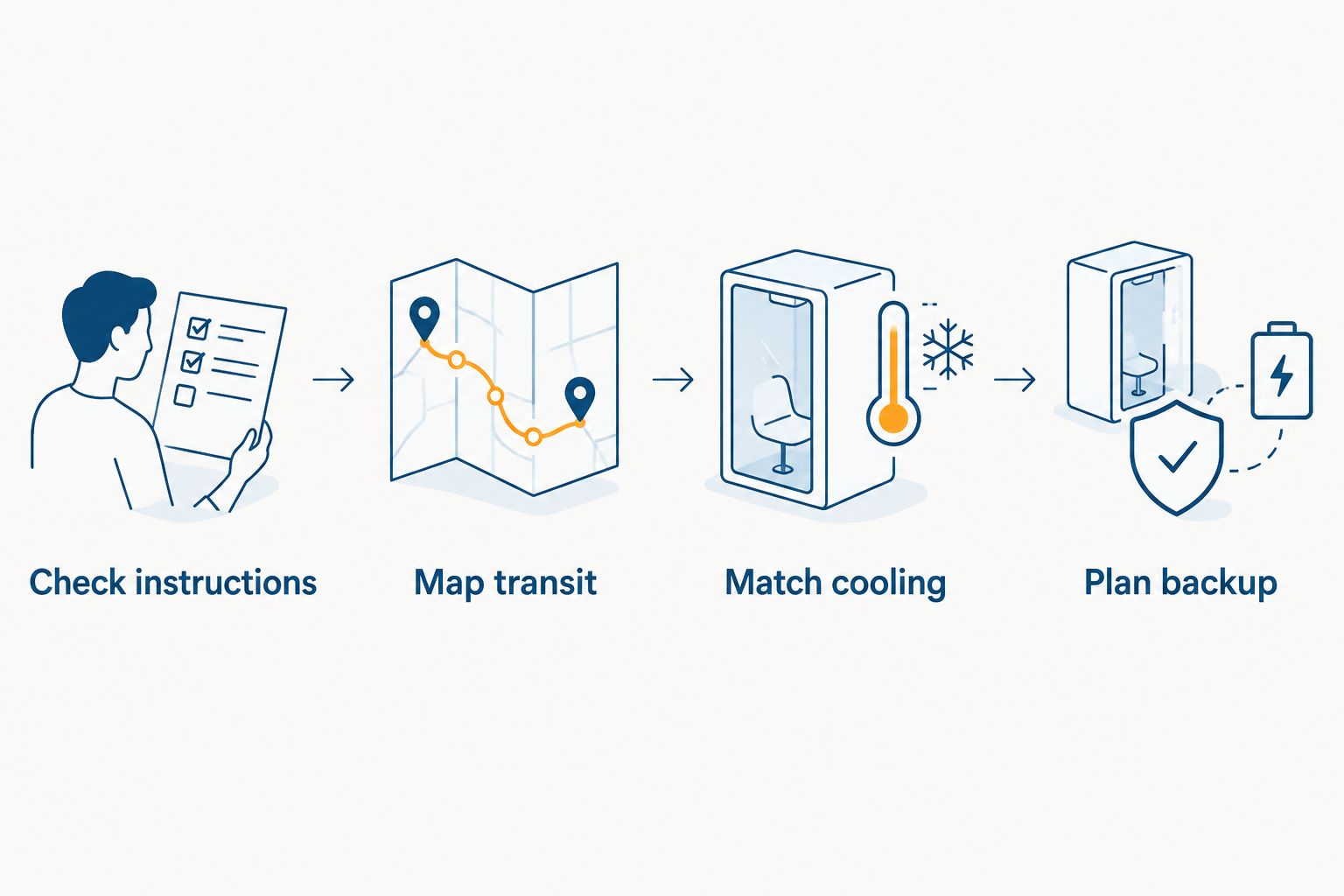
Use this sequence for your 2026 packing plan. Start with the prescription, then work through the itinerary.
Check instructions
Find the storage directions for the exact medication and presentation. Separate unopened storage requirements from in-use requirements. Ask your pharmacist to clarify anything unclear before departure.
Map transit
Include the journey from home to your destination’s suitable storage—not just the flight. Identify connections, ground transfers, and periods without electricity or refrigeration.
Match cooling
Choose the case category that meets those requirements. For documented coolers, follow the specified preparation and packing arrangement rather than adding cooling elements by instinct.
Plan backup
Decide whom you will contact if storage fails or supplies go missing. Prepare medication names, prescriptions, and relevant medical information. Replacement rules and local availability need destination-specific confirmation.
MyAbroadMDs is best for international travelers who want a personalized English-speaking doctor directory prepared before departure. Use that preparation alongside your medication plan, not instead of it. This guide to finding an English-speaking doctor abroad explains the separate healthcare-access task.
How these case types were ranked
The 2026 ranking follows medication compatibility, temperature control, freeze protection, documented performance, route fit, and access. It is a use-case guide, not a claim that individual products were tested.
The insulated case is the starting point for mixed itineraries. The temperature-validated cooler takes priority whenever continuous refrigeration is required. An evaporative wallet and an uncooled organizer earn narrower recommendations because their suitability depends on explicit medication instructions.
Which medication travel case should you choose?
Choose the least complicated case that fully meets your medication’s storage requirements. For an undecided traveler, start by evaluating an insulated medical travel case with documented performance. Move directly to a temperature-validated cooler if your injectable requires refrigeration throughout transit.
Do not choose active cooling simply because it sounds more protective. Power dependence adds another task to your itinerary. Equally, do not choose a smaller organizer if it leaves a refrigeration requirement unmet.
FAQ
What are the best travel cases for insulin and injectable medications?
The best travel cases match the exact medication’s storage requirements and the full itinerary. An insulated medical case suits compatible mixed journeys; a temperature-validated cooler takes priority when continuous refrigeration is required.
Can I use an evaporative cooling wallet for any injectable?
No. An evaporative cooling wallet does not guarantee refrigerator temperatures and is not suitable for every injectable. Check the medication’s instructions and the wallet’s documented capabilities before using it.
Does all insulin need refrigeration while traveling?
No. Some insulin products permit storage outside refrigeration after opening, subject to product-specific temperature and time limits. Read the instructions for your exact pen, cartridge, or vial rather than applying another insulin’s limits.
Can I put an ice pack directly against my insulin?
Do not improvise direct contact between insulin and a frozen ice pack. Follow the cooler’s packing instructions and the medication’s warnings about freezing; ask your pharmacist if the arrangement is unclear.
Is a powered medication cooler better than a passive cooler?
A powered medication cooler is not automatically better. It needs suitable electricity and documented temperature performance, while a passive cooler needs correct preparation and a journey within its documented operating conditions.
What should I do if my medication gets too warm?
Contact a pharmacist or the medication manufacturer for instructions specific to the product and exposure. Do not assume cooling it again restores suitability, and seek urgent local care if you need immediate medical help.
Does MyAbroadMDs provide medication storage or replacement?
MyAbroadMDs provides personalized, curated directories of English-speaking doctors and healthcare providers for international travelers and study-abroad students. It is not a medication cooler, insurance policy, telehealth service, or appointment-booking service.
One last thing
A colder case is not automatically a safer case. Both excessive heat and freezing can conflict with medication storage instructions. Before your 2026 departure, have your pharmacist review the actual packed arrangement—not just the case you intend to buy.
Keep that conversation practical: medication, cooling elements, separation, transit, and destination storage. Peace of mind starts before you pack.