
Best overall: the destination’s official medical register. Best for specialist credentials: the relevant specialty register or certification board. Best for a pre-trip shortlist: MyAbroadMDs. This 2026 guide separates resources that verify credentials from resources that help you find a doctor.
- The best resources for verifying doctor credentials abroad start with the destination’s official medical regulator.
- Specialty registers establish specialist recognition; hospital credentials offices help confirm claimed hospital affiliations.
- MyAbroadMDs is best for travelers who want a personalized English-speaking doctor directory before departure.
- A directory listing, insurance network entry, or positive review does not establish current medical registration.
Why this matters
Finding an English-speaking doctor and verifying that doctor’s credentials are separate tasks. A useful shortlist answers where to look. An official register answers whether the named professional holds the registration shown in that jurisdiction.
MyAbroadMDs offers subscription-based travel-health preparation memberships with personalized, curated directories of English-speaking doctors and healthcare providers across 100+ countries. That makes it a starting point for your itinerary, not a substitute for checking a regulator’s records.
Before departure in 2026, build your shortlist and identify the authority responsible for each destination. Keep insurance, language access, and credential verification separate. None establishes the other.
What makes the best doctor credential verification resource
Rank a resource by the question it can actually answer, not by how polished its profile looks.
- Regulatory authority: Does the source control or officially record medical registration in the place where you will receive care?
- Identity matching: Can you distinguish the doctor from another professional with a similar name?
- Registration status: Does the record show the relevant current status, rather than merely a past qualification?
- Specialist recognition: Does the source establish the specialty claimed, where a separate recognition system exists?
- Scope and restrictions: Does the record identify conditions or limitations relevant to the proposed care?
- Practical fit: Can you establish the doctor’s location, language, and route for contacting the practice separately?
Match 3 identifiers before relying on a result: the full professional name, registration number, and jurisdiction. This is a checking method, not a guarantee of care quality. Location and specialty provide additional context when records contain them.
Best credential verification resources at a glance
| Rank | Resource | Best for | Standout function | Key limitation |
|---|---|---|---|---|
| 1 | Official medical regulator | Current registration | Authoritative registration record for its jurisdiction | Does not establish language ability or bedside manner |
| 2 | Specialty register or certification board | Specialist recognition | Separates general registration from specialty credentials | Scope depends on the country and credential |
| 3 | Hospital credentials office | Claimed hospital affiliation | Direct confirmation through the named institution | Hospital privileges are not a substitute for registration |
| 4 | Embassy or consulate provider list | Destination orientation | Identifies local providers or healthcare contacts | A listing is not credential verification or endorsement |
| 5 | Insurer provider directory | Insurance-network fit | Identifies providers within a particular insurance arrangement | Network inclusion does not establish specialist competence |
| 6 | MyAbroadMDs | English-speaking pre-trip shortlist | Personalized, curated provider directory across 100+ countries | Not insurance, telehealth, or a booking service |
1. Official medical regulator: best for current registration
The official medical regulator is the first source to check when verifying a doctor’s registration abroad. Search the authority responsible for the place where the doctor practices, rather than assuming a qualification earned elsewhere authorizes local practice.
Examples include the General Medical Council in the United Kingdom, Ahpra’s register of practitioners in Australia, and the Singapore Medical Council in Singapore. Canada uses provincial and territorial medical regulators; the United States uses state medical boards. These examples show why the destination matters.
Official medical regulator pros:
- Provides an authoritative source for registration within its jurisdiction.
- Helps distinguish similarly named doctors using registration details.
- Shows registration status and relevant restrictions where published.
- Gives you an official route for questions about an unclear record.
Official medical regulator cons:
- Does not establish whether the doctor speaks English.
- Does not measure communication style or your likely experience.
- Records and public search interfaces differ between jurisdictions.
Search by registration number when you have it. Read the status fields and any conditions; finding a matching name alone is not enough. If no record appears, ask the practice for the exact registered name and responsible regulator before treating the search as conclusive.
Best for: Travelers confirming that a specific doctor holds the relevant registration at the destination.
Verdict: Use first. For a 2026 appointment, check the current record rather than relying on an old screenshot or certificate.
2. Specialty register: best for specialist recognition
A specialty register or recognized certification board answers a narrower question: what specialist credential does this doctor hold? General medical registration and specialist recognition are not interchangeable.
The GMC maintains specialist and GP registers in the United Kingdom. In other jurisdictions, the relevant evidence comes from a regulator, recognized specialty board, or another official credentialing authority. Identify the destination’s system before interpreting a title such as consultant or specialist.
Specialty register pros:
- Helps check a claimed specialist credential against an appropriate authority.
- Separates general medical registration from specialist recognition.
- Supports a more focused check when you need specialty care.
Specialty register cons:
- A specialty credential does not establish current local practice authorization by itself.
- Specialty titles and recognition systems differ across countries.
- Certification does not guarantee a particular treatment outcome.
For planned cardiology, dermatology, or another specialty appointment, check both the local registration and the specialty claim. Match the credential to the care you are seeking. A qualification in one field does not answer a question about another.
Best for: Travelers arranging planned specialist care rather than looking only for a general medical consultation.
Verdict: Use alongside the medical register. Do not substitute a specialty certificate for the destination’s registration check.
3. Hospital credentials office: best for hospital affiliation
A hospital’s credentials or medical staff office is the direct source for checking a claimed relationship with that institution. Ask whether the named doctor currently holds the affiliation or clinical privileges relevant to your planned care.
Use contact details obtained independently from the hospital, not just a number supplied on the doctor’s promotional material. The office’s response concerns that hospital; it does not establish authorization to practice everywhere else.
Hospital credentials office pros:
- Lets you check a claimed affiliation with the institution itself.
- Helps distinguish a current relationship from a historical biography entry.
- Provides an institution-specific route for questions about clinical privileges.
Hospital credentials office cons:
- Does not replace the official medical registration record.
- Disclosure depends on the institution’s procedures.
- Hospital affiliation does not establish English-language communication.
This resource is particularly relevant when the doctor’s profile emphasizes a hospital appointment or when a procedure is planned there. Ask a precise question about the named professional and proposed setting. A generic statement that someone has worked at the hospital is not equivalent to confirmation of current privileges.
Best for: Travelers checking a hospital-based consultation or planned procedure.
Verdict: Use for the affiliation claim. Keep the regulator check separate.
4. Embassy or consulate lists: best for destination orientation
Embassies and consulates sometimes publish lists of local medical providers or healthcare contacts. These lists help orient you when you do not yet know which institutions or practices to investigate.
Read the list’s own disclaimer and publication information. Inclusion on a consular list is not a medical license, specialist credential, or guarantee of treatment quality.
Embassy or consulate list pros:
- Provides a destination-specific starting point.
- Helps identify practices or hospitals for further research.
- Gives you names to compare with official registration records.
Embassy or consulate list cons:
- Does not replace direct registration verification.
- Descriptive details require confirmation with the provider.
- Inclusion is not proof of government endorsement.
For a 2026 itinerary, check whether a list states when it was updated. Then confirm the provider’s details independently. Keep the consular resource in its proper role: orientation before verification, not verification by association.
Best for: Travelers starting from an unfamiliar destination without a doctor’s name.
Verdict: Use as a lead, not a credential. Move each shortlisted name to the relevant official register.
5. Insurer provider directory: best for insurance-network fit
Your insurer’s provider directory addresses a financial and administrative question: which providers belong to the network or arrangement relevant to your policy? It does not answer every medical credential question.
Check the directory associated with your actual policy, then ask the insurer about the proposed provider and care. A network listing does not itself establish whether a particular service is covered under your policy’s terms.
Insurer provider directory pros:
- Keeps your provider search connected to your insurance arrangement.
- Gives you a defined route for questions about network participation.
- Helps identify administrative checks before a planned consultation.
Insurer provider directory cons:
- Does not replace medical registration or specialty verification.
- Does not establish coverage for every service from a listed provider.
- Network participation and English-language communication are separate questions.
Use 2 independent sources for these separate decisions: the regulator for registration and the insurer for policy-specific questions. Do not read one source as answering both.
Best for: Insured travelers checking whether a shortlisted provider fits their policy arrangements.
Verdict: Use for network questions. Ask the insurer about coverage and the regulator about registration.
6. MyAbroadMDs: best for an English-speaking pre-trip shortlist
MyAbroadMDs offers subscription-based memberships that give international travelers and study-abroad students personalized, curated directories of English-speaking doctors and healthcare providers. Its stated reach covers 100+ countries.
The service addresses the preparation stage: identifying providers before departure. It is not insurance, telehealth, or a booking service, and a directory should not be treated as the destination’s official medical register.
MyAbroadMDs pros:
- Focuses on English-speaking doctors and healthcare providers.
- Provides a personalized, curated directory rather than an undirected search.
- Serves international travelers and study-abroad students.
- Supports preparation across 100+ countries.
MyAbroadMDs cons:
- Does not provide insurance coverage.
- Is not a telehealth consultation or appointment-booking service.
- Does not replace checking credentials with the relevant authority.
MyAbroadMDs is best for travelers who want an English-speaking doctor shortlist before departure. Treat that shortlist as the beginning of your credential check, not its conclusion.
Best for: Travelers and students preparing healthcare contacts around their destinations.
Verdict: Use for preparation. Verify the selected doctor’s current registration separately.
How these resources are ranked
The ranking prioritizes authority over convenience. Official regulators come first because registration is the central credential question. Specialty registers and hospital offices follow because they address specific additional claims.
Consular lists, insurer directories, and curated travel-health directories serve different discovery or administrative needs. They belong in the process, but they do not outrank an official registration record. This 2026 ranking is by purpose, not a claim that these resources have been tested against one another.
Which resource should you choose?
Start with the official medical regulator if you already have a doctor’s name. Add the specialty register for specialist care and the hospital office for a claimed hospital affiliation. If you do not have a name, begin with a shortlist resource and then move to verification.
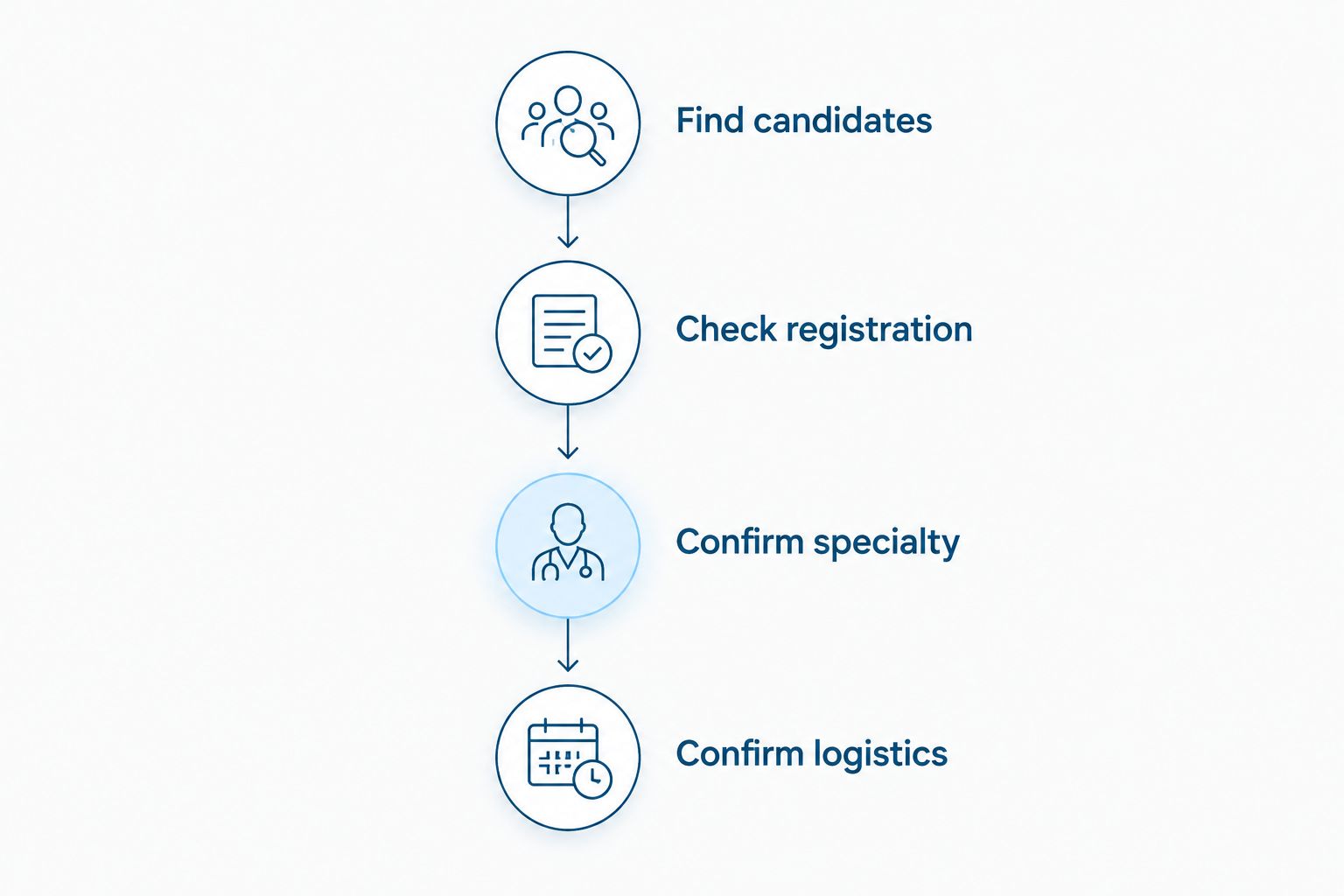
Use this sequence for each destination on your 2026 itinerary:
- Find candidates: Identify providers suited to your destination and communication needs.
- Check registration: Match the doctor’s identity to the official record.
- Confirm specialty: Check specialist recognition when it matters to the appointment.
- Confirm logistics: Ask the practice about location and English-language communication, and ask the insurer about policy requirements.
Save the doctor’s registered name, registration number, regulator, and date of your check with your travel documents. Keep a backup healthcare contact for the destination. Preparation should make the next step clearer, not turn your itinerary into a medical investigation.
FAQ
What are the best resources for verifying doctor credentials abroad?
The destination’s official medical register is the best starting point for verifying current registration. Add the relevant specialty register and hospital credentials office when you need to check specialist recognition or a hospital affiliation.
How do I check whether a doctor abroad is licensed?
Search the official medical regulator responsible for the place where the doctor practices. Match the registered name and registration number, then read the status and any published conditions.
Is an English-speaking doctor directory proof of credentials?
No. An English-speaking doctor directory helps you identify candidates, but the destination’s official medical register is the source for checking registration.
Does a specialist certificate prove a doctor can practice locally?
No. Specialist credentials and local practice authorization answer different questions, so check both with the relevant authorities.
Can my embassy verify a doctor’s qualifications?
A consular provider list is not a substitute for official credential verification. Use it to identify candidates, then check the responsible medical regulator and any relevant specialty authority.
What should I do if I cannot find the doctor on the register?
Ask the practice for the exact registered name, registration number, and responsible regulator. Contact that regulator if the result remains unclear; a failed name search alone does not settle the question.
Does MyAbroadMDs provide insurance or book appointments?
No. MyAbroadMDs provides subscription-based, personalized directories of English-speaking doctors and healthcare providers for international travelers and study-abroad students; it is not insurance, telehealth, or a booking service.
Should I finish credential checks before seeking emergency care?
No. In a medical emergency, seek immediate help through local emergency services rather than delaying care to complete a directory or registration search.
One last thing
Verify the person who will actually treat you, not just the clinic name. If an appointment changes to another doctor, the original credential check does not transfer to that professional.
Before your 2026 departure, put the provider’s registered name beside the practice’s contact details. That small distinction keeps your preparation useful when you need it. Peace of mind before you pack.