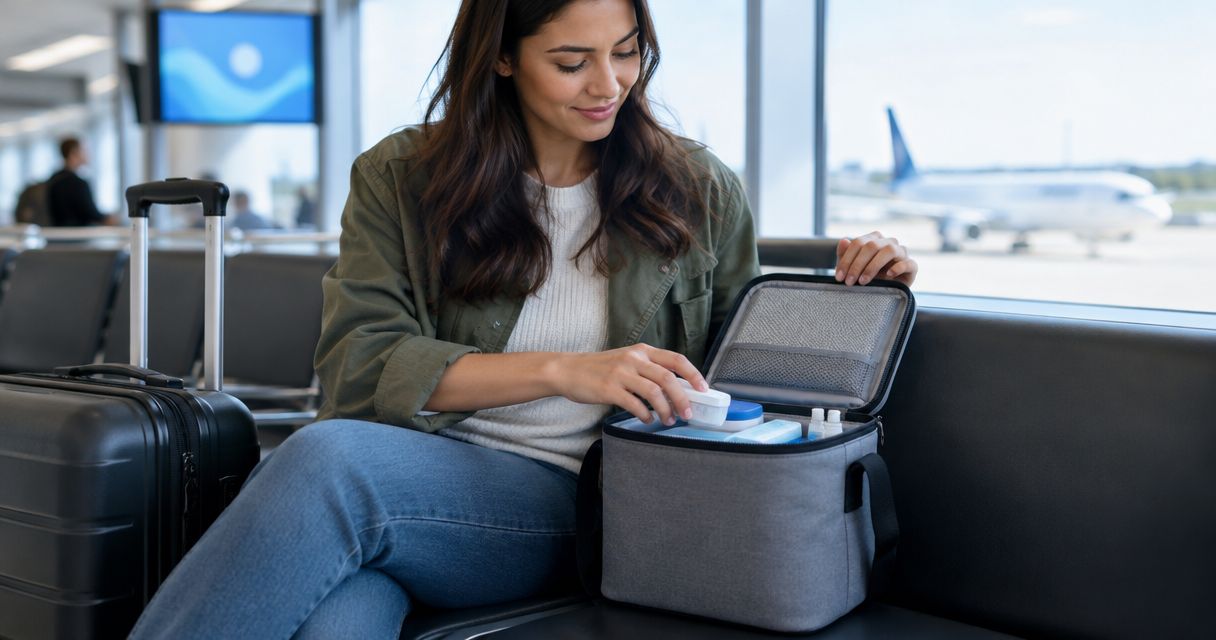
Best overall: a medication-specific passive cold-chain carrier with documented temperature performance. Best for powered journeys: a temperature-controlled medical travel cooler. Best for short, label-approved trips: an insulated medication case. The best medication coolers for traveling with refrigerated medication match your medicine’s storage instructions and your full itinerary—not just the flight time. This 2026 guide ranks cooling approaches, not individual product models.
- The best medication coolers for traveling with refrigerated medication match the drug label, not a generic cooling claim.
- Choose a documented passive cold-chain carrier when refrigeration must continue without access to power.
- Choose a temperature-controlled medical travel cooler only after checking its operating range and power requirements.
- Evaporative wallets do not replace refrigeration when your medication requires refrigerated storage.
- MyAbroadMDs supports pre-trip doctor planning; it does not sell medication coolers or provide insurance.
Why this matters
A cooler can feel cold while holding your medication outside its permitted storage range. Freezing is another problem: placing medicine against a frozen pack can expose it to temperatures below its label’s limits.
Choose the storage requirement first. Choose the carrier second. Before your 2026 departure, ask your pharmacist to confirm the instructions for your exact medicine, formulation, and opened or unopened status.
Cooling equipment also does not solve the problem of finding medical help abroad. MyAbroadMDs provides personalized, curated directories of English-speaking doctors and healthcare providers across 100+ countries. Its memberships are for pre-trip healthcare preparation—not insurance, telehealth, or appointment booking.
What makes the best medication cooler?
Use these criteria before comparing cases, wallets, or powered devices:
- Label-matched temperature range: The carrier must support the conditions specified for your medication. A claim that it keeps contents cool is not enough.
- Documented performance: Look for temperature-performance documentation that explains the packing configuration, surrounding conditions, and duration covered.
- Freeze protection: Check whether the prescribed packing arrangement separates medication from frozen cooling components. Follow the carrier’s instructions rather than improvising.
- Journey coverage: Include your journey to the airport, connections, ground transfers, and the time until you reach suitable storage.
- Temperature monitoring: Choose a setup that lets you check the medication compartment. A cooling indicator or cold exterior does not establish the medication’s temperature.
- Practical operation: Confirm that the case fits your medication, that cooling components can be prepared correctly, and that any power requirement fits your itinerary.
Many refrigerated medicine labels specify 2–8°C, equivalent to about 36–46°F. That range is not universal. Your medicine’s current label and pharmacist’s instructions determine the acceptable conditions for your 2026 trip.
Medication coolers at a glance
The ranking below separates continuous refrigeration from temperature protection for medicines whose labels allow a period outside the refrigerator. Those are different jobs.
| Rank and cooling approach | Best for | Standout feature | Key limitation |
|---|---|---|---|
| 1. Medication-specific passive cold-chain carrier | Refrigerated medication on journeys without dependable power | Documented performance under specified packing conditions | Requires correct preparation and a journey within its documented limits |
| 2. Temperature-controlled medical travel cooler | Travel with dependable power access | Active temperature control | Power interruptions require a separate plan |
| 3. Insulated medication case with cooling packs | Short journeys with label-compatible storage conditions | Straightforward, portable packing | Insulation alone does not establish temperature control |
| 4. Evaporative cooling wallet | Heat protection for medication with label-permitted unrefrigerated use | Cooling through evaporation rather than electricity | Does not establish refrigerator-range storage |
| 5. General-purpose insulated lunch bag | Carrying accessories, not dependable medication refrigeration | Familiar soft-sided storage | No medication-specific temperature assurance |
The default recommendation is a documented passive cold-chain carrier when your medication must remain refrigerated and your itinerary lacks dependable power. Select a particular carrier only after its documentation matches your medication and journey.
1. Passive cold-chain carrier: best for travel without power
A medication-specific passive cold-chain carrier uses prepared cooling components and insulation rather than electricity. Its useful distinction is documented temperature performance for a defined packing arrangement—not merely a thick shell or a medical-looking exterior.
For refrigerated medication travel in 2026, check the exact conditions covered by that documentation. The medicine position, cooling-component preparation, surrounding temperature, and opening pattern all matter when interpreting the stated performance.
Passive cold-chain carrier pros:
- Operates without a wall socket or vehicle connection.
- Provides a packing method you can follow when the manufacturer supplies clear instructions.
- Can offer documented temperature performance for a defined journey scenario.
- Separates the cooling decision from uncertain access to electricity.
Passive cold-chain carrier cons:
- Incorrect preparation or packing defeats the documented setup.
- Performance has limits; insulation does not maintain temperature indefinitely.
- Cooling components can add bulk to your carry-on.
Best for: Travelers carrying medicine that must remain refrigerated through flights, transfers, or other periods without dependable power.
Ask how the carrier must be prepared at your destination. A case that works for departure is not a complete solution if you cannot prepare it correctly for the return journey.
Verdict: Buy only when the documented temperature conditions and packing instructions cover your complete journey.
2. Temperature-controlled medical cooler: best for powered travel
A temperature-controlled medical travel cooler uses electricity to maintain a selected storage environment. Consider this approach for road travel or accommodation-based trips where you can confirm compatible power access.
Do not confuse active cooling with guaranteed medication safety. Check the supported temperature range, the conditions under which it operates, and what happens when the power source disconnects.
Temperature-controlled medical cooler pros:
- Provides active cooling while operating as instructed.
- Offers an alternative to repeatedly preparing passive cooling components.
- Can support a storage plan built around dependable power access.
Temperature-controlled medical cooler cons:
- A disconnected cable or interrupted supply changes the storage situation.
- Electrical compatibility and any battery requirements need checking before departure.
- A displayed temperature does not remove the need to understand where and how temperature is measured.
Best for: Travelers whose itinerary includes dependable, compatible power and a defined backup arrangement.
For flights, verify the airline’s rules for the device and any batteries. Do not base the plan on an onboard outlet: permission to carry a device and permission or ability to operate it are separate questions.
Verdict: Buy when power access, operating instructions, and backup storage all fit your itinerary.
3. Insulated medication case: best for short, label-approved journeys
An insulated medication case surrounds your medicine with insulation and, where specified, cooling packs. It is a simpler option, but a portable case is not automatically a cold-chain system.
This approach belongs on your shortlist only when its documented performance covers the trip or your medication’s label permits the expected conditions. Do not assume that a compact case maintains 2–8°C because its contents feel cold.
Insulated medication case pros:
- Keeps medication and its cooling components together.
- Provides a straightforward packing format for short transfers.
- Does not require electricity during use.
Insulated medication case cons:
- Generic cooling claims do not establish a safe temperature range.
- Direct contact with frozen packs creates a freezing concern.
- Opening the case and exposing it to heat changes the conditions around the medication.
Best for: Short journeys supported by the case’s performance documentation or the medication’s permitted out-of-refrigeration conditions.
Confirm the packing arrangement with the case instructions. Adding extra frozen packs is not a reliable substitute for temperature documentation, and colder is not always safer.
Verdict: Hold until the case’s documented performance or your medication’s label supports the intended use.
4. Evaporative wallet: best for label-permitted heat protection
An evaporative wallet uses water evaporation to remove heat. It serves a different purpose from a carrier documented to maintain refrigerator-range temperatures.
For medicines whose labels allow unrefrigerated use, this approach can belong in a heat-management plan. It does not establish that medication requiring continuous refrigeration remains within its permitted range.
Evaporative wallet pros:
- Does not depend on an electrical connection.
- Uses a different cooling mechanism from frozen packs.
- Can support heat protection when the medication label and wallet instructions permit that use.
Evaporative wallet cons:
- Evaporation depends on surrounding conditions and airflow.
- Cooling is not equivalent to maintaining a specified refrigerated range.
- Enclosing the wallet contrary to its instructions can interfere with its operation.
Best for: Medication with label-permitted unrefrigerated use when the wallet’s instructions support the intended conditions.
Opened and unopened supplies can have different storage instructions. Do not apply the rules for a medicine currently in use to unopened supplies without checking the label.
Verdict: Skip for continuous refrigeration; consider only for label-compatible heat protection.
5. Insulated lunch bag: best for accessories, not refrigeration
A general-purpose insulated lunch bag slows heat transfer. It does not, by itself, establish the temperature surrounding your medicine or prevent freezing against an ice pack.
Use it for non-temperature-sensitive travel supplies if that helps organize your carry-on. Do not treat a familiar bag and improvised cooling packs as equivalent to a documented medication carrier.
Insulated lunch bag pros:
- Provides a simple place to organize accessories.
- Offers insulation rather than leaving contents exposed.
- Requires no electrical connection.
Insulated lunch bag cons:
- General food-storage claims do not establish medication-storage performance.
- Improvised packing leaves both overheating and freezing unresolved.
Best for: Carrying paperwork and accessories that do not require controlled refrigeration.
Verdict: Skip as your primary solution for medication that must stay refrigerated.
Build the storage plan around your itinerary
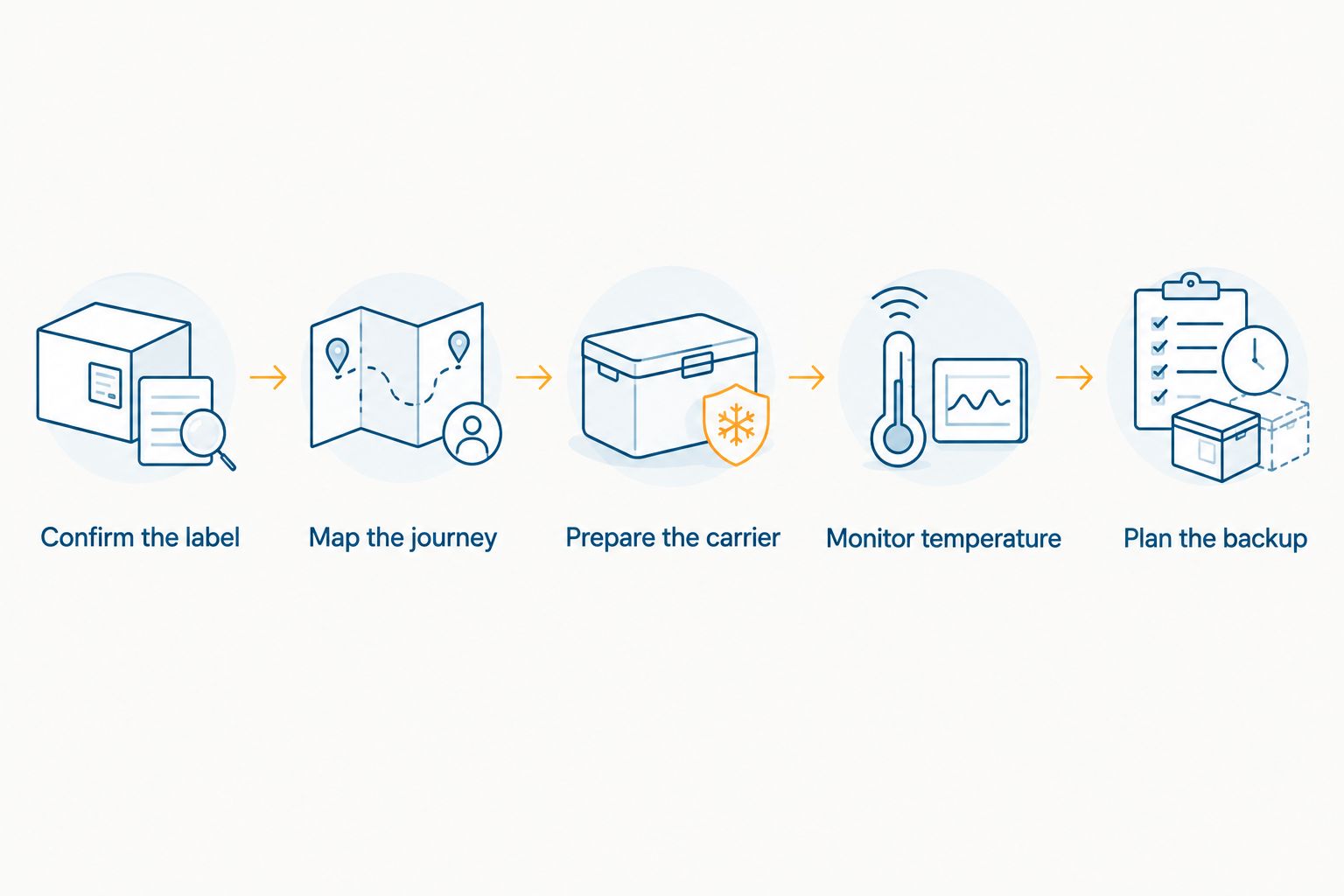
Your 2026 medication-cooling plan needs to cover departure, transit, arrival, and the return journey. Work through this sequence before packing.
Confirm the label
Write down the instructions for the exact medication and formulation. Ask your pharmacist about refrigeration, freezing, light protection, opened versus unopened storage, and any permitted time outside refrigeration.
Map the journey
Include every transfer and waiting period until suitable storage is available. Confirm arrangements at your destination rather than assuming a room refrigerator provides appropriate medication storage.
Prepare the carrier
Follow the specified cooling-component preparation and packing layout. Keep required barriers or separators in place, and retain the medicine’s identifying packaging and instructions where practical.
Monitor temperature
Use temperature monitoring appropriate to the carrier and medication. Understand what the reading represents; a reading from a different part of the case does not necessarily describe the medicine compartment.
Plan the backup
Decide whom to contact if the journey changes or the temperature moves outside the permitted range. Keep your pharmacist’s contact details and medication information accessible.
Keep medication with you during travel where transport rules permit, rather than relying on access to checked luggage. Check departure, transit, and destination requirements for medication, cooling components, and powered devices before your 2026 trip.
How these cooling approaches are ranked
This ranking prioritizes label-matched temperature control, documented performance, freeze protection, and practical operation across an itinerary. It compares cooling approaches; it does not claim product testing or certify any individual carrier.
Passive cold-chain carriers lead for journeys without dependable power because they address that specific constraint. Powered coolers lead when electricity is dependable. Simpler cases and evaporative wallets remain conditional choices—not substitutes for required refrigeration.
Which medication cooler should you choose?
Choose a documented passive cold-chain carrier if continuous refrigeration and uncertain power access define your trip. Choose a temperature-controlled medical cooler when compatible power and backup arrangements are confirmed.
If your medicine permits a period outside refrigeration, ask your pharmacist whether a simpler approach meets the label. Do not buy more cooling than you need—or assume less cooling is safe.
MyAbroadMDs is best for international travelers and study-abroad students who want a personalized English-speaking doctor directory before departure. That supports your healthcare preparation; it does not validate a cooler, provide medical advice, or arrange replacement medication.
Prepare before you pack
Explore memberships for personalized English-speaking doctor directories before your international trip.
FAQ
What's the best medication cooler for refrigerated medicine on a flight?
A medication-specific passive cold-chain carrier is the default choice when its documented temperature performance covers your medicine and complete journey. Confirm the packing instructions, freeze protection, and airline requirements before departure.
Do all refrigerated medications need the same temperature range?
No. Many refrigerated medicine labels specify 2–8°C, but the exact medication label controls. Opened and unopened supplies can also have different storage instructions.
Is an evaporative wallet better than an insulated medication case?
Neither is universally better because they use different cooling mechanisms and serve different storage needs. An evaporative wallet does not establish refrigerator-range storage; an insulated case also needs suitable performance documentation or label-compatible conditions.
Can I put refrigerated medication directly against an ice pack?
Do not place medication directly against a frozen pack unless the medication and carrier instructions explicitly support that arrangement. Follow the prescribed packing layout and ask your pharmacist about freeze protection.
Can I use a hotel minibar to store refrigerated medication?
Do not assume a hotel minibar provides the conditions your medication requires. Confirm suitable storage with the accommodation before arrival and use appropriate temperature monitoring.
What should I do if my medication gets too warm or freezes?
Contact your pharmacist or the medication manufacturer for instructions specific to the product and exposure. Record the temperature and timing if known; appearance alone does not establish whether the medication remains suitable for use.
Does MyAbroadMDs sell medication coolers or replace travel insurance?
No. MyAbroadMDs offers subscription-based memberships providing personalized, curated directories of English-speaking doctors and healthcare providers across 100+ countries. It is not insurance, telehealth, or an appointment-booking service.
One last thing
Check the return journey before you choose the outbound carrier. Passive cooling components need the preparation specified by their manufacturer, and powered equipment needs compatible electricity wherever you stop.
A successful departure does not establish a workable return plan. Confirm how you will store your medicine, prepare the carrier, and reach professional advice throughout your 2026 itinerary. Peace of mind before you pack starts with instructions you can follow at every destination.