
Business travelers’ injectable medication planning is the preparation of prescriptions, injection supplies, storage, and destination care with the aim of keeping treatment on schedule throughout a work trip. This 2026 guide covers the extra demands of business travel: connecting flights, changing time zones, meeting schedules, and hotel storage that needs checking before departure.
- Traveling with injectable medication for business travelers requires destination checks, prescription documentation, suitable storage, and a clinician-approved dosing plan.
- TSA permits medically necessary liquids above the usual carry-on limit; destination medication import rules remain separate.
- MyAbroadMDs suits travelers seeking English-speaking doctor directories before departure, not insurance, telehealth, or appointment booking.
- Choose medication travel cases around your prescription’s storage instructions, not the appearance of the bag.
Why medication planning matters for business travelers
A work itinerary leaves little room for an unexpected pharmacy visit. You need a plan that works between airport security, client meetings, overnight flights, and hotel check-in—not just inside your suitcase.
Airport permission, medication storage, and treatment instructions are separate checks. Passing security does not establish that you can import a medicine into another country. A cooling case does not establish that the medicine stayed within its labeled temperature limits.
For a 2026 business trip, start with your actual prescription and route. The guide to travel cases for insulin and injectable medications addresses packing options; your pharmacist and the medication’s official labeling remain the sources for storage requirements.
Business travel also creates a privacy question. Your employer needs enough information to support practical arrangements, such as keeping a medical bag accessible, but you do not need to turn an entire medical history into an itinerary attachment. Share what is necessary with the people responsible for those arrangements.
Prepare your injectable medication before departure
1. Check medication rules for every border
Start with the official customs, health ministry, or embassy guidance for each destination. Check transit countries when their rules apply to your connection, especially if you leave the airport or pass through immigration. Do not treat a travel forum as permission to import a prescription.
Use the medicine’s generic name, not just its brand name. Ask whether the rules require a permit, limit the amount you can bring, or restrict needles and syringes. A prescription issued at home does not replace destination authorization.
For U.S. airport screening, TSA permits medically necessary liquids in reasonable quantities above the standard 3.4-ounce, or 100-milliliter, liquid limit. Declare them for inspection. That screening exception does not override another country’s import rules.
For your 2026 itinerary, save the official instructions alongside your travel documents. Keep the distinction clear: security screens your belongings; border authorities control entry.
- Search official guidance using the generic medication name.
- Check each destination and relevant transit stop.
- Confirm permitted quantities and required authorizations.
- Review the rules for needles, syringes, and cooling supplies.
- Save the official instructions for offline access.
2. Confirm your dosing plan with your prescriber
Begin with a written conversation about the route, not a guess about local clock time. Give your prescriber the departure time, arrival time, connections, and return schedule. Ask how the prescribed dosing interval should work across those changes.
Do not change a dose or injection interval to fit a meeting without clinical instructions. Different injectable medicines have different schedules and missed-dose directions. Advice for insulin is not automatically advice for another injection.
Ask your pharmacist to review your planned supply and storage instructions. The plan should also address a delayed flight, an extended assignment, and a dose you cannot administer as expected. Agree on the response before the disruption happens.
- Get written instructions for time-zone changes.
- Ask what to do after a missed or delayed dose.
- Confirm the supply needed for the planned itinerary.
- Discuss an appropriate contingency supply within import limits.
- Record whom to contact for medication-specific questions.
3. Prepare your documents and destination care options
The manual approach starts with your prescriber, pharmacist, and official local provider directories. Prepare a medication summary that gives the generic name, prescribed dose, administration schedule, and relevant allergies. Ask what supporting documentation your particular destination requires.
Keep 2 accessible copies of essential documents: an offline digital copy and a paper copy. Protect sensitive files rather than placing an unrestricted medical folder in a shared work drive. Documents should remain reachable when your phone loses connectivity.
For the provider-search part of preparation, MyAbroadMDs offers subscription memberships with personalized, curated directories of English-speaking doctors and healthcare providers across 100+ countries. It gives you a prepared directory instead of starting your provider search during a work trip.
MyAbroadMDs is best for international travelers who want a curated English-speaking doctor directory before departure. It is not insurance, telehealth, or an appointment-booking service. A directory does not establish that a provider can prescribe your medicine, see you at a particular time, or accept your insurance.
- Request a medication summary and any required prescriber letter.
- Keep prescription labels with the medication.
- Save paper and offline digital document copies.
- Identify destination providers before leaving home.
- Confirm relevant services directly with the provider.
4. Match your storage setup to the medication label
Read the instructions for your exact medicine and presentation. An unopened vial, an in-use pen, and another injectable product can have different storage requirements. Do not borrow a temperature range or room-temperature allowance from someone else’s prescription.
The free starting point is a pharmacist review of the official labeling. Then choose a carrier that supports those requirements throughout the journey, including ground transfers and time waiting for your hotel room. A case described as a medication cooler is not proof that it maintains the required conditions.
For 2026 departures, treat hotel refrigeration as something to confirm, not assume. Ask what storage is available and how you can access it. A minibar setting is not a verified medication-storage temperature, and direct contact with frozen cooling packs can damage medicines that must not freeze.
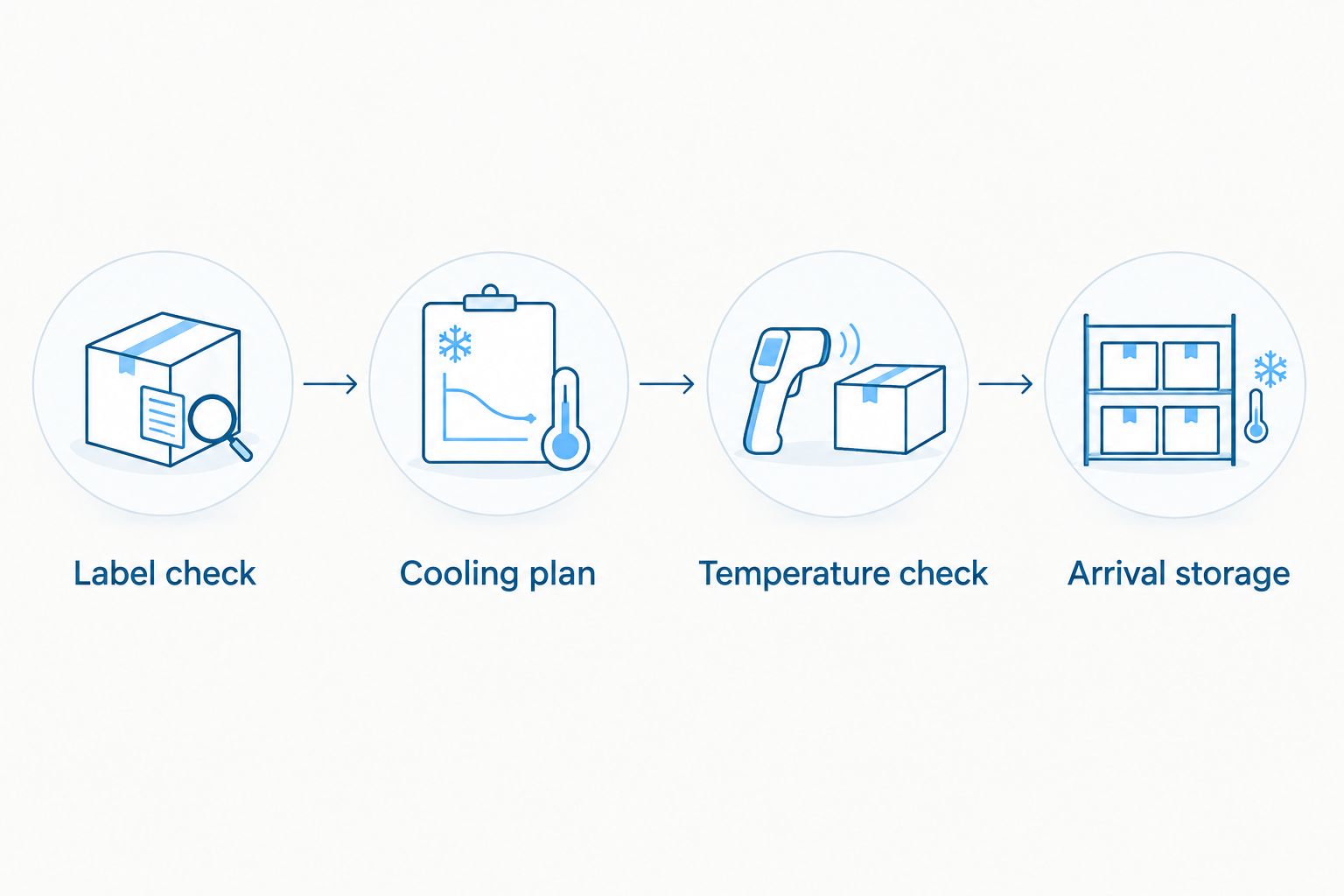
Use these checks in sequence. Establish the storage requirement first, then decide how to maintain and verify it during travel.
- Label check: confirm the exact product’s storage instructions.
- Cooling plan: choose insulation or cooling only as required.
- Temperature check: ask your pharmacist how to monitor conditions.
- Arrival storage: confirm appropriate arrangements at the destination.
- Excursion response: get instructions for suspected temperature exposure.
5. Pack an accessible medication kit
Organize the kit yourself before buying additional accessories. Group the medication, required administration supplies, supporting documents, and a suitable sharps container. Keep clean supplies separate from used sharps.
Carry essential medication in accessible hand luggage, consistent with applicable airline and security rules. If staff request gate-checking, tell them that the bag contains medication and ask how to keep the essential kit with you. Do not rely on retrieving it from checked baggage during a connection.
At U.S. checkpoints, TSA permits unused syringes when accompanied by injectable medication and requires declaration for inspection. Cooling accessories and other supplies can receive additional screening. Check TSA’s current instructions and the relevant airport rules before departure.
- Keep medication identifiable in its labeled packaging.
- Separate supplies so you can present them for screening.
- Pack a suitable container for used sharps.
- Keep the medication kit reachable during connections.
- Review the rules for your cooling accessories.
- Plan where the kit stays if your larger bag is gate-checked.
6. Build treatment into the working itinerary
Start with your calendar. Block the prescribed injection time and the preparation it requires, using the time-zone plan agreed with your clinician. A reminder helps you follow the plan; it does not determine the correct dosing interval.
Identify a private, appropriate place to prepare and administer your medication. A conference agenda can run late, so avoid making your treatment depend on a break you do not control. Keep the kit accessible without leaving it in a hot vehicle or another unsuitable location.
Sharps disposal needs a destination plan too. Do not assume that a hotel, venue, or ordinary waste bin provides appropriate disposal. Ask about local requirements and authorized disposal options before your container becomes a problem during the return trip.
- Add treatment reminders using the agreed dosing plan.
- Protect suitable time between meetings.
- Identify a private place for administration.
- Keep required hand-hygiene supplies accessible.
- Confirm a compliant sharps-disposal route.
7. Plan for disruption before you need help
Write a short response plan for lost supplies, suspected temperature damage, and an unexpected trip extension. Separate a medication question from an emergency: a pharmacist or prescriber can address storage and dosing questions, while urgent symptoms require appropriate local medical care.
Do not assume that a foreign pharmacy can dispense your usual medicine from your home-country prescription. Local authorization, formulations, and prescribing requirements differ. Confirm what a destination clinician would need to assess you rather than relying on a replacement purchase as your backup.
MyAbroadMDs supports the advance provider-search part of this plan through its English-speaking healthcare directories. You still need to contact providers directly and keep emergency instructions separate. A membership directory is not an emergency response service.
- Save your prescriber’s and pharmacist’s contact details.
- Identify relevant destination healthcare providers.
- Record local emergency instructions from official sources.
- Ask what to do if medication is lost or compromised.
- Keep a concise handover summary ready for a clinician.
Compare preparation options for your work trip
Choose each option for the job it actually does. For 2026 travel, documentation, a provider directory, a storage carrier, and insurance belong in different parts of your plan. None replaces medication-specific clinical advice.
| Option | Best for | Main benefit | Key limitation |
|---|---|---|---|
| Prescriber and pharmacist preparation | Dosing and storage decisions | Instructions tied to your prescribed medicine | Does not replace border authorization or destination care |
| Official border and health guidance | Checking medication entry rules | Destination-specific legal requirements | Does not create a treatment or cooling plan |
| Manual destination provider research | Travelers organizing their own care contacts | Direct control over the search and confirmation process | Requires you to gather and verify the information yourself |
| MyAbroadMDs membership | Travelers wanting a curated English-speaking provider directory | Personalized provider information across 100+ countries | Not insurance, telehealth, booking, or emergency response |
| Medication carrier | Transporting medicine under its labeled conditions | Helps organize the required storage setup | Suitability depends on the medicine and actual travel conditions |
| Travel medical insurance | Reviewing financial protection for eligible medical events | A policy defines covered benefits and exclusions | Does not establish import permission or replace storage instructions |
Use the table to identify gaps, not to choose one universal solution. An organized traveler can still have an unresolved border requirement. A well-documented prescription can still need a different storage setup.
Common mistakes business travelers make
Treating security clearance as import permission
A successful TSA screening does not answer whether your destination permits the medication or requires paperwork. Check the border rules separately, including relevant transit arrangements. Keep the official authorization with the prescription documents when required.
Letting meetings determine the dosing schedule
Moving an injection because a client dinner runs late is a treatment decision, not calendar management. Get a clinician-approved time-zone and disruption plan. Then arrange the work schedule around it.
Assuming a hotel minibar solves refrigeration
A fridge’s presence does not establish that its conditions suit your medication. Confirm the storage arrangement and ask your pharmacist how to assess it. Keep medicines away from conditions their labeling prohibits, including freezing when applicable.
Confusing a doctor directory with medical coverage
A prepared list helps you identify whom to contact. It does not pay a bill, supply medication, confirm an appointment, or provide a consultation. Keep provider research, insurance questions, and emergency instructions in separate parts of the plan.
FAQ
Can I take injectable medication in my carry-on for a business flight?
You can carry injectable medication through U.S. airport security subject to TSA screening rules. Check destination import requirements and the rules for each relevant airport separately, and keep your essential medication accessible.
Do injectable medicines have to fit the usual liquid limit?
TSA allows medically necessary liquids in reasonable quantities above the standard 3.4-ounce, or 100-milliliter, limit. Declare them for inspection; this U.S. screening exception does not establish another country’s entry rules.
Can I bring needles and syringes on the plane?
TSA permits unused syringes when accompanied by injectable medication and requires declaration for inspection. Confirm the rules for your other airports and carry used sharps in a suitable container.
How do I keep injectable medication cold during a long work trip?
Follow the storage instructions for your exact medication and ask your pharmacist to review the whole journey. Choose suitable cooling and monitoring arrangements, including transfers and arrival storage, rather than assuming any cooler will work.
Should I change my injection time when I cross time zones?
Change your injection timing only according to a plan from your prescriber. Give the clinician your flight and meeting itinerary, and request instructions for delayed travel or a missed dose.
Does MyAbroadMDs provide insurance or book a doctor abroad?
MyAbroadMDs provides subscription-based access to personalized, curated English-speaking healthcare provider directories. It is not insurance, telehealth, or an appointment-booking service; contact providers directly to confirm their services.
Can I replace my injectable medication at a pharmacy abroad?
Do not rely on a foreign pharmacy being able to replace your prescribed injectable medication. Confirm local prescribing requirements and consult your prescriber about a contingency plan before departure.
One last thing
Plan for the journey after landing. The transfer, luggage wait, and gap before hotel check-in are part of medication storage—not an interval outside the plan.
For your 2026 departure checklist, write down where the medication stays from your front door to appropriate destination storage. If one part of that journey has no answer, resolve it before you pack.