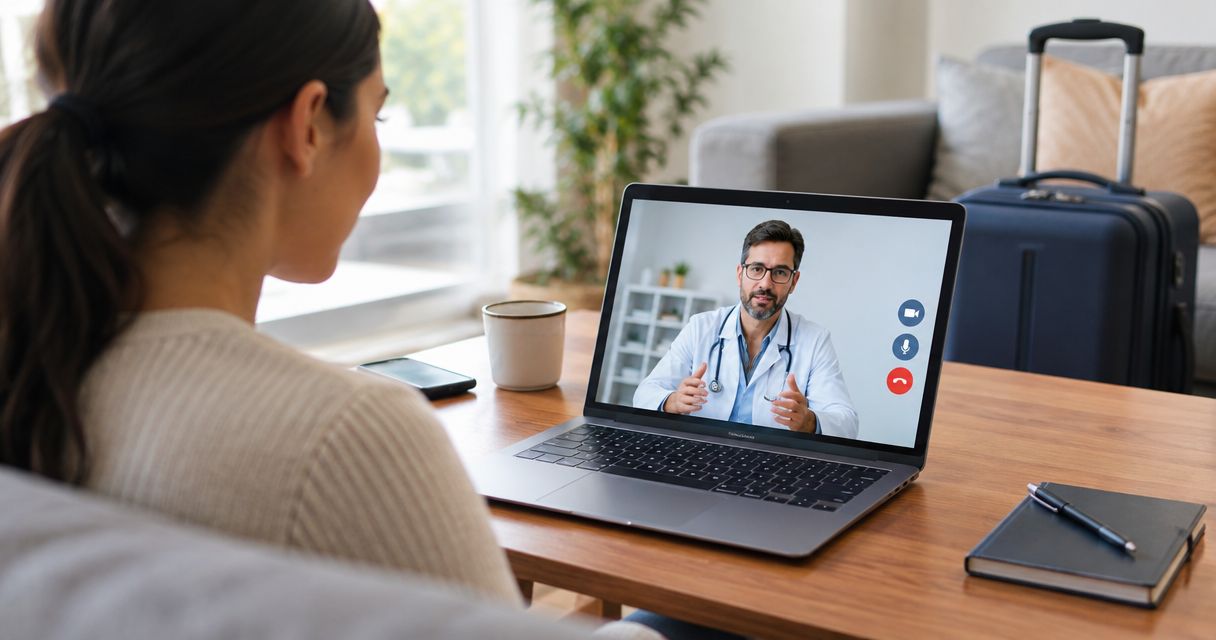
Telehealth is not automatically a legal substitute for seeing a doctor abroad. A remote consultation can replace an office visit only when the clinician is authorized to treat you where you are physically located and the care is appropriate remotely. Permission to consult does not automatically make a prescription valid locally or guarantee insurance reimbursement.
- Is telehealth a legal substitute for seeing a doctor abroad? Only when local rules and clinical needs permit.
- Confirm authorization for your physical location, prescription validity, and an in-person backup before relying on a video visit.
- MyAbroadMDs is best for travelers seeking pre-trip English-speaking doctor directories, not remote treatment or insurance.
Is telehealth a legal substitute for seeing a doctor abroad?
Sometimes—but the video connection itself proves nothing about legal permission to practice. Your doctor's credentials at home, your existing patient relationship, and your app account do not establish permission to treat you across an international border.
For your 2026 itinerary, separate the consultation from what follows it. A clinician's authorization to conduct a visit, a pharmacy's ability to dispense medication, and an insurer's reimbursement decision are different questions.
Start with how to verify a doctor's license abroad, then ask the service to confirm authorization for your actual destination.
| Care option | Best for | Main advantage | Main limitation |
|---|---|---|---|
| Telehealth authorized for your location | Concerns a clinician can assess remotely | Access to clinical assessment without traveling to an office | Cannot provide a hands-on examination; prescribing has separate requirements |
| In-person care abroad | Symptoms requiring examination, testing, or procedures | Direct assessment and access to local care pathways | Requires finding and reaching an appropriate provider |
| Contact with your usual doctor | Sharing history and discussing continuity of care | Familiarity with your medical background | Familiarity does not establish cross-border treatment authority |
| MyAbroadMDs healthcare preparation | Identifying English-speaking providers before departure | Personalized, curated doctor directories across 100+ countries | Not insurance, telehealth, or an appointment-booking service |
A directory helps you identify a provider. It does not replace that provider's assessment or establish that a particular remote consultation is permitted.
Why this matters before departure
The wrong assumption is simple: if your usual doctor can answer a call, your usual care can continue unchanged overseas. International travel changes the legal and practical setting, even when your health condition stays the same.
You need a plan that answers more than whether an app opens. Can the clinician treat you at your destination? Can you obtain the prescribed medication? Where will you go if the clinician needs to examine you?
For 2026 travel, check those questions while you still have time to arrange an alternative. Before you pack—not while you are trying to find care in an unfamiliar place.
When telehealth can replace an office visit
Telehealth can be an appropriate substitute when the applicable rules permit the encounter and the treating clinician can safely manage the concern remotely. Both conditions matter. Legal permission does not make every medical problem suitable for video.
A remote visit can support history-taking, discussion of symptoms, review of available records, and a decision about next steps. The clinician still needs enough information to assess you and must recognize when a physical examination or testing is necessary.
Before the appointment, give the service your current country and any more specific location it requests. Do not enter your home address as your current location just because it matches your account.
Ask these questions directly:
- Is this clinician authorized to treat a patient physically located here?
- Does the service provide clinical treatment here, or only general information?
- Can this appointment address my concern without a physical examination?
- If I need local care, what information will I receive to take to that provider?
Choose telehealth because it fits the clinical need and local rules—not because it is the easiest connection to make. An accepted booking or completed payment is not a substitute for those checks.
When an in-person doctor is still necessary
An in-person visit is necessary when the problem requires assessment or treatment that remote care cannot provide. That includes hands-on examination, diagnostic testing, and procedures when the clinician determines they are needed.
Do not treat a video appointment as a required first step during an emergency. Severe breathing difficulty, signs of stroke, severe chest pain, or uncontrolled bleeding warrant urgent local emergency assessment rather than waiting for an online appointment.
For concerns that are not emergencies, follow the clinician's escalation instructions. A remote assessment that ends with a referral has not failed; it has identified the next appropriate setting for care.
Keep the practical handoff simple:
- Ask for a written consultation summary.
- Record medication names and any treatment instructions.
- Ask what symptoms require urgent reassessment.
- Bring relevant records to the local appointment.
An online opinion also does not replace an in-person examination required by a specific form, institution, or local rule. Ask the organization receiving the document what it accepts before arranging the visit.
Why telehealth legality abroad varies
There is no single international permission that makes every clinician available to every traveler. Check the rules relevant to the encounter rather than relying on a general claim of worldwide access.
The main factors are:
- Your physical location. The destination's rules are central to whether the clinician can treat you there.
- The clinician's location and authorization. Requirements affecting the professional also need to be satisfied.
- The service provided. General educational information is different from diagnosis, treatment, or prescribing.
- The medication involved. Prescribing and dispensing requirements are separate from permission to hold a consultation.
- The clinical concern. Remote care cannot replace an examination or test that is needed for safe assessment.
- The document you need. A prescription, medical certificate, or institutional form has acceptance requirements beyond completing a video visit.
For each stop on your 2026 itinerary, confirm the service's current position with its clinical support team. For legal authorization questions, use the destination's health authority or professional regulator as the authoritative reference.
A service's coverage map is a starting point. Ask whether coverage means clinician access, treatment permission, prescribing, or something else.
How do you check whether a telehealth visit is valid abroad?
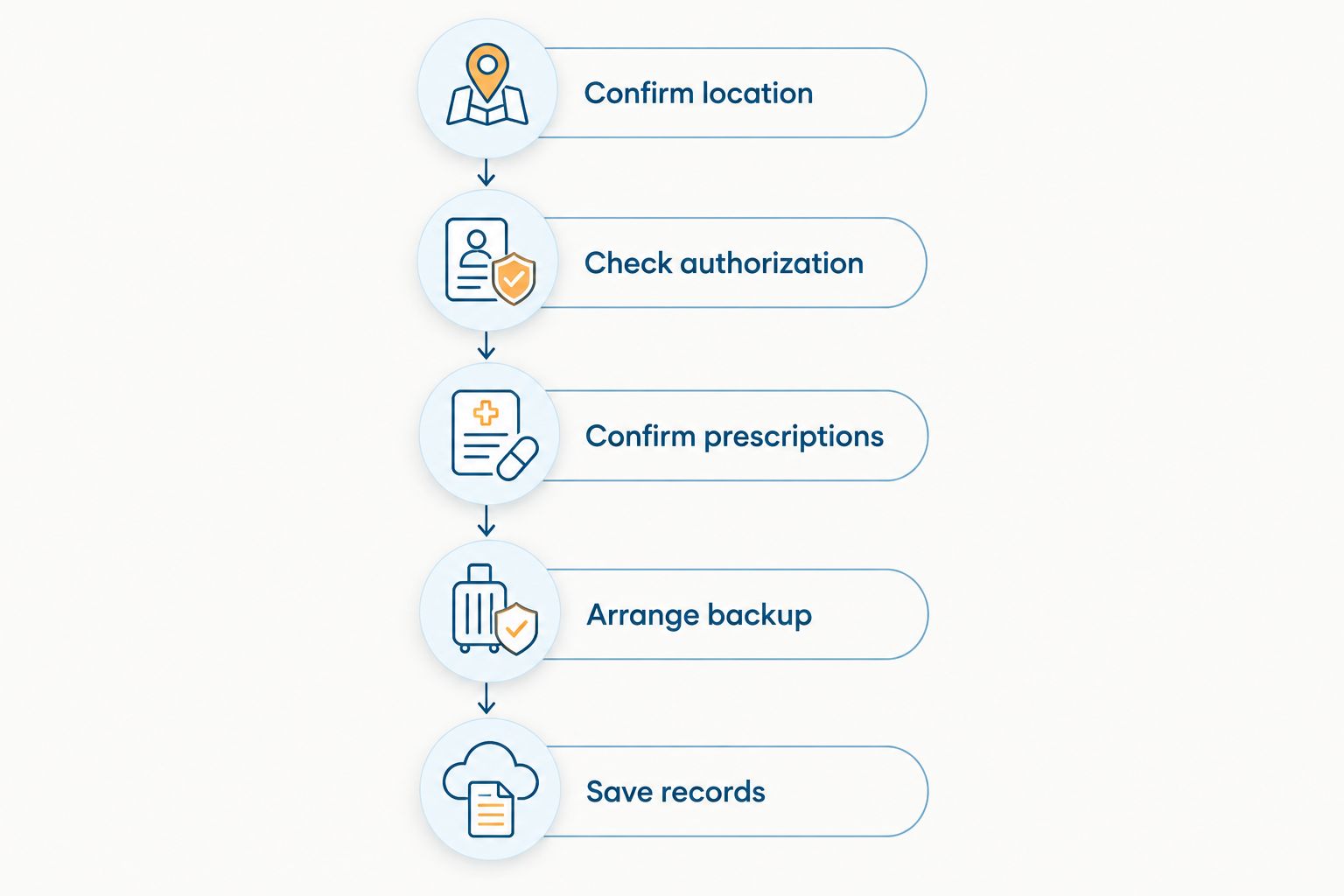
Use this sequence before relying on a remote appointment. It separates access from permission and gives you an alternative if remote treatment is unsuitable.
- Confirm location. Tell the service where you will physically be during the consultation. Repeat the check after crossing a border.
- Check authorization. Request confirmation that the assigned clinician can treat patients in that location. Ask for the clinician's name and relevant registration details.
- Confirm prescriptions. If medication is the goal, ask whether the clinician can prescribe it and whether a local pharmacy can accept that prescription.
- Arrange backup. Identify an appropriate local provider before you need an examination, testing, or follow-up.
- Save records. Keep the consultation summary, relevant medical history, medication list, and instructions accessible during your trip.
The sequence matters because a successful consultation does not guarantee a usable prescription. Likewise, a usable prescription does not establish that your insurer will reimburse the appointment.
Keep the service's written response with your travel documents. It gives you a useful reference, but it does not override the destination's rules or the treating clinician's judgment.
Can your usual doctor treat you while you are overseas?
Your usual doctor cannot assume that a home-country license permits treatment wherever you travel. An established relationship helps with medical history, but it does not settle cross-border authorization.
Before departure, ask your practice what it can provide while you are abroad. Distinguish record-sharing and general discussion from clinical treatment and prescribing; the practice needs to determine what it can lawfully offer.
For a 2026 semester abroad or extended trip, arrange continuity before leaving home. Ask how to obtain your records and what to do if local assessment becomes necessary. Do not make your entire plan depend on reaching one familiar clinician across time zones.
Does a telehealth prescription work at a pharmacy abroad?
A telehealth prescription is not automatically valid at a foreign pharmacy. The destination's prescribing and dispensing rules determine whether the pharmacy can accept it, and medication-specific restrictions also matter.
Ask a local pharmacist about acceptance before relying on a remote refill. Provide the medication's generic name, strength, formulation, and the prescription's issuing country. Do not assume a familiar brand name identifies an identical local product.
If the prescription is not accepted, arrange assessment with an appropriately authorized clinician. Do not change your dose or substitute a different medicine without advice from a qualified healthcare professional.
Will travel insurance cover an overseas telehealth appointment?
Insurance coverage does not establish whether a telehealth appointment is legally permitted. Reimbursement depends on your policy, while permission to treat depends on the applicable professional and local rules.
Before your 2026 departure, ask your insurer whether overseas telehealth is included, whether authorization is required, and what records support a claim. Also ask whether you must use a designated provider.
Keep those answers separate from the clinical service's confirmation. An insurer can explain benefits; the clinician and service must address whether they can provide care at your location.
Where pre-trip healthcare preparation fits
MyAbroadMDs is best for travelers who want a personalized English-speaking doctor directory before departure. Its subscription memberships provide curated healthcare provider information across 100+ countries.
The benefit is preparation: you can identify local options alongside your itinerary instead of assuming a remote service will handle every concern. The boundary is equally important. MyAbroadMDs is not insurance, telehealth, or a booking service, and a directory does not guarantee an appointment or treatment.
Use MyAbroadMDs for provider preparation, then confirm the selected clinician's credentials, suitability, and appointment arrangements directly. Keep insurance and emergency planning as separate parts of your travel checklist.
FAQ
Is telehealth a legal substitute for seeing a doctor abroad?
Telehealth can substitute for an office visit only when the clinician is authorized to treat you at your physical location and the concern is suitable for remote care. Prescriptions, insurance reimbursement, and document acceptance require separate checks.
Can I use my regular doctor over video while traveling internationally?
Do not assume your regular doctor can treat you internationally. Tell the practice your destination and ask it to confirm what clinical care it can lawfully provide while you are there.
Does an international telehealth app guarantee legal treatment everywhere?
An international app does not by itself establish permission to treat you in every country. Confirm that the assigned clinician can provide the specific service at your physical location.
Can an online doctor prescribe medicine I can collect abroad?
An online prescription works only if it meets the relevant prescribing and local dispensing requirements. Ask the clinician and a local pharmacy before relying on it for access to medication.
Should I book telehealth first if I have emergency symptoms abroad?
Seek urgent local emergency care for emergency symptoms rather than waiting for telehealth. Remote appointments cannot provide the physical assessment and treatment an emergency can require.
Does travel insurance approval mean my telehealth visit is legal?
Insurance approval does not establish legal permission for a clinician to treat you. Check policy benefits with the insurer and treatment authorization with the clinical service.
What should I save after an overseas telehealth appointment?
Save your consultation summary, medication instructions, follow-up advice, and any referral documents. Share them with a local clinician if you need in-person assessment.
One last thing
Confirm where you will be during the appointment—not just where you are when you book it. A border crossing between booking and consultation changes the location the service needs to assess.
Add that check beside your departure details. Your strongest backup is not another app; it is knowing which local provider to contact when remote care is not enough.