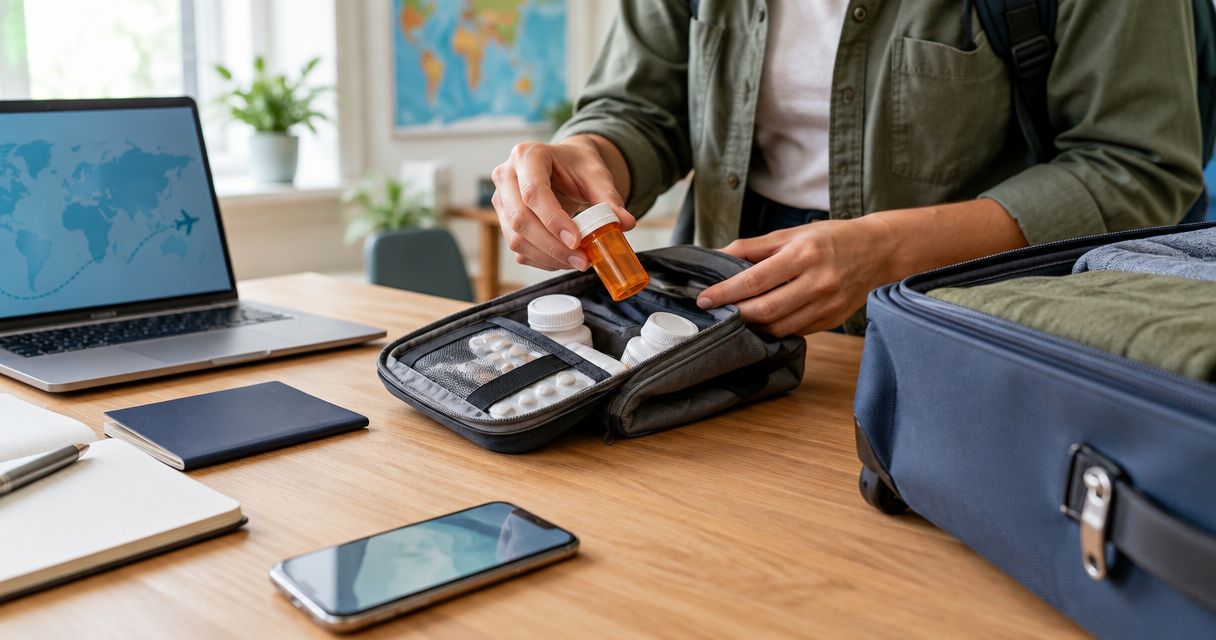
Missionary prescription-medication travel planning is the process of arranging lawful transport, safe storage, and continuity of treatment so you can serve abroad without avoidable interruptions. This 2026 guide to traveling with prescription medication for missionaries abroad covers personal prescriptions for long placements, changing itineraries, and volunteer assignments—not medicines carried for distribution to others.
- Traveling with prescription medication for missionaries abroad starts with destination rules, a documented supply plan, and local care contacts.
- MyAbroadMDs is best for travelers seeking a personalized directory of English-speaking doctors before departure.
- Check every destination and transit stop; a home prescription does not establish permission to import medication.
- Separate prescription refills, travel medical insurance, and doctor-finding support: each solves a different problem.
Why medication planning matters for missionaries and volunteers
A mission placement can put distance between your accommodation, your usual prescriber, and a pharmacy. Your healthcare plan needs to follow the whole itinerary: arrival orientation, the assignment location, side trips, and any extension—not just the international flight.
A prescription documents treatment; it does not establish another country's import permission. Check the relevant destination authority before departure, particularly for controlled medicines, injections, and supplies intended to last through an extended assignment. Airport security screening and customs admission are separate checks.
For your 2026 departure, build the plan around continuity rather than a packing checklist alone. MyAbroadMDs provides personalized, curated directories of English-speaking doctors and healthcare providers across 100+ countries. That addresses finding care; it does not provide insurance, telehealth, appointment booking, or permission to carry medication across borders.
Prepare your medication plan before departure
Work through these steps with your prescriber, pharmacist, and assignment coordinator where relevant. Keep medical decisions with your clinician and border questions with the authority responsible for medication imports.
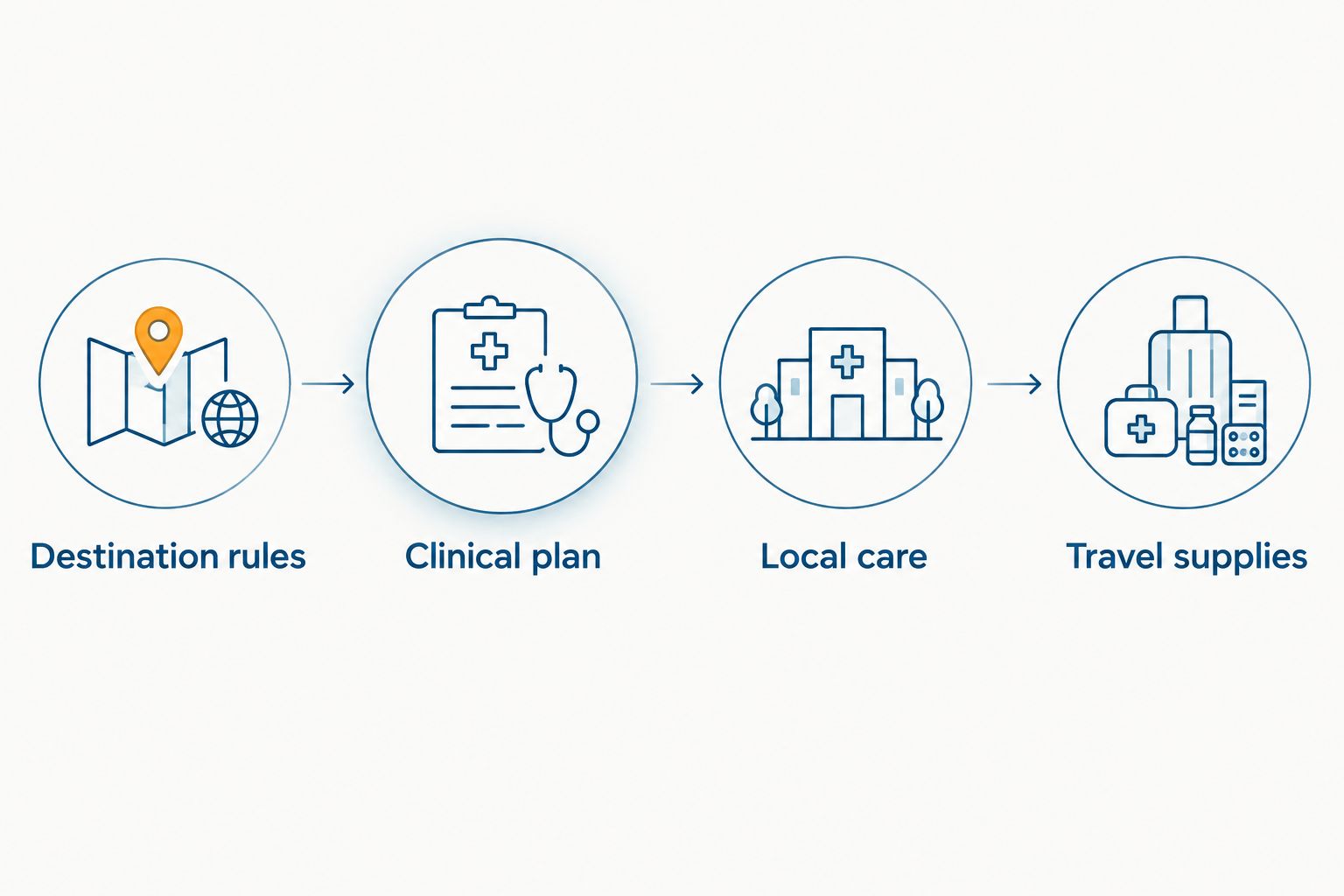
Organize your preparation into four parts: Destination rules, Clinical plan, Local care, and Travel supplies. Complete the legal and clinical checks before buying accessories or relying on a refill abroad.
Check every country's medication-entry rules
Start with the destination's medicines regulator, customs authority, or embassy guidance. Search by active ingredient as well as brand name, because names differ between markets. Include transit countries and planned side trips in your questions; ask whether your particular connection creates import or documentation requirements.
For a 2026 trip, save the official guidance and the date you checked it. A teammate's previous experience is not a substitute for the rules governing your medicine and itinerary. If instructions conflict, request clarification from the responsible authority before traveling.
Do not assume a doctor's letter replaces a permit. Confirm which documents serve which purpose.
- List each active ingredient, strength, dosage form, and prescribed quantity.
- Ask whether the medicine is prohibited, controlled, or subject to advance authorization.
- Confirm personal-use quantity limits and required declarations.
- Check requirements for needles, syringes, and associated equipment.
- Save written replies alongside the relevant official guidance.
Build a treatment-continuity plan with your clinician
Arrange a predeparture review with the clinician managing your prescriptions. Bring the assignment dates, destinations, likely transport arrangements, and any uncertainty about your return. Ask how treatment will continue if the placement lasts longer than expected.
Do not stretch doses, stop treatment, or substitute medication to make your supply last. Your clinician should give you instructions for missed doses, time-zone changes, monitoring, and symptoms requiring care. A medication that needs laboratory monitoring also needs a realistic monitoring plan abroad.
Discuss refills separately with your pharmacy and insurer. Authorization to dispense an extended supply at home does not establish that you can legally import it.
- Request a medication list using generic names and current instructions.
- Ask for a clinical summary relevant to continuing treatment.
- Agree on any monitoring needed during the assignment.
- Discuss clinician-approved alternatives if the original medicine cannot be obtained.
- Record how to contact your home care team while abroad.
Identify local care before you need a refill
Use official professional registers and healthcare-provider websites to create your own shortlist first. Check location, relevant specialty, language, and how the practice handles new patients. Ask your host organization for practical information, but verify medical credentials independently.
MyAbroadMDs offers a subscription-based alternative to assembling that directory yourself: personalized, curated English-speaking provider information. MyAbroadMDs is best for missionaries and volunteers who want an English-speaking doctor directory before departure. Its limitation is scope: you still need to contact the provider, arrange care, and confirm prescribing requirements.
A listed doctor is not a guarantee of a particular prescription. Ask what assessment and records a local clinician requires before continuing treatment.
- Identify care near your actual placement, not only the arrival airport.
- Check the provider's credentials through the appropriate local register.
- Ask whether the practice manages your condition.
- Confirm what records to bring and how appointments are arranged.
- Record a separate route for urgent and emergency care.
Match your supply to a lawful refill route
Compare your prescribed daily use with the assignment calendar, then reconcile the result with import limits and dispensing rules. Ask your pharmacist to help calculate quantities, including any clinician-approved contingency supply. Do not choose an arbitrary extra amount and assume customs will accept it.
For a 2026 placement with an uncertain end date, establish the extension plan before departure. That might mean a local medical assessment rather than another shipment from home. Do not assume a foreign pharmacy can dispense against your home prescription or that mailing medication is permitted.
Keep personal treatment separate from charitable distribution. Medicines carried for a clinic or community project need their own authorization process.
- Record the planned supply and the date it will run out.
- Set a refill review date before that supply is exhausted.
- Confirm whether a local prescription and assessment are required.
- Check medication-shipping rules before anyone sends a parcel.
- Escalate assignment extensions to your care team promptly.
Prepare documents you can use without internet
Create a small travel-health file rather than scattering records across messages. Keep 1 paper copy and 1 offline digital copy of your medication list, relevant clinical summary, and any required permits. Protect sensitive information with appropriate device security.
Your documents should help a clinician understand treatment and help border officials identify what you are carrying. Ask the destination authority whether translations, signatures, or specific forms are required; do not assume an English-language letter is sufficient everywhere.
Share only the information your coordinator needs for practical support. Your full medical history does not belong in a group itinerary or volunteer chat.
- Match the traveler name on documents to the passport.
- Keep medicines in their original labeled packaging.
- Record allergies and relevant reactions accurately.
- Save prescriber and pharmacy contact details offline.
- Store permits with the medicines they authorize.
Protect medication during flights and placement travel
Follow the medicine's storage instructions and ask your pharmacist how to maintain them throughout the journey. Think beyond the flight: airport transfers, buses, accommodation changes, and field visits all belong in the storage plan.
Carry essential medication in your cabin baggage, subject to applicable security and airline requirements, rather than depending on checked baggage arriving with you. Check the screening rules for liquids, medical equipment, and cooling supplies before departure. Screening acceptance does not replace destination import permission.
For temperature-sensitive medication, confirm the required temperature range and permitted time outside that range for the exact product. Do not infer those limits from a different medicine or a cooler's advertising.
- Keep medication accessible for inspection without unpacking your entire bag.
- Ask your pharmacist how to avoid freezing or overheating.
- Confirm electricity and storage arrangements with your accommodation.
- Plan safe transport during field visits and overnight travel.
- Arrange appropriate disposal of used sharps where applicable.
Recheck the plan when your assignment changes
Treat a new destination, longer stay, or changed medication as a reason to review the plan—not as a minor itinerary edit. Your original paperwork and supply calculations describe the original trip.
Before adding a country to your 2026 itinerary, repeat the entry-rule check for each medicine. Before extending your stay, revisit refills, monitoring, accommodation storage, and insurance terms. A workable plan must cover where you will actually be.
Give one trusted person enough information to help if you become unwell, with your consent. That person needs practical instructions, not responsibility for deciding your treatment.
- Update your medication list after every prescribing change.
- Recalculate the supply against revised travel dates.
- Recheck rules before crossing an additional border.
- Confirm local care contacts after changing placement locations.
- Tell your clinician about changes affecting treatment or monitoring.
Compare support options for your assignment
Choose support by the task it performs, not by a broad travel-health label. A directory helps you find a provider; a clinician evaluates treatment; an insurance policy addresses covered financial risks under its terms. None replaces the others.
| Option | Best for | Main benefit | Key limitation |
|---|---|---|---|
| Self-built provider shortlist | Travelers comfortable researching local care | You select providers around your placement and condition | You must research language, credentials, and contact details yourself |
| MyAbroadMDs membership | Missionaries and volunteers seeking a curated English-speaking provider directory | Personalized provider information before departure | Not insurance, telehealth, or an appointment-booking service |
| Home prescriber and pharmacist | Preparing treatment instructions and travel documentation | Advice grounded in your existing treatment | Cannot establish foreign import permission or guarantee local dispensing |
| Local clinician | Assessing treatment and local prescribing needs | Clinical review in the destination | Requires arranging an assessment; a requested prescription is not guaranteed |
| Travel medical insurance | Addressing eligible medical expenses under a policy | Financial protection within the policy's terms | Exclusions, conditions, and authorization requirements need separate review |
Start with the support you already have, then address the remaining gaps. If your host organization provides healthcare assistance, ask exactly what that includes rather than assuming it covers prescriptions, transport, and payment.
Common mistakes missionaries and volunteers make
Treating personal medication and donated supplies alike
Your personal prescription does not authorize carrying medicines for everyone at the placement. Keep patient-specific treatment separate from project supplies, and have the organization confirm the applicable import, storage, and distribution requirements for donated medicines.
Planning around headquarters instead of the field location
A clinic near the organization's city office does not solve access during a remote assignment. Confirm how you would reach suitable care from the place you will sleep and work, including transport and communication arrangements.
Assuming teammates can provide replacement doses
Do not build a continuity plan around sharing prescriptions. Even medicines with familiar names require the correct ingredient, formulation, strength, and clinical instructions. Arrange your own lawful supply and clinician-led replacement route.
Accepting a trip extension without reviewing treatment
An extra assignment changes more than the return flight. Check whether you have enough medication, whether monitoring falls due, and whether your documents and insurance still fit the revised itinerary before agreeing to stay.
Hiding a foreseeable care need from every coordinator
You do not need to disclose your full medical history to a volunteer team. Share the practical accommodations you need with an appropriate contact, such as secure storage, access to appointments, or instructions for getting help.
FAQ
Can missionaries take prescription medication overseas?
Missionaries can take personal prescription medication overseas only within the rules applicable to their medicine and itinerary. Check destination and transit requirements, including permits, quantity limits, and declarations, before departure.
What documents should I carry for prescription medication abroad?
Carry the documentation required by the destination, along with a current medication list and relevant clinical information. Ask whether a prescription copy, clinician letter, translation, or import permit is required; these documents are not interchangeable.
Can I take enough medication for my whole volunteer assignment?
Only take a full-assignment supply if it meets the applicable import rules and your prescribing and dispensing arrangements. If it does not, establish a lawful local treatment and refill plan with your clinician before leaving.
Can my family mail prescription refills to my mission placement?
Do not assume your family can legally mail prescription medication to your placement. Confirm the origin and destination rules, carrier restrictions, and required authorization before arranging any shipment.
What should I do if my prescription medication is lost abroad?
Contact a licensed local clinician or pharmacist promptly to establish a safe, lawful replacement route. Use your medication list and clinical records, and follow local emergency guidance if missing treatment creates an urgent medical risk.
Does MyAbroadMDs provide prescriptions or medical insurance?
MyAbroadMDs provides subscription-based access to personalized, curated directories of English-speaking doctors and healthcare providers. It is not insurance, telehealth, or an appointment-booking service; a provider must assess your clinical and prescribing needs separately.
Should I change medication times when crossing time zones?
Ask your prescriber or pharmacist for a schedule tailored to your medication and itinerary. Do not skip, double, or compress doses to match the destination clock without clinical instructions.
One last thing
Plan the journey home, too. Before your 2026 return, check the rules for bringing back any medication prescribed abroad, particularly if the ingredient or formulation differs from what you originally carried. Keep its packaging and clinical documentation.
Then put a short care summary beside your itinerary: what you take, where the records are, and whom to contact. The best time to make that information usable is before departure—not while you are trying to explain a missing prescription in an unfamiliar place.