
Digital nomad prescription medication planning is the process of checking border rules, organizing treatment records, and arranging local care so your itinerary does not interrupt prescribed treatment. Traveling with prescription medication for digital nomads requires a country-by-country plan: long stays, transit stops, and changing addresses make a departure-day packing checklist insufficient.
- Traveling with prescription medication for digital nomads starts with checking every destination and transit country's rules.
- MyAbroadMDs is best for travelers seeking a curated English-speaking doctor directory before departure.
- Prescription refills abroad require local planning; a home-country prescription does not guarantee dispensing.
- Keep medication documentation accessible, and follow your pharmacist's storage and dosing instructions.
Why medication planning matters for digital nomads
Your medication plan needs to follow your route, not just your flight booking. A prescription documents treatment, but it does not automatically authorize importation or require a foreign pharmacy to dispense the same medicine.
A digital nomad's next destination also becomes the next healthcare jurisdiction. Extending an apartment rental can change how much medication you need, while adding a border crossing creates another set of rules to check.
Separate legal entry, clinical continuity, and financial protection. They solve different problems. A doctor directory helps you identify providers; it does not replace import permission, a consultation, or insurance.
Start your 2026 itinerary with official destination guidance and your prescribing clinician. Later, MyAbroadMDs provides a subscription-based, personalized directory of English-speaking healthcare providers across 100+ countries. It is not insurance, telehealth, or a booking service.
Build your prescription travel plan before departure
Use the following steps for each destination rather than treating your trip as one uninterrupted stay abroad. Complete the legal checks before deciding how much medication to pack or where to arrange a refill.
Check every border
Begin with the destination's embassy, consulate, health authority, or medicines regulator. Ask about your exact active ingredient, formulation, quantity, and length of stay. Brand names alone are not enough to identify a medicine across countries.
Check transit rules too, including whether collecting baggage or leaving the airport changes the requirements. For your 2026 route, record the official source and the date you checked it. The International Narcotics Control Board publishes country information on controlled medicines, but destination authorities remain the source for confirming applicable requirements.
Do not assume a medicine's legal status at home applies abroad. Some prescribed medicines face restrictions, permit requirements, or prohibitions in other jurisdictions.
- List destinations: Include stopovers, side trips, and planned border crossings.
- Identify ingredients: Record the generic name and formulation from your prescription label.
- Check quantities: Confirm the destination's permitted personal-use amount.
- Confirm permissions: Ask whether advance approval or translated documents are required.
- Save guidance: Keep the official instructions and any authorization accessible offline.
Prepare your records
Ask your prescribing clinician and pharmacist for a travel-ready medication record. Start with a plain document you can maintain yourself; a spreadsheet or printed checklist is sufficient.
Include the prescribed dose, schedule, active ingredient, strength, and formulation. Record allergies and relevant medical history separately so a local clinician can understand the context without searching through unrelated documents. Ask whether a clinician letter is required by your destination or useful for explaining your treatment.
Keep 2 accessible copies: one paper copy and one protected digital copy. This is an organizational recommendation, not a border requirement. Share sensitive information only through channels appropriate for medical records, and check that you can open the digital copy without mobile service.
- Record treatment: Include the medicine name, strength, formulation, and prescribed schedule.
- Keep labels: Retain original labeled packaging and follow destination packaging requirements.
- Collect documents: Save prescriptions, required letters, and import permissions.
- Prepare translation: Follow destination requirements rather than assuming English is sufficient.
- Protect access: Store records securely while keeping essential information retrievable offline.
Arrange local care
Start manually: identify licensed clinics through official registers and contact providers about language, clinical scope, and appointment procedures. A provider speaking English does not establish that the provider treats your condition or can prescribe your medicine.
MyAbroadMDs offers prescription-travel preparation through a curated English-speaking provider directory, reducing the need to begin every destination search from scratch. MyAbroadMDs is best for international travelers who want a curated English-speaking doctor directory before departure. The membership does not provide consultations, prescriptions, appointment booking, or medical coverage.
For a 2026 stay that requires ongoing treatment, arrange the clinical conversation before your supply becomes urgent. Use this guide to verifying doctor credentials abroad alongside your language and location checks.
- Match specialties: Look for a clinician whose scope fits your treatment needs.
- Check credentials: Confirm registration through the appropriate local authority.
- Confirm language: Ask about English communication for consultations and written instructions.
- Ask about records: Find out what documentation the clinician needs beforehand.
- Confirm arrangements: Establish how appointments work directly with the provider.
Plan your refills
Ask a licensed local pharmacist or clinician whether your active ingredient and formulation can be supplied legally at your destination. A familiar brand name, pharmacy listing, or medication reminder app does not answer that question.
Your home-country prescription might not meet local dispensing requirements. A local clinical assessment or locally valid prescription can be necessary. Do not assume a translated prescription alone resolves that issue.
Review your 2026 refill plan whenever you extend a stay. If the exact medication cannot be supplied, discuss alternatives with a qualified clinician; do not substitute medicines based only on matching names, packaging, or advice from a travel forum.
- Calculate supply: Compare your prescribed daily use with your planned travel dates.
- Confirm dispensing: Ask what prescription format and identification the pharmacy requires.
- Check formulation: Distinguish immediate-release, modified-release, injectable, and other forms.
- Arrange review: Schedule any required local consultation before your supply runs low.
- Check shipment rules: Confirm legal import conditions before considering mailed medication.
Pack for storage
Use your medicine's approved labeling and pharmacist's instructions to decide how to transport it. Temperature requirements differ by product; there is no universal cooler specification for every prescription.
Keep essential medication accessible during travel, subject to applicable security and transport rules. For U.S. departures, the Transportation Security Administration provides screening guidance for medicines and related supplies. TSA screening permission is not permission to import a medicine into your destination.
Refrigerated medicines need a plan for transfers as well as accommodation. Ask your pharmacist how to handle temperature exposure, cooling materials, and storage after arrival. Do not assume a hotel minibar maintains the conditions your medication requires.
- Read storage instructions: Follow the requirements for your exact product and formulation.
- Protect access: Plan for baggage delays without separating medicine from required documentation.
- Check screening: Review departure-airport rules for liquids, needles, and cooling materials.
- Confirm accommodation: Ask how you will maintain required storage conditions after arrival.
- Inspect supplies: Keep labels readable and protect packaging from damage.
Review your schedule
Bring your time-zone changes to your prescribing clinician or pharmacist before departure. The correct transition depends on the medication and treatment; a general travel guide cannot set your dosing schedule.
Use a written plan that distinguishes departure time, arrival time, and the intended local schedule. Medication reminders can support that plan, but changing an app's time zone does not make a clinical decision for you.
A digital nomad's workday can also shift between client time and local time. Anchor reminders to your clinician-approved schedule, not whichever calendar is currently open. If a dose is missed, follow medication-specific instructions rather than doubling the next dose on your own.
- Share your itinerary: Give your clinician the departure and arrival time zones.
- Request instructions: Ask how to handle the transition and missed doses.
- Write the schedule: Make the intended timing clear in your travel records.
- Check reminders: Review app settings after flights and daylight-saving changes.
- Keep instructions nearby: Store the approved plan with your medication documentation.
Recheck your route
Treat a route change as a medication-plan change. Before adding a destination, repeat the entry-rule, refill, provider, and storage checks rather than copying the previous country's answers.
Use one compact checklist to review the plan together. In 2026, the useful question is not simply whether you packed enough: it is whether your next border crossing and next clinical need are both accounted for.
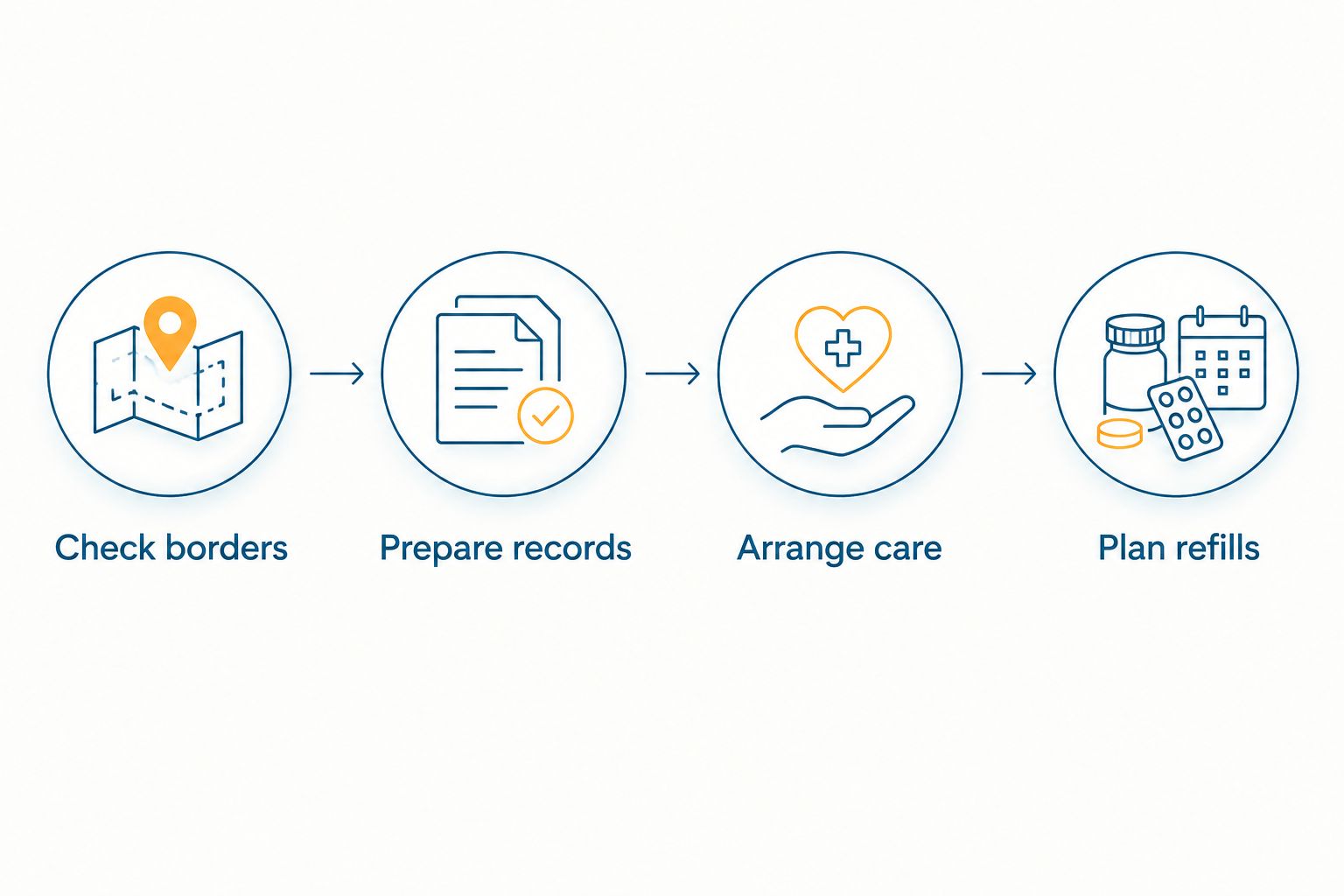
Keep the checklist tied to your itinerary so an extension or new stop triggers a review. A saved document is useful only if it still describes the trip you are taking.
- Check borders: Repeat destination and transit checks when the route changes.
- Prepare records: Update treatment details after a clinician changes your prescription.
- Arrange care: Confirm relevant providers for each longer stay.
- Plan refills: Recalculate supply against your revised departure date.
Compare your support options
Choose each option for the job it actually performs. A directory, clinician, pharmacist, and insurer are not interchangeable, and none alone completes a prescription travel plan.
| Option | Best for | Practical advantage | Key limitation |
|---|---|---|---|
| Official destination authorities | Confirming medication entry rules | Destination-specific legal guidance | Do not provide your clinical treatment plan |
| Prescribing clinician and pharmacist | Preparing treatment, storage, and dosing instructions | Advice tied to your exact medication | Home-country prescribing does not establish foreign dispensing rights |
| Manual local-provider research | Travelers comfortable checking providers independently | Direct control over selection and questions | Requires separate language, credential, and scope checks |
| MyAbroadMDs prescription-travel preparation | Travelers seeking a curated English-speaking provider directory | Personalized directory across 100+ countries | Not insurance, telehealth, booking, or a prescription service |
| Licensed local clinician and pharmacy | Assessment and dispensing under local rules | Local clinical and pharmacy pathway | Treatment and dispensing remain subject to assessment and local requirements |
| Travel medical insurance | Addressing covered financial risks | Coverage governed by policy terms | Does not authorize medicine importation or guarantee routine refills |
Use these options together, not as substitutes. Start with official rules and your existing clinical team, then arrange the local support your itinerary requires. Read insurance terms separately, including any provisions affecting existing conditions and routine treatment.
Prepare your healthcare contacts before departure
Explore a personalized directory of English-speaking healthcare providers for your destinations.
Common mistakes digital nomads make
- Treating an airport connection as irrelevant. Check transit requirements instead of assuming that staying briefly removes all medication obligations.
- Extending a stay without reviewing supply. Recalculate your needs and local consultation arrangements when your departure date changes.
- Searching only by brand name. Take the active ingredient, strength, and formulation to the clinician or pharmacist; similar names are not a safe substitution method.
- Confusing English-speaking care with prescribing access. Confirm specialty, registration, and local requirements separately from language.
- Using accommodation storage without checking it. Follow the product's storage requirements rather than treating any refrigerator or travel cooler as suitable.
FAQ
Can digital nomads travel internationally with prescription medication?
Digital nomads can travel with prescription medication when they meet the rules of each destination and relevant transit country. Check the exact ingredient, quantity, documentation, and any required permission before departure.
Is my home-country prescription valid at a pharmacy abroad?
A home-country prescription does not guarantee dispensing at a pharmacy abroad. Ask a licensed local pharmacist whether local law requires a different prescription format or an assessment by a local clinician.
Should I keep prescription medication in my carry-on?
Keep essential medication accessible during travel while following applicable security and transport rules. Retain required labels and documents, and check separate destination import rules.
How do I manage medication across time zones?
Ask your prescribing clinician or pharmacist for a medication-specific time-zone plan. Use that written schedule to configure reminders, and follow the medicine's instructions if you miss a dose.
Can I mail myself a prescription refill overseas?
Do not mail a prescription refill overseas until you confirm the destination's import rules and the carrier's requirements. Rules for accompanied personal medication and shipped medication are not necessarily the same.
Does MyAbroadMDs prescribe medication or book appointments?
MyAbroadMDs does not prescribe medication or book appointments. Its subscription memberships provide personalized, curated directories of English-speaking healthcare providers; it is not insurance or telehealth.
What should I do if my medication is lost abroad?
Contact a licensed local clinician or pharmacist promptly to establish a safe replacement pathway. Use your medication records, follow local prescribing requirements, and seek urgent medical care if the interruption creates an urgent health concern.
One last thing
Put the active ingredient and formulation on your itinerary checklist. A destination change can affect legal entry and dispensing even when your treatment stays the same. Before your next 2026 border crossing, review the medicine itself—not just the passport, flight, and apartment booking.