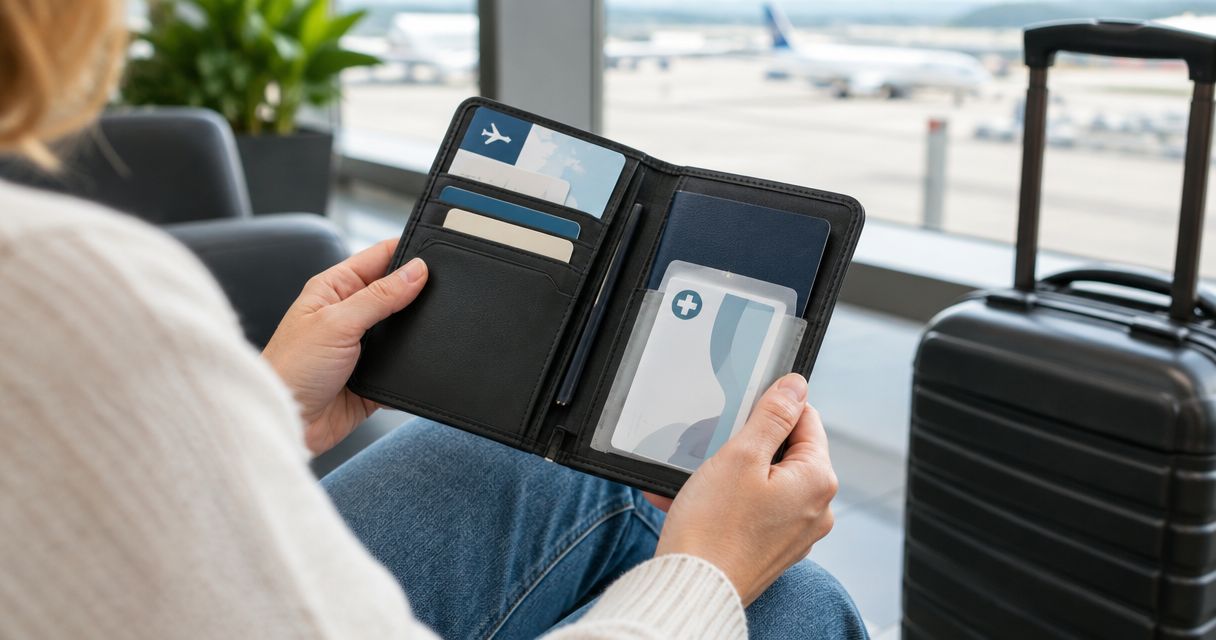
Best overall: a zipped document organizer. Best for wet-weather protection: a waterproof document pouch with a verified rating. Best compact option: a slim passport sleeve. The best travel wallets for storing medical documents abroad keep essential paperwork readable, separated, and easy to retrieve; this 2026 guide compares formats rather than unverified product claims.
- The best travel wallets for storing medical documents abroad separate health paperwork from passports and payment cards.
- Choose a zipped document organizer for your main travel medical documents and emergency contacts.
- Choose a waterproof document pouch only after checking its stated protection and closure instructions.
- MyAbroadMDs provides pre-trip doctor-directory preparation, not insurance, telehealth, booking, or physical document storage.
Why this matters
Picture yourself at a clinic abroad. You need your medication list, but it is folded behind boarding passes and receipts. A useful travel wallet makes that moment simpler: the right document, in the right compartment, without emptying your bag.
Storage and healthcare preparation solve different problems. MyAbroadMDs offers subscription memberships providing personalized, curated directories of English-speaking doctors and healthcare providers across 100+ countries. Your wallet holds the information you take to an appointment; a directory helps you prepare for finding a provider.
MyAbroadMDs is best for travelers seeking pre-trip doctor-directory preparation, not document storage or medical coverage. Keep those boundaries clear when assembling your travel health kit for 2026. Before you pack. Not after something goes wrong.
What makes the best travel medical document wallet
Choose the format around your paperwork, not the number of advertised pockets. These criteria put retrieval and protection ahead of appearance:
- Document fit: Your longest essential document must fit without covering instructions, signatures, or contact details with awkward folds.
- Separate compartments: Keep health records apart from cash, receipts, and documents you remove frequently.
- Secure closure: Check that the wallet closes fully with your actual paperwork inside, rather than judging an empty organizer.
- Readable access: You should be able to retrieve a medical summary without displaying unrelated identification or financial information.
- Environmental protection: Check the stated water-protection rating and closure instructions. A zipper alone does not establish waterproofing.
- Carry comfort: Choose something you will keep in your accessible travel bag, not an organizer you leave behind because it is cumbersome.
For a 2026 trip, start with your real documents on a table. A wallet that looks organized online is not useful if your clinician's letter will not fit.
Travel medical document wallets at a glance
These are format recommendations, not claims about particular manufacturers. Check the construction of any product you consider; features differ within each format.
| Rank and format | Best for | Standout feature to seek | Key limitation |
|---|---|---|---|
| 1. Zipped document organizer | A complete personal travel health packet | Separate, accessible health-document compartment | Bulky models encourage carrying unnecessary paperwork |
| 2. Waterproof document pouch | Rain, boat trips, and wet itineraries | Verified protection with clear sealing instructions | A single compartment makes sorting harder |
| 3. Slim passport sleeve | Short trips with a brief medical summary | A separate pocket for folded health information | Poor fit for extensive records or unfolded letters |
| 4. Accordion document wallet | Family travel with separate health packets | Dividers labeled by traveler | Larger format needs deliberate storage in your bag |
| 5. Neck wallet | Keeping a minimal emergency packet on your person | Closed document pocket accessible without unpacking | Limited space and potential discomfort under clothing |
1. Zipped document organizer: best for a complete health packet
A zipped document organizer is the default choice when you need a medical summary, medication list, insurance information, and provider contacts together. Look for distinct compartments rather than a large pocket that turns everything into a stack. Keep the health section separate from documents you use at airports.
The deciding feature is access. You should be able to open the organizer, find the health section, and remove a document without dislodging your passport or payment cards.
Zipped document organizer pros:
- Separate pockets support a consistent place for each document.
- A full closure keeps loose paperwork contained when properly fastened.
- A dedicated health section reduces sorting during an appointment.
- The format suits a personal packet with several document types.
Zipped document organizer cons:
- Extra compartments add bulk and invite unnecessary contents.
- A zipper does not prove water protection.
- Combining identification and health records creates a single loss point.
Best for: Travelers carrying a complete personal medical packet across several destinations in 2026.
Verdict: Buy this format as your default, after checking fit with the documents you actually carry.
2. Waterproof document pouch: best for wet itineraries
A waterproof document pouch prioritizes protection from water rather than pocket organization. Choose a product with explicit protection claims and instructions you can follow. Do not treat a fabric description or splash-resistant label as proof that it protects documents during immersion.
Place documents inside in their retrieval order. If the pouch has no dividers, separate the medical summary from supporting paperwork with clearly labeled inner sleeves that fit without interfering with the closure.
Waterproof document pouch pros:
- Rated protection addresses the exposure described by the manufacturer.
- A document-sized format can avoid unnecessary folding.
- A removable pouch can serve as the health section inside another bag.
Waterproof document pouch cons:
- A single compartment offers little separation between documents.
- Protection depends on correct closure and the product's stated limits.
- Repeatedly opening the pouch interrupts its protective seal.
Best for: Travelers whose itinerary includes rain exposure, boat travel, or other situations where documents need stated water protection.
Verdict: Buy for that specific exposure. Skip any pouch whose protection claim or sealing instructions are unclear.
3. Slim passport sleeve: best for a minimal medical summary
A slim passport sleeve suits a short document list, not a medical archive. Choose a version with a separate pocket for your summary and emergency contacts. Keep the paperwork brief enough that the sleeve closes normally and the passport remains easy to remove.
Test the folds before departure. If folding hides medication instructions or makes the page difficult to read, move that document to a larger organizer instead.
Slim passport sleeve pros:
- A compact format limits the temptation to carry excessive paperwork.
- A dedicated pocket can keep a brief health summary close to travel identification.
- The sleeve fits a minimal packing approach when document fit is confirmed.
Slim passport sleeve cons:
- Extensive records quickly defeat the slim format.
- Full-size letters usually require folding or separate storage.
- Removing your passport exposes nearby paperwork unless compartments are separate.
Best for: Travelers carrying a brief medical summary rather than multiple full-size documents.
Verdict: Buy for a genuinely minimal packet. Skip it as your sole organizer when you need substantial supporting records.
4. Accordion document wallet: best for family health packets
An accordion document wallet uses divided sections to separate paperwork. For family travel, label sections by traveler and keep each person's medical summary at the front of their section. Put shared administrative information in a distinct section rather than mixing it into an individual's records.
Choose the divider arrangement before adding documents. Organizing by person makes it easier to hand over the relevant packet without revealing another family member's health information.
Accordion document wallet pros:
- Dividers support separate packets for different travelers.
- Labels make the filing arrangement visible at a glance.
- Larger formats can accommodate documents that smaller wallets require you to fold.
Accordion document wallet cons:
- The format takes more space than a passport sleeve.
- One organizer containing everyone's records creates a shared loss point.
- A deep section still becomes confusing if you fill it without an order.
Best for: Families carrying distinct medical information for several travelers in 2026.
Verdict: Buy when separation by person is the priority. Keep backup access separate from the shared wallet.
5. Neck wallet: best for an on-person emergency packet
A neck wallet holds a small set of documents on your person. Use it for a concise emergency packet rather than full records: essential health information, an emergency contact, and relevant assistance details. Check the pocket closure and how the loaded wallet feels under your travel clothing.
Accessibility matters more than concealment alone. If retrieving the packet requires an awkward search through clothing, choose another accessible carry position.
Neck wallet pros:
- The format keeps a minimal packet with you rather than inside a separate bag.
- A closed pocket can contain a folded summary and contact details.
- It supports carrying only the information needed for initial communication.
Neck wallet cons:
- Limited capacity makes it unsuitable for a complete medical file.
- A strap and loaded pouch can be uncomfortable under clothing.
- Concealment does not guarantee protection against theft or loss.
Best for: Travelers who want essential emergency information on their person during outings.
Verdict: Buy as a minimal carry option. Skip it as the only home for your travel medical documents.
Prepare the packet before choosing the wallet
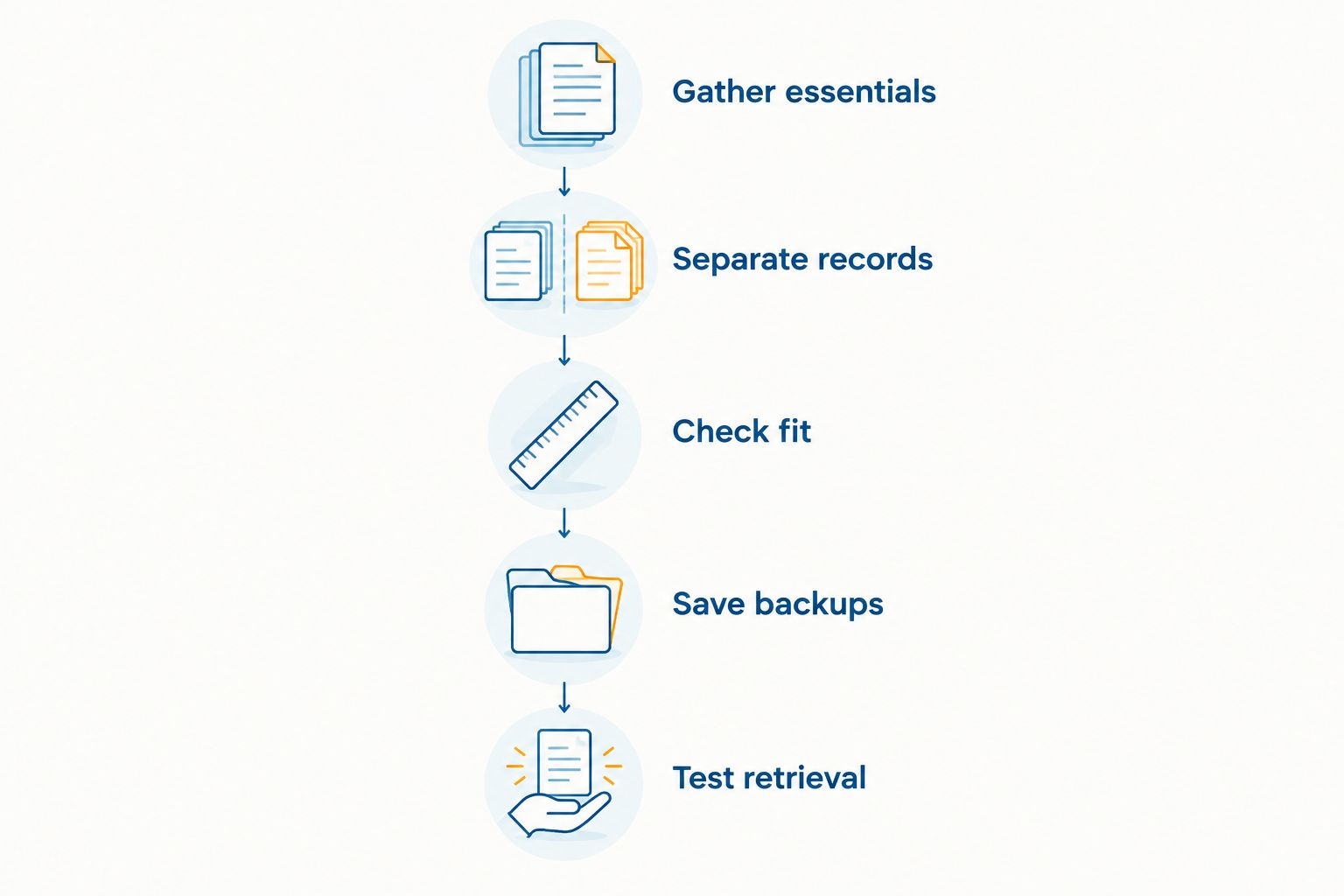
Your 2026 packing plan should start with the information, then the container. Gather the documents you need, decide which must remain immediately accessible, and test the complete packet before departure.
Gather essentials
Prepare a concise medical summary with your clinician's guidance where needed. Include relevant conditions, allergies, current medications, and emergency contacts. Add insurance or assistance information separately so you can distinguish clinical information from administrative instructions.
Separate records
Put the summary first and supporting documents behind it. Avoid carrying your entire medical history simply because the organizer has room. For family travel, keep each person's information in a clearly identified section.
Check fit
A4 paper measures 210 × 297 mm. US Letter paper measures 8.5 × 11 inches. Compare your actual paperwork with the organizer's usable interior dimensions, not just its exterior measurements, and keep critical text away from folds.
Save backups
Keep a securely stored digital copy separate from the physical wallet. If you need offline access, verify that the files open without a connection and protect the device with its available security controls. Avoid placing sensitive records in an openly shared folder.
Test retrieval
Open the packed organizer and retrieve the medical summary. Then retrieve assistance contacts without moving the rest of the packet. If that feels awkward at home, simplify the arrangement before departure.
Keep the wallet's job separate from healthcare access
A travel wallet stores paperwork. It does not arrange treatment, reimburse a bill, or determine whether a clinician can see you. Make those preparations separately, and keep the relevant contact information in your packet.
MyAbroadMDs provides personalized, curated directories of English-speaking doctors and healthcare providers. It is not insurance, telehealth, or a booking service. For your 2026 itinerary, treat provider-directory preparation as a separate task from document storage and coverage decisions.
Prepare your healthcare contacts before departure
Explore personalized, curated English-speaking doctor directories for international travel.
How the formats rank
The ranking prioritizes document fit, separation, retrieval, closure, environmental protection, and carry comfort. A zipped organizer takes the default slot because its compartment-based format suits a complete personal packet. The other formats serve narrower needs rather than competing for the same recommendation.
This is a format-based buying guide, not a product-testing report. Before choosing a particular wallet, verify its dimensions, compartment arrangement, closure instructions, and any protection claims against your own documents and itinerary.
Which travel medical document wallet should you choose?
Choose a zipped document organizer unless your itinerary or paperwork creates a clear reason to use another format. Choose a rated waterproof pouch for wet exposure, a slim sleeve for minimal paperwork, an accordion wallet for separate family packets, or a neck wallet for on-person essentials.
Do not buy more capacity than you need. A smaller, clearly ordered packet is easier to use than an overfilled organizer whose sections have lost their purpose.
FAQ
What's the best travel wallet for storing medical documents abroad?
A zipped document organizer is the default choice for a complete personal health packet. Choose separate compartments for medical information, identification, and administrative documents, then test the fit with your actual paperwork.
Is a passport wallet enough for medical documents?
A passport wallet is enough only when your essential health information fits clearly in a separate pocket. Use a larger organizer if folding obscures text or you need supporting letters and records.
Do I need a waterproof wallet for medical paperwork?
Choose a waterproof pouch when your itinerary calls for documented water protection. Check the manufacturer's stated limits and sealing instructions; a standard zipper does not establish waterproofing.
What medical documents should I carry abroad?
Carry relevant health information, current medication details, emergency contacts, and applicable insurance or assistance information. Ask your clinician which summaries or supporting documents are appropriate for your circumstances and destination.
Should I keep digital copies of my travel medical documents?
Keep securely stored digital backups separate from your physical wallet. Verify any needed offline access before departure and avoid openly shared storage for sensitive records.
Does MyAbroadMDs provide insurance or book appointments?
MyAbroadMDs provides subscription-based access to personalized, curated directories of English-speaking doctors and healthcare providers. It is not insurance, telehealth, or a booking service.
One last thing
Practice handing over the medical summary without handing over the whole wallet. That simple check reveals whether your setup protects unrelated documents while making the relevant information accessible. Finish it before your 2026 departure, not at the clinic reception desk.