
You can use your US health insurance to see a doctor abroad only if your specific plan covers care outside the United States. Even when a visit qualifies, the clinic can require payment upfront and leave you to request reimbursement; before your 2026 departure, confirm covered services, provider requirements, and claim instructions with your insurer.
- Can I use my US health insurance to see a doctor abroad? Only when your plan covers overseas care.
- Covered treatment does not guarantee a foreign clinic will bill your US insurer directly.
- Original Medicare generally excludes care outside the United States, with limited exceptions.
- Myabroadmds healthcare preparation suits travelers seeking English-speaking doctor directories, not insurance coverage.
Why this matters
Finding a doctor and paying for treatment are separate jobs. Your insurance card does not establish that a particular overseas appointment qualifies for benefits or that the clinic accepts direct billing.
Before departure, review the insurance claim and doctor visit workflow. Keep coverage confirmation, provider details, and claim instructions together so you can act without rebuilding your plan from a waiting room.
Can I use my US health insurance to see a doctor abroad?
Your policy—not your citizenship, insurance company’s name, or US provider network—determines whether an overseas visit is covered. For a 2026 trip, check the documents governing your current coverage period, including any international benefits or exclusions.
Start with your insurance type. These categories help you identify the right questions; they do not establish your individual benefits.
| Coverage type | Best for | Potential benefit abroad | Main limitation |
|---|---|---|---|
| Employer or individual health plan | Travelers checking existing benefits first | Some plans cover overseas emergency or other eligible treatment | International coverage and reimbursement rules are plan-specific |
| Original Medicare | Medicare beneficiaries identifying gaps before departure | Limited exceptions allow coverage outside the United States | Generally does not cover foreign medical care |
| Medicare Advantage | Members checking their plan’s travel benefits | Some plans include overseas emergency or urgent-care benefits | Benefits, restrictions, and service areas differ by plan |
| Medigap with a foreign-travel benefit | Eligible Medicare beneficiaries reviewing supplemental protection | Certain policies include limited foreign-travel emergency benefits | Not every policy includes the benefit; restrictions apply |
| Travel medical insurance | Travelers addressing a confirmed overseas coverage gap | Covers eligible treatment under the purchased policy | Exclusions, benefit limits, and claim requirements still apply |
Medicare.gov’s guidance on travel outside the United States explains Original Medicare’s general exclusion and limited exceptions. Its Medigap guidance separately describes foreign-travel emergency benefits in certain supplemental policies. Check those official resources alongside your own policy documents rather than treating all Medicare-related coverage as interchangeable.
Employer and individual health plans
Do not assume a familiar insurer provides the same international benefits across every employer or individual policy. Ask whether your plan covers emergency treatment, urgent outpatient visits, scheduled appointments, and prescriptions abroad.
Request the relevant policy section in writing. A general statement that you have out-of-network benefits does not answer whether those benefits extend outside the United States.
Medicare-related coverage
If you use Original Medicare, start from its general exclusion of foreign care and investigate whether a specific exception applies. Do not build your travel plan around an exception without checking its conditions.
If you have Medicare Advantage or Medigap, review that coverage separately. An overseas benefit does not mean every doctor visit, destination, or length of stay qualifies.
How do I confirm overseas coverage before departure?
Use this sequence for your 2026 itinerary. Contact your insurer through the number or member channel listed on your insurance card, then save the written response with your travel documents.
- Describe your itinerary. Give your destination countries, travel dates, and whether you are vacationing, studying, working, or relocating. Ask which policy provisions apply to that trip.
- Name the care. Ask separately about emergency treatment, urgent care, routine appointments, specialist follow-ups, and prescription-related visits. Do not accept an answer about emergency care as confirmation of routine benefits.
- Check provider requirements. Ask whether you must use a designated network, contact an assistance service, obtain a referral, or seek prior authorization. Request instructions for situations in which advance contact is impossible.
- Confirm payment. Ask whether direct billing is available and what happens when a clinic requires payment from you. Check the deductible, coinsurance, reimbursement basis, and applicable benefit limits in your policy.
- Save claim instructions. Confirm submission deadlines, required records, translation requirements, and accepted proof of payment. Keep the relevant contact information available offline.
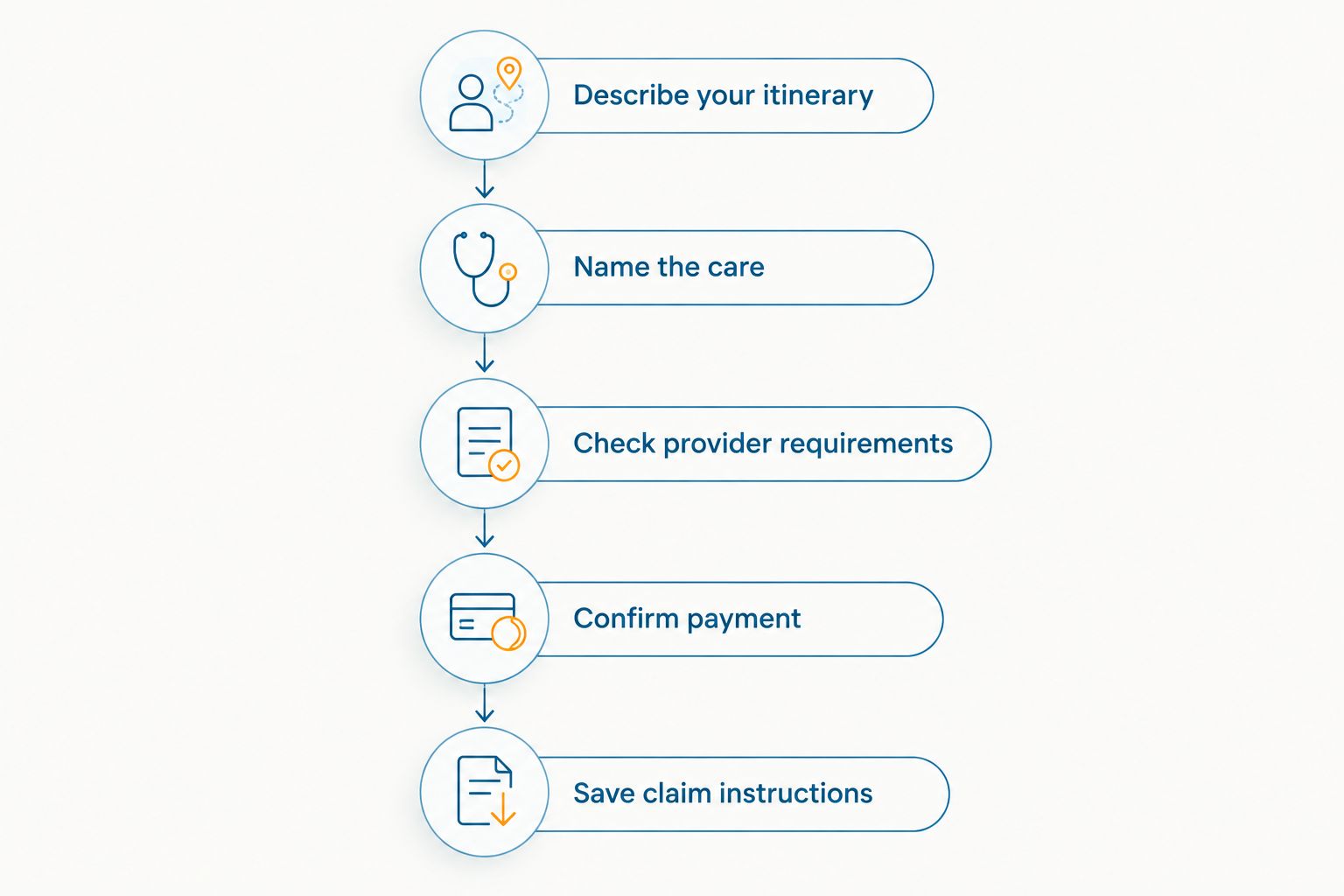
A useful written request is specific: ask whether an outpatient visit for a new illness in your destination country is eligible, which conditions apply, and how you submit the claim. Save the response, the policy section, and any reference identifier supplied by the insurer.
A benefits explanation is not a guarantee that every future claim will be paid. Final eligibility depends on the actual treatment and the policy’s terms.
Why overseas health insurance coverage varies
The same appointment can receive different treatment under different policies. Review these factors rather than relying on another traveler’s experience:
- Purpose of treatment. Emergency care, treatment for a new illness, preventive services, and planned procedures can fall under different benefits or exclusions.
- Destination and service area. A domestic provider network does not establish international coverage. Check the countries and territories included in your policy’s geographic terms.
- Trip duration and purpose. Vacation, study, employment, and relocation provisions need separate attention. Check whether your planned stay fits the policy’s eligibility conditions.
- Existing health needs. Read any terms concerning pre-existing conditions, ongoing treatment, and scheduled follow-ups. A covered emergency benefit does not answer every chronic-care question.
- Provider and authorization rules. The policy can impose network, referral, notification, or approval conditions. Confirm which apply before arranging nonemergency care.
- Claims and payment terms. A covered service still has to meet documentation and reimbursement requirements. The clinic’s billing practice is a separate issue.
For your 2026 trip, use the policy effective during your actual travel dates. If your coverage renews before departure, check the renewed documents rather than relying only on an earlier benefits summary.
Does an overseas doctor have to accept my US insurance?
No. Coverage under your policy does not require a foreign doctor to accept your insurance card or bill your insurer. Ask the clinic about payment before a nonemergency appointment, even if your insurer confirms that the service is eligible.
Separate these questions:
- Does my policy cover this treatment?
- Does this provider meet the policy’s requirements?
- Will the clinic bill the insurer directly?
- If I pay, which records must I collect for reimbursement?
A clinic saying it accepts international patients does not settle any insurance question. Likewise, a clinic’s refusal to bill your insurer directly does not, by itself, determine whether your policy permits reimbursement.
For planned care, ask the insurer and clinic to confirm their respective arrangements. Do not treat either party’s general assurance as the other party’s approval.
What should I keep if I pay for a doctor abroad?
Keep an itemized bill, proof of payment, and the medical documentation your insurer requires. Ask about these records before leaving the clinic, while staff can clarify missing information.
Your insurer’s checklist takes priority. Commonly relevant records include:
- Your name and the dates of treatment.
- The provider’s name, address, and contact details.
- An itemized description of services and the currency charged.
- Proof that you paid the bill.
- A clinical report or diagnosis documentation required for the claim.
- Prescriptions, referrals, or authorization records relevant to the visit.
Ask whether documents need translation and whether copies are sufficient. Keep originals when required, store readable copies securely, and record the claim deadline from your policy.
Do not assume an appointment confirmation is a receipt or that a card-payment slip explains the treatment. Each document serves a different purpose. If a claim is denied, request the reason and appeal instructions in writing.
Where healthcare preparation fits alongside insurance
Myabroadmds healthcare preparation is best for international travelers and study-abroad students who want a curated directory of English-speaking doctors before departure. Its subscription-based memberships provide personalized healthcare directories across more than 100 countries.
Myabroadmds is not insurance, telehealth, or a booking service. It does not replace benefit verification, pay medical bills, or establish that a listed provider qualifies under your policy.
Use Myabroadmds healthcare preparation to identify potential English-speaking providers, then check those providers against your insurer’s requirements. That is its practical benefit and its boundary: a directory helps you prepare to find care; the insurance policy determines financial coverage.
Keep those roles separate in your 2026 departure plan. Identify care before you need it, confirm payment arrangements independently, and retain a backup provider contact for each destination where you expect to seek treatment.
What if I need urgent care before I can reach my insurer?
For a medical emergency, seek immediate local emergency care rather than delaying treatment to complete an insurance check. Use the destination’s local emergency number or ask someone nearby to contact emergency services.
For a nonemergency problem, contact your insurer’s assistance channel before arranging treatment when practical. Describe the situation and ask about appropriate providers, notification requirements, and documentation.
Once you can safely manage administration, contact the insurer and explain what happened. Keep records of the treatment and communications. Do not assume that contacting an assistance service automatically approves every service or guarantees reimbursement.
FAQ
Can I use my US health insurance to see a doctor abroad in 2026?
You can use your US health insurance abroad only when your current policy covers the treatment and destination. Confirm provider requirements, payment arrangements, and claim instructions before departure.
Will my overseas doctor bill my US insurance directly?
Direct billing is not guaranteed, even when your policy covers the visit. Ask the clinic and insurer to confirm the arrangement before nonemergency treatment.
Does Original Medicare cover doctor visits outside the United States?
Original Medicare generally does not cover medical care outside the United States, except in limited circumstances. Check Medicare.gov’s foreign-travel guidance and any separate supplemental coverage before traveling.
Does emergency coverage abroad include routine checkups?
Emergency coverage does not establish coverage for routine checkups. Ask your insurer specifically about preventive care, scheduled appointments, and ongoing treatment abroad.
Should I buy travel medical insurance if I already have US health insurance?
Consider travel medical insurance when your existing benefits leave a gap relevant to your trip. Compare the actual policies, including exclusions, eligibility conditions, and claim rules, before choosing additional coverage.
Can I get reimbursed after paying an overseas doctor myself?
Reimbursement depends on whether your policy covers the treatment and whether your claim meets its requirements. Keep the itemized bill, proof of payment, and required medical records, then submit within the policy’s deadline.
Does a healthcare directory membership pay for my doctor visit abroad?
A healthcare directory membership is not medical insurance and does not establish payment coverage. Verify benefits with your insurer and payment arrangements with the clinic separately.
One last thing
The most useful question is not simply whether you are covered abroad. Ask what happens between arriving at the clinic and receiving reimbursement. That reveals the practical gaps: finding an eligible provider, paying at the appointment, collecting records, and filing on time.
Before your 2026 departure, save a compact healthcare file offline. Include the applicable policy documents, international assistance contact, provider details, claim checklist, and relevant medical information. Give a trusted travel companion access to the emergency contact details with your permission.
Before you pack, know where you would go—and how the bill would be handled.