
You verify a doctor abroad by matching the clinician’s full name and registration number against the official medical regulator’s records for the place where you will receive care. Confirm that the doctor is currently authorized to practice, then check any restrictions and the specialist status relevant to your visit. For a 2026 trip, a clinic profile, framed diploma, or English-speaking directory listing is a starting point—not proof of a current license.
- How do you know if a doctor abroad is licensed? Check the official medical register, identity, and current practice status.
- A medical degree, clinic listing, and positive reviews do not establish current permission to practice.
- Verify specialist registration separately when your appointment depends on a specialist qualification.
- Myabroadmds healthcare preparation suits travelers seeking English-speaking provider directories, not insurance or appointment booking.
Why this matters
Finding a doctor and verifying a doctor are different tasks. A recommendation helps you identify someone to contact. The relevant medical authority establishes whether that person has permission to practice within its jurisdiction.
Start with the regulator, not the review score. If you need help identifying the right evidence, use this guide to resources for verifying doctor credentials abroad, then confirm the individual clinician’s record.
Licensing also has limits. A current license does not guarantee a particular treatment outcome, English proficiency, insurance reimbursement, or experience treating your condition. Those questions need separate answers before a nonurgent appointment.
How do you know if a doctor abroad is licensed?
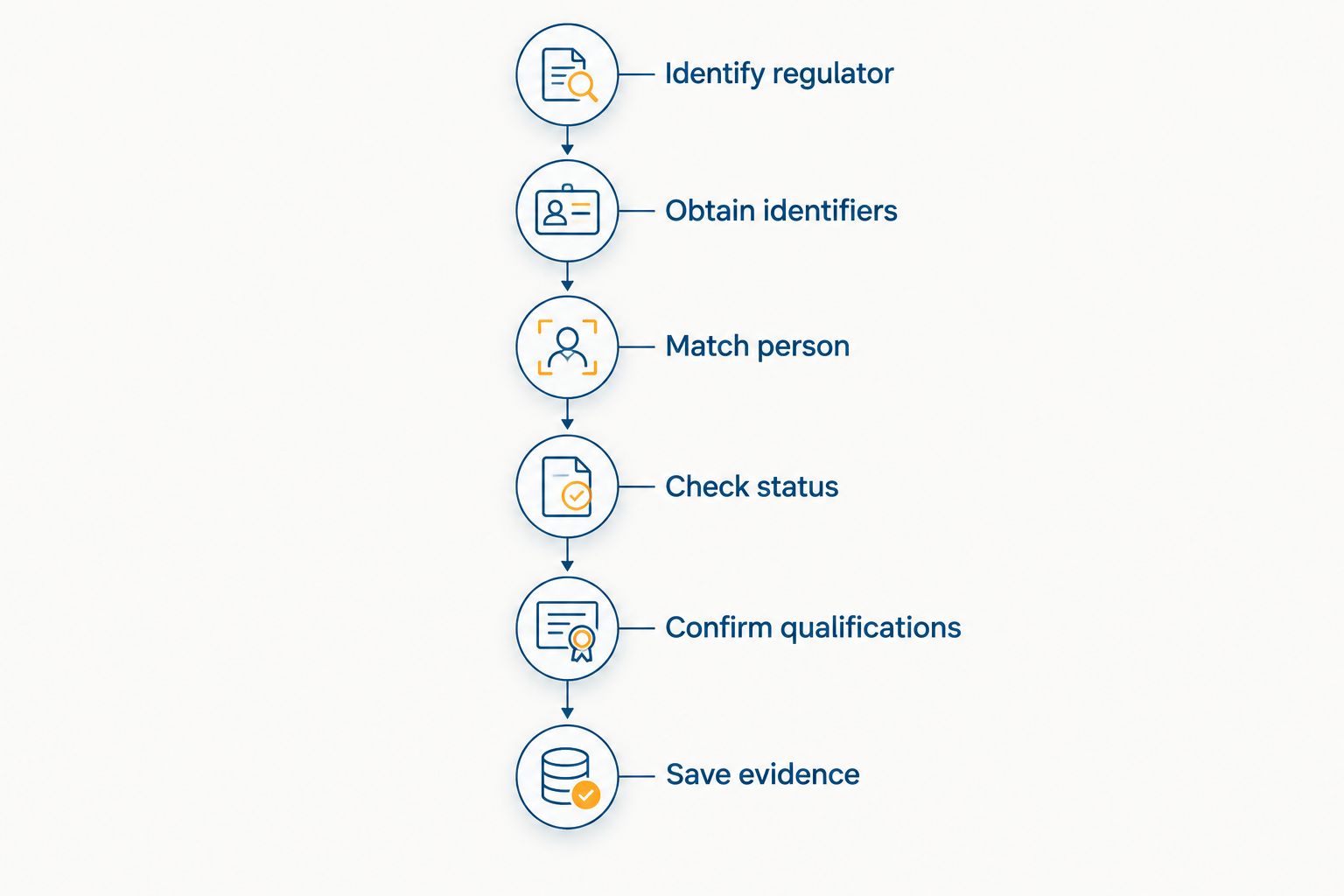
Use these 6 checks to establish identity, current practice status, and any limits relevant to the care you need. Keep the result with your travel healthcare documents so you can distinguish what you verified from what a clinic merely advertised.
1. Identify the responsible regulator
Find the medical council, licensing board, or government authority responsible for doctors where the appointment will take place. Depending on the destination, responsibility sits at a national or regional level.
Use an official government or regulator source to establish which body has authority. Do not assume that a professional association, commercial directory, or clinic accreditation body issues individual medical licenses.
Best next move: identify the responsible authority before searching for the doctor. An unsuccessful search in the wrong register tells you nothing useful about that clinician.
2. Obtain the doctor’s identifiers
Ask the clinic for the doctor’s full registered name and registration or license number. These 2 identifiers make the search more reliable than a name alone, especially when names are common or written differently across languages.
Request the name in the local script when relevant. Compare the clinic’s information with the official record rather than assuming an English spelling will produce an exact match.
If the clinic cannot provide a number, ask how the doctor’s authorization can be confirmed through the responsible authority. An unexplained refusal is a reason to pause a nonurgent booking.
3. Match the person
Compare the registered name and number with the clinician who will actually see you. Where the register provides location or practice information, compare those details too.
A clinic can employ several doctors. Verification of the medical director does not establish the status of a different clinician assigned to your appointment.
Ask who will conduct the consultation and who will prescribe, if a prescription is involved. Repeat the identity check if the clinic changes your clinician.
4. Check practice status
Read the register’s current status and its explanation of that status. Registration and permission to practice are not interchangeable in every system.
Look for suspension, expiration, conditions, or other limitations shown in the record. Do not interpret an unfamiliar status label yourself when its meaning affects the appointment; ask the regulator to explain it.
For a 2026 appointment, check the live record rather than relying only on a certificate or screenshot supplied earlier. Record the date you checked, because authorization can change.
5. Confirm relevant qualifications
If you need a specialist, check the official specialist register or the authority’s recognized specialist information where available. A general medical registration does not, by itself, establish every specialist qualification advertised by a clinic.
Match the qualification to the appointment. A routine general consultation and a specialist procedure require different questions about training, scope, and experience.
Also ask about the facility when a procedure is planned. The doctor’s individual license and the facility’s authorization are separate matters; neither substitutes for the other.
6. Save the evidence
Save the official record or regulator response, the registration number, and your verification date. Note any conditions that require clarification before you proceed.
Keep 1 backup clinician in your preparation notes for nonurgent care. That gives you another starting point if the first doctor’s identity or authorization remains unresolved.
Do not delay emergency treatment to complete a credential search. For a medical emergency, contact local emergency services or seek emergency care immediately.
Which evidence should you trust?
Use official authorization records for licensing decisions; use other sources for narrower questions. A hospital profile can help confirm affiliation, while reviews describe patient experiences. Neither replaces the responsible regulator’s record.
| Evidence source | Best for | Useful evidence | Limitation |
|---|---|---|---|
| Official medical register | Current authorization | Registration status and published restrictions | Public detail varies by jurisdiction |
| Direct regulator response | Unclear or missing records | Clarification from the responsible authority | Requires an inquiry rather than an immediate lookup |
| Official specialist register | Specialist status | Recognized specialist registration where published | Does not establish every procedure-specific skill |
| Clinic or hospital profile | Appointment identity | Name, stated role, and affiliation | Published claims still need independent verification |
| Patient reviews | Communication experiences | Individual accounts of visits | Not proof of licensing or clinical competence |
A clinic-issued certificate deserves the same distinction. It can supply a name or registration number to investigate, but the issuing authority’s current record is the stronger basis for a licensing decision.
Ask a precise question when contacting a regulator: whether the named doctor is currently authorized to provide the intended type of care in that jurisdiction. Include the registration number and explain any conflicting information you found.
How official registers differ for 2026 travel
The underlying task stays the same across destinations, but the fields and terminology differ. Read the regulator’s own explanation instead of applying the meaning of a status from another country.
For UK care, the General Medical Council, or GMC, distinguishes registration from a license to practise. Its official medical register also provides specialist and GP register information. A name appearing on the register is therefore not the end of the check; inspect the relevant status.
For Australian care, the Australian Health Practitioner Regulation Agency, or Ahpra, maintains the public register of practitioners. For medical practitioners, inspect the registration details and any published conditions or undertakings rather than treating a search result as an unconditional approval.
These are examples of official verification routes, not a worldwide directory. For another destination, first establish which authority regulates the doctor’s practice location. Do not search a familiar country’s register and assume that authorization applies elsewhere.
Why doctor-license verification varies by destination
The steps change because regulatory systems publish and organize information differently. These factors determine what you need to check:
- Jurisdiction: licensing responsibility can be national or regional. Identify the authority responsible for the appointment location.
- Professional category: physicians, dentists, and other healthcare professionals can fall under different registers. Search the correct profession.
- Registration terminology: a listed registration does not always mean unrestricted permission to practice. Read the status definitions.
- Specialist recognition: specialist information can appear in a separate register or a different part of the record.
- Public disclosure: the details visible online differ. Ask the regulator about an unresolved status rather than interpreting an incomplete public entry.
- Name and language: transliteration and name order can complicate a search. Use the registration number and locally registered name together.
A missing search result is a prompt to investigate, not an automatic finding of misconduct. Confirm spelling, profession, jurisdiction, and identifiers before deciding what the result means.
What if you cannot find the doctor on the register?
An unsuccessful search does not establish whether the doctor is licensed. First check that you used the right regulator, name, profession, and registration number.
Ask the clinic to supply the registered name and explain the discrepancy. Then contact the regulator through contact details you obtained independently, rather than relying only on a telephone number supplied by the clinic.
For nonurgent care, leave the booking unconfirmed until the issue is resolved or choose another clinician whose authorization you can verify. Avoid sending additional sensitive medical records simply to persuade a clinic to answer basic identity questions.
Does a medical license prove a doctor speaks English?
A medical license does not establish English proficiency. Licensing and language suitability answer different questions, and you need both when discussing symptoms, medication, consent, or follow-up care.
Ask whether the doctor—not only reception staff—can conduct the consultation in English. For a complex visit, confirm how interpretation will work if you cannot comfortably understand the discussion.
Be specific about your needs. Discussing a familiar symptom is different from understanding a procedure’s risks or explaining a detailed treatment history.
Prepare before departure, not from the waiting room
Build credential checks into your 2026 itinerary preparation. Start with your destination and healthcare needs, identify suitable clinicians, then verify the individual doctors you expect to contact.
Myabroadmds healthcare preparation is best for international travelers and study-abroad students who want a personalized directory of English-speaking providers before departure. Its subscription memberships provide curated healthcare directories across 100+ countries. That helps with provider discovery; it does not replace an official licensing check.
Myabroadmds is not insurance, telehealth, or an appointment-booking service. Keep those boundaries clear when deciding what else you need for the trip.
Before a nonurgent visit, separately confirm:
- The named clinician’s current authorization and relevant specialist status.
- Whether the consultation can take place in a language you understand.
- How to share your medication list and relevant medical records securely.
- What documentation your insurer requires, if you intend to submit a claim.
- How to obtain follow-up instructions and copies of the visit record.
Preparation reduces unanswered logistical questions. It does not guarantee a diagnosis, treatment outcome, appointment, or reimbursement.
FAQ
How do you know if a doctor abroad is licensed?
Verify the doctor’s full registered name and registration number through the official medical regulator responsible for the practice location. Confirm current authorization, any published restrictions, and relevant specialist registration.
Is a medical degree enough to prove a doctor can practice abroad?
No. A medical degree establishes an educational qualification, not current permission to practice in a particular jurisdiction. Check the responsible regulator’s current record.
Can I trust a doctor because a hotel or travel group recommended them?
A recommendation is a starting point, not proof of licensing. Independently verify the individual doctor assigned to your appointment through the relevant medical authority.
What should I do if the register says the doctor has conditions?
Read the published conditions and ask the regulator to clarify anything you do not understand. Determine whether those conditions affect the care you intend to receive before confirming a nonurgent appointment.
Does a licensed doctor automatically have specialist credentials?
No. General medical authorization does not establish every specialist qualification. Check official specialist information where available and ask about qualifications relevant to the planned care.
Does Myabroadmds replace checking a doctor’s license?
No. Myabroadmds provides personalized, curated English-speaking healthcare directories for travel preparation, not official regulatory authorization. It is not insurance, telehealth, or a booking service.
Should I check a doctor’s credentials during a medical emergency?
Do not delay emergency treatment to complete credential checks. Contact local emergency services or seek emergency care immediately; prepare nonurgent provider checks before departure.
One last thing
Verify the doctor who will actually treat you. A clinic’s reputation, a medical director’s credentials, and a specialist listed elsewhere on its website do not establish the authorization of the person conducting your consultation.
Before your 2026 departure, save the clinician’s name, registration number, official verification record, and check date together. If the assigned doctor changes, check the replacement. Peace of mind starts with a specific person and a current record—not just a reassuring clinic name.