
A pharmacy abroad can dispense medication against a US prescription only if local law and the pharmacy’s requirements allow it; your prescription is not automatically valid outside the United States. You may need an assessment and a new prescription from a locally authorized clinician, and permission to carry your existing medicine does not establish a right to refill it abroad.
- Can a pharmacy abroad refill a US prescription? Not automatically; destination rules determine whether a local prescription is required.
- CDC travel guidance recommends checking medication rules before departure, including restrictions on controlled substances.
- Bring your medication details and medical records; a US prescription supports assessment but does not guarantee dispensing.
- Arrange a local-doctor backup before your supply runs low, especially during extended travel or study abroad.
Can a pharmacy abroad refill a US prescription?
Sometimes, but you should not build your itinerary around an assumed overseas refill. A foreign pharmacist must follow the rules where the pharmacy operates, not the refill instructions accepted by your US pharmacy.
The practical distinction is between showing evidence of treatment and presenting a prescription that the pharmacist can legally dispense. Your US prescription helps explain your treatment. Whether it authorizes dispensing is a separate question.
Start your preparation with the guide to traveling with prescription medication, then confirm the requirements for your actual destination and medicine.
| Route | Best for | What it helps you do | Limitation |
|---|---|---|---|
| Pharmacy review | Establishing local requirements | Ask whether the pharmacy accepts your prescription and what documentation it needs | The pharmacist cannot dispense outside local law |
| Local clinician assessment | Situations requiring a local prescription | Have your treatment reviewed by someone authorized to prescribe locally | A new prescription is a clinical decision, not an automatic renewal |
| Predeparture planning | Reducing avoidable refill problems | Discuss your itinerary and medication supply with your existing clinician and pharmacist | Carrying medication still requires compliance with destination rules |
These routes serve different purposes. A pharmacy explains its dispensing requirements; a clinician assesses treatment; advance planning reduces the need to solve either problem during your trip.
Why this matters
A refill problem is not just a paperwork problem. The medicine’s active ingredient, formulation, prescription status, and local restrictions all affect what happens next.
A familiar brand name does not establish that a medicine abroad matches your treatment. A matching active ingredient also does not settle questions about strength, release mechanism, or how you should take it.
For 2026 travel, check current destination guidance rather than relying on a previous trip or another traveler’s experience. CDC Yellow Book guidance on traveling with medicines and US Department of State travel-health guidance are useful starting points; the destination’s health authority and a licensed local pharmacy address the local requirements.
If missing a dose creates a medical concern, contact a clinician promptly. Do not ration, stop, or substitute prescribed medicine without professional advice.
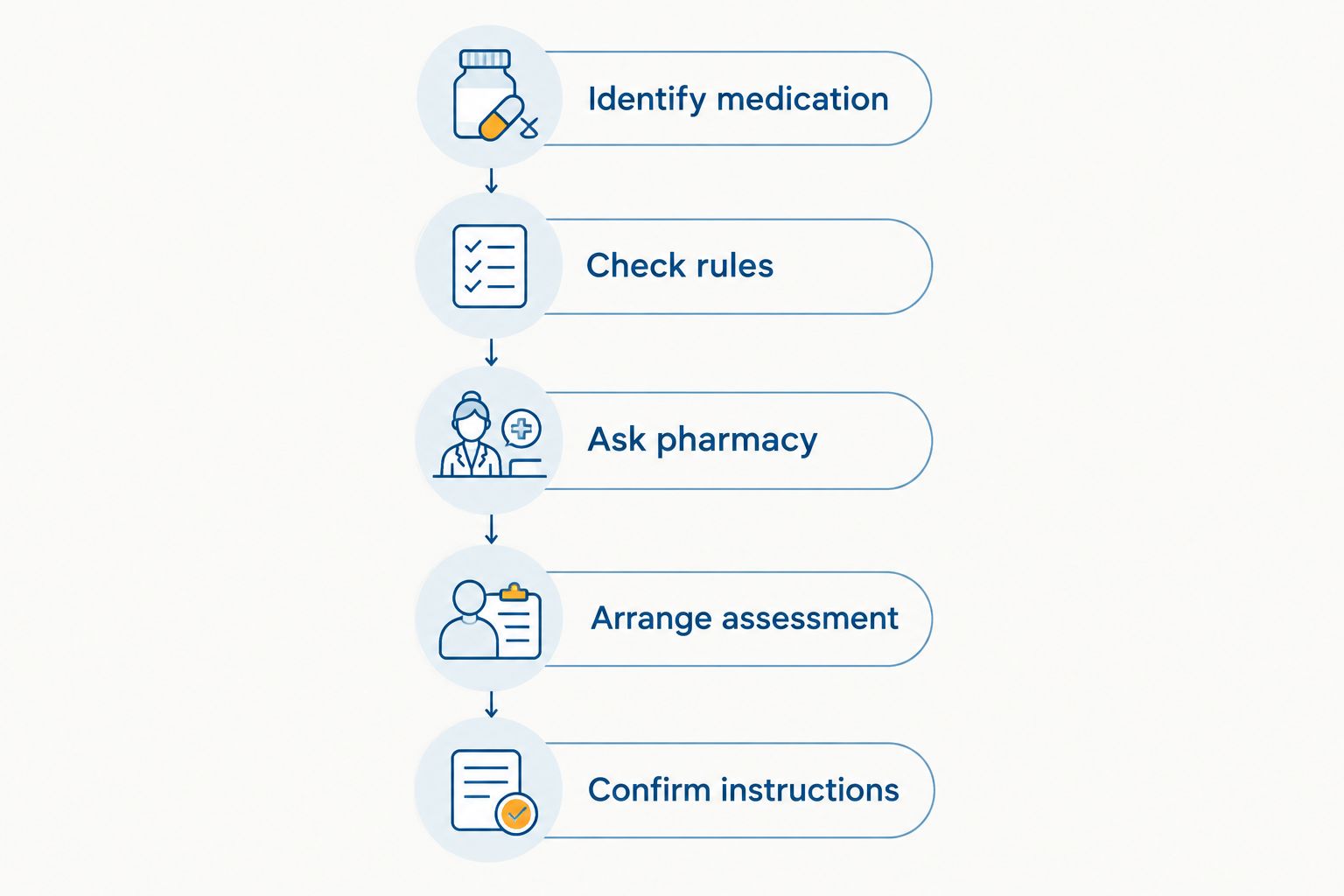
How to arrange a prescription refill abroad
Use these 5 steps to separate legal requirements from clinical decisions. Begin while you still have time to arrange an assessment, rather than waiting until your medication runs out.
1. Identify the exact medication
Write down the generic name, strength, dosage form, and prescribed directions. Include whether the medicine is extended-release, an injection, an inhaler, or another formulation that affects its use.
Keep the original labeled packaging when possible. A photograph of the label provides a backup reference, but it is not a substitute for a legally acceptable prescription.
If you only know the brand name, ask your US pharmacist for the active ingredient before departure. Avoid choosing a replacement by package appearance or a similar-sounding name.
2. Check destination rules
Ask the destination’s health authority or appropriate official source whether your medicine is restricted and whether foreign prescriptions are recognized. Check transit-country rules separately when carrying medication through another country.
Import permission and prescribing authority answer different questions. Being allowed to enter with a personal supply does not mean a local pharmacy can dispense additional medication against your US prescription.
For controlled substances, confirm the specific active ingredient. A broad statement about prescription medicines does not establish the rules for your treatment.
3. Ask a licensed pharmacy
Contact a licensed pharmacy in your destination and explain that your prescription was issued in the United States. Give the generic name and formulation, then ask what prescription and identity documents the pharmacist requires.
Ask directly: Does this pharmacy accept this US prescription, or is a prescription from a locally authorized clinician required? Request clarification if the answer concerns carrying medication rather than obtaining a refill.
A useful conversation establishes the next action. It does not need to resolve your entire medical history over a message or telephone call.
4. Arrange local assessment
If a local prescription is required, arrange an assessment with a clinician authorized to prescribe where you are. Bring your treatment information, allergies, relevant records, and your existing prescriber’s contact details.
The clinician must decide whether continuing the treatment is appropriate. Records support that assessment; they do not require the clinician to reproduce the US prescription.
Describe your remaining supply and any symptoms clearly. If interruption is approaching, explain that when requesting care so the service can assess urgency.
5. Confirm the instructions
Before leaving the pharmacy, ask the pharmacist to explain the dispensed medicine’s active ingredient, strength, formulation, and directions. Compare those details with the local prescription, not just your familiar packaging.
Ask about storage and any instructions you do not understand. If something differs from your usual treatment, resolve it with the pharmacist or prescribing clinician before taking it.
Do not calculate a substitute dose yourself. Different formulations require professional review even when the medicine names look related.
Why prescription refill requirements vary abroad
There is no single international refill rule. These factors determine which questions you need to resolve:
- Destination law: Each jurisdiction sets its own rules for recognizing prescriptions and dispensing medicines.
- Medication classification: Controlled drugs and other restricted medicines require specific checks, not assumptions based on ordinary prescriptions.
- Prescriber authorization: A prescription’s validity depends on whether the issuing clinician is recognized under the applicable local rules.
- Formulation: The active ingredient alone does not establish that a different strength or release mechanism matches your treatment.
- Clinical circumstances: A clinician assesses your current condition, treatment history, and whether prescribing is appropriate.
- Documentation: Legible medication details and relevant records help professionals understand your existing treatment, without overriding legal requirements.
Check these factors for each destination on a multi-country itinerary. An answer from a pharmacy in one country does not establish the rules at your next stop.
What should you bring to a pharmacy or doctor abroad?
Prepare 3 document groups: medication information, clinical background, and identification. Keep them accessible without making your entire medical history available to everyone helping with your trip.
Medication information: Bring the labeled packaging, a copy of your prescription, and a list of generic names, strengths, formulations, and directions. Include relevant storage instructions supplied with the medicine.
Clinical background: Carry a concise treatment summary, allergies, and relevant clinician letters or records. Ask your existing clinician what information a new prescriber would need to assess continued treatment.
Identification and contacts: Bring the identification requested by the local service and your US prescriber’s contact information. Keep 2 contact routes in your travel plan: your home prescribing team and a local healthcare contact.
For your 2026 departure, review the documents against your current treatment. An old medication list that no longer matches what you take creates confusion rather than reassurance.
Keep sensitive records secure. Share medical information directly with the healthcare professional or through the service’s designated process, rather than posting it in travel groups.
Can a pharmacy abroad use a photo of my US prescription?
A photo of your US prescription is supporting information, not automatic authorization to dispense. Whether an image or electronic document is acceptable depends on local rules and the pharmacy’s requirements.
Carry a readable copy, but ask the pharmacy what it needs. Do not assume that showing a pharmacy app, prescription label, or US refill history replaces a locally valid prescription.
Do I need a local doctor if I already have refills remaining?
Remaining US refills do not establish that a pharmacy abroad can dispense your medicine. You need a locally authorized clinician when local requirements call for a new prescription or when clinical assessment is necessary.
Your US prescriber can provide treatment records and answer clinical questions. That support does not automatically give the prescriber authority to practice or prescribe in your destination.
Can I get controlled medication refilled abroad?
Controlled medication requires destination-specific checks before you rely on an overseas refill. The rules for importing your existing supply and obtaining a new prescription are separate.
For a 2026 itinerary involving ADHD medication, sedatives, opioid medicines, or another controlled treatment, confirm the exact ingredient with official destination sources. Do not switch medicines, arrange cross-border shipping, or change your schedule without checking the applicable rules and speaking with your clinician.
Build your healthcare backup before departure
Your backup should identify where to ask about dispensing requirements and where to seek clinical assessment. Save those details alongside your itinerary, not only in an email you will need to search while unwell.
MyAbroadMDs is best for international travelers and study-abroad students who want a curated English-speaking doctor directory before departure. Its subscription-based memberships provide personalized directories of doctors and healthcare providers across 100+ countries.
MyAbroadMDs healthcare preparation does not replace a valid prescription. It is not insurance, telehealth, or a booking service, and directory access does not authorize a clinician to prescribe a particular medicine.
Treat that distinction as part of your planning. MyAbroadMDs helps with identifying healthcare resources; the local clinician and pharmacist make the prescribing and dispensing decisions within their respective roles.
FAQ
Can a pharmacy abroad refill a US prescription in 2026?
A pharmacy abroad can dispense against a US prescription only when local rules and the pharmacy’s requirements allow it. Confirm the requirements for your destination and exact medicine before relying on an overseas refill.
Can my US doctor send a prescription to a pharmacy overseas?
Sending a prescription does not establish that an overseas pharmacy can legally accept it. Ask the pharmacy whether the US prescriber and prescription meet local requirements or whether a local assessment is necessary.
Does a prescription bottle count as a prescription abroad?
A prescription bottle documents your existing treatment but does not automatically satisfy local prescribing requirements. Bring it to help identify the medicine, and ask what additional documentation is required.
Can I use the same brand of medicine in another country?
Do not rely on the brand name alone to identify a replacement medicine abroad. Ask a pharmacist to verify the active ingredient, strength, formulation, and directions against the prescription.
What should I do if I run out of medicine while traveling?
Contact a licensed local pharmacy or healthcare service promptly and explain your medication, remaining supply, and symptoms. Seek urgent medical care if you become seriously unwell, and do not change your treatment without clinical advice.
Can a telehealth appointment get me a refill overseas?
A telehealth appointment results in a usable prescription only if the clinician can legally prescribe for your location and the prescription meets local dispensing rules. Confirm those requirements before treating telehealth as your refill plan.
Does MyAbroadMDs prescribe medication or arrange pharmacy refills?
MyAbroadMDs provides pre-trip healthcare preparation and personalized English-speaking provider directories, not prescribing or pharmacy dispensing. It is not insurance, telehealth, or a booking service.
One last thing
A remaining refill on your US prescription is not a portable permission slip. Before your 2026 departure, ask your clinician and pharmacist to help you document the treatment, then verify the destination’s requirements separately.
Put the generic name beside the brand name in your travel records. That small preparation gives the next pharmacist or clinician a clearer starting point. Before you pack. Not after your supply runs out.