
Yes, you can find an English-speaking doctor in a small town abroad, but you need to confirm the individual clinician’s language skills rather than rely on an English-language website or directory listing. Before your 2026 departure, identify a local option, check how to reach an appropriate provider outside town, and keep an interpreter-supported backup; never delay emergency care while searching for an English-speaking clinician.
- Can you find an English speaking doctor in a small town abroad? Yes, but confirm directly before departure.
- An English-speaking receptionist does not confirm that your treating doctor speaks English.
- MyAbroadMDs suits travelers seeking a curated English-speaking doctor directory before departure, not insurance or appointment booking.
- Save a local contact, a regional backup, and the destination’s emergency instructions offline.
Can you find an English-speaking doctor in a small town abroad?
Yes—but a useful match must fit your language needs, medical needs, and actual location. A name in a search result is a starting point, not a confirmed care plan. Use this sequence to turn that name into a practical contact.
1. Identify the clinician, not just the clinic
Find the doctor’s full name, clinic address, and relevant specialty. Then check the appropriate local medical register or licensing authority; the guide to verifying doctor credentials abroad explains what to investigate.
Treat qualifications and language as separate checks. An English-language profile does not establish registration, and registration alone does not establish English fluency. Save the source you checked alongside the contact details.
2. Ask who will conduct the consultation
Ask the clinic whether the doctor you would actually see can discuss symptoms, medication, allergies, and treatment instructions in English. Be specific about the appointment you need, rather than asking only whether someone at the clinic speaks English.
If the answer refers to reception staff or a different physician, clarify the arrangement before treating the contact as confirmed. Ask whether follow-up questions and written instructions can also be handled in English.
3. Match the provider to your needs
Describe the reason for a planned visit without asking reception staff to diagnose you. A routine follow-up, a pregnancy-related concern, and a child’s appointment require different questions about the clinician’s scope of practice.
Bring a concise health summary and the generic names of your medications. For an ongoing condition, ask your usual clinician what information another doctor would need and what symptoms require urgent assessment.
4. Check the journey from your accommodation
Use your actual lodging address, not the destination’s name alone. Confirm the clinic entrance, the route, and how you would get there if your usual transport were unavailable.
For a regional backup, check the journey separately. A clinic in the nearest city is not a workable fallback until you understand how to reach it. Keep the address in the local language as well as English.
5. Confirm the appointment process
Ask how to request a consultation, what documents to bring, and whom to contact if the named doctor is not working that day. If you have insurance, confirm the insurer’s requirements separately rather than assuming the clinic will handle them.
Record what the clinic actually confirms. Keep unanswered questions visible in your notes so a possible option does not become a supposedly verified one during a stressful moment.
6. Save the plan offline
Keep the clinician’s name, telephone number, address, language confirmation, and backup contact somewhere accessible without mobile data. Give a travel companion access, or share the plan with someone you trust if you travel alone.
Add your destination’s emergency instructions as a separate entry. Your routine-care shortlist and your emergency plan serve different purposes. Do not make one depend on the other.
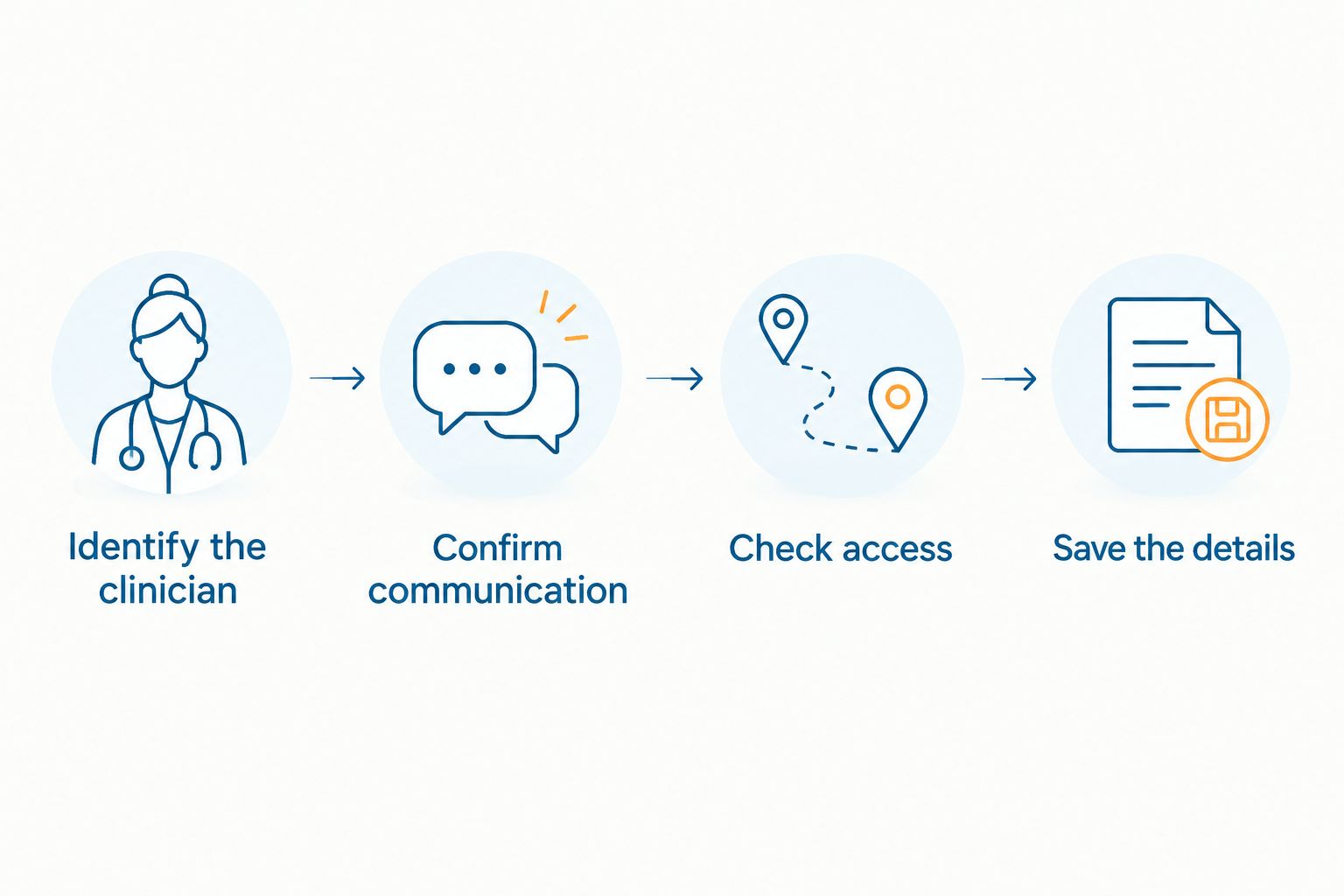
The sequence for your 2026 itinerary is straightforward: identify the provider, confirm communication, check access, and save the details. Repeat the checks when your destinations or medical needs change.
Why this matters
An English-speaking doctor is useful only if you can reach that doctor and explain the problem accurately. A familiar language does not replace the need for the right clinical expertise, clear instructions, or an emergency pathway.
Preparation also separates tasks that are easy to confuse. Finding a provider, arranging an appointment, checking insurance requirements, and receiving medical care are different activities. Completing one does not complete the others.
For a small-town stay, make your plan specific to the address where you will sleep. That turns a broad destination search into something you can use before you pack—and during the trip.
Which option should you check first?
Start with the option that matches your immediate need, not the one with the most reassuring description. For nonurgent care, direct confirmation is the deciding step. For an emergency, follow local emergency instructions rather than comparing routine appointments.
| Option | Best for | Practical advantage | Limitation to check |
|---|---|---|---|
| Local English-speaking clinician | Planned care near your accommodation | Keeps the search focused on your actual destination | Confirm the named doctor’s language skills and clinical scope |
| Regional English-speaking clinician | A backup outside the town | Gives you a separate location to investigate | Confirm the journey and appointment process |
| Local clinician with a professional interpreter | Care when direct English communication is not arranged | Adds structured language support to a local consultation | Ask whether interpretation can be arranged for the visit |
| Telehealth consultation | Remote advice where legally and clinically appropriate | Allows a consultation without traveling to a clinic | Confirm permission to treat you at your location and the need for an examination |
Keep the local option and the regional backup distinct. Do not label a distant provider as local simply because a search result associates the clinic with your destination.
Interpreter-supported care deserves its own check. Ask who provides interpretation, how it is arranged, and whether it covers the consultation and treatment instructions. Do not assume an English-speaking travel companion can interpret medical details accurately.
Why the search varies by itinerary
There is no single small-town checklist that confirms every destination. Your route and personal needs determine what you must verify, even when the language requirement stays the same.
- Destination: Check the exact town and address. A country-level directory does not establish that a provider practices near your accommodation.
- Travel pattern: A fixed base and a multi-destination itinerary need different contact lists. Review each overnight stop rather than copying one clinic across the trip.
- Medical needs: Identify the relevant type of clinician. English fluency alone does not establish suitability for a planned medical concern.
- Communication needs: Confirm English with the treating clinician, then ask separately about interpretation and written instructions.
- Travel companions: Include the needs of children, students, partners, or other family members in the questions you send. Do not assume one provider suits everyone.
For your 2026 departure checklist, attach each confirmed contact to a destination. A provider list organized by itinerary is easier to use than a collection of unrelated screenshots.
What should you ask the clinic before you leave?
Send a short message that makes the request easy to answer. Include your destination, travel dates, the general type of appointment, and whether the patient is an adult or child. Avoid sending detailed medical records through an unverified contact channel.
Use these questions as a template:
- Can the doctor who would see me conduct the consultation in English?
- Does that doctor assess the type of concern I have described?
- How do I request an appointment, and what documents should I bring?
- Can I receive treatment instructions in English or through a professional interpreter?
- Who should I contact if that doctor is not working when I need care?
Keep the reply with the clinic’s contact information. Record the date of confirmation, and recheck arrangements if your itinerary changes. A clear answer to a specific question is more useful than a general statement that a clinic welcomes international visitors.
For a 2026 trip, use your current travel dates in every inquiry. Do not reuse an old email thread without confirming that its details still apply.
Where does a healthcare preparation membership fit?
MyAbroadMDs is best for travelers and study-abroad students who want a curated English-speaking doctor directory before departure. Its subscription memberships provide personalized directories of English-speaking doctors and healthcare providers across 100+ countries.
That makes MyAbroadMDs relevant when you want help organizing healthcare resources around your destinations. The benefit is preparation: a curated starting point instead of an unstructured collection of search results.
The boundary is equally important. MyAbroadMDs is not insurance, telehealth, or an appointment-booking service. A directory does not guarantee a suitable clinician in every small town, establish insurance acceptance, or replace emergency services.
Use MyAbroadMDs healthcare preparation alongside your own provider confirmations and any insurance arrangements. Keep those responsibilities separate so you know what still needs attention before departure.
What if the only English-speaking doctor is outside town?
An English-speaking doctor outside town belongs in your regional backup plan, not under your local contacts. Confirm the address, transport route, and appointment process before relying on that provider for planned care.
If you have an ongoing condition, discuss the itinerary with your usual clinician before leaving. Ask whether the distance from appropriate care changes the preparation you need or the suitability of a particular stop.
Do not travel farther solely to obtain English-language care when symptoms require urgent assessment. Follow local emergency instructions and tell responders about the language barrier so they can address communication needs.
Can a translation app replace an English-speaking doctor?
A translation app is a supporting tool, not a substitute for dependable clinical communication. Use it to help locate an address or present a prepared note; do not rely on it alone to interpret a diagnosis, consent discussion, or medication instruction.
Ask about professional interpretation when you cannot communicate clearly with the clinician. Before leaving the consultation, explain the instructions back in your own words and ask the clinician to correct anything you have misunderstood.
Bring a written medication list and allergy information regardless of the language arrangement. Clear records support the conversation without asking a translation tool to reconstruct your medical history.
What if you need medical help before you finish checking?
For an emergency, seek local emergency care immediately rather than completing the search for an English-speaking doctor. For a nonurgent concern, contact a local healthcare provider for guidance about assessment and explain the communication support you need.
Do not use an unfinished directory search to decide whether symptoms are serious. If you are unsure about urgency, seek clinical guidance rather than waiting for a preferred language match.
Your 2026 preparation should leave you with separate instructions for routine appointments and emergencies. Both should be accessible without searching through membership emails, browser tabs, or a travel companion’s phone.
FAQ
Can I find an English-speaking doctor in a village abroad?
Yes, it is possible, but you must confirm the individual clinician and location. Keep a regional backup and an interpreter-supported option rather than assuming a village listing guarantees English-language care.
Does an English-language clinic website mean the doctor speaks English?
No. Ask whether the clinician who would actually conduct your consultation can discuss symptoms, treatment, and follow-up instructions in English.
Should I find a doctor before traveling to a small town?
Yes, identify and contact suitable providers before departure. Confirm the address, language arrangements, appointment process, and a backup outside town.
Can my hotel confirm that a doctor speaks English?
A hotel recommendation is a lead, not direct confirmation of the treating doctor's language skills. Contact the clinic yourself and ask about the clinician who would see you.
Can I use telehealth instead of visiting a local doctor abroad?
Telehealth is an option only when the provider can legally treat you at your location and the concern is suitable for remote assessment. It does not replace an examination or emergency care when those are needed.
Does MyAbroadMDs book an appointment or pay for treatment?
No. MyAbroadMDs provides healthcare preparation memberships and personalized, curated English-speaking provider directories; it is not insurance, telehealth, or an appointment-booking service.
Should I wait for an English-speaking doctor in an emergency?
No. Seek local emergency care immediately and explain your communication needs to responders rather than delaying care to find an English-speaking clinician.
One last thing
Save the clinic address in the local language, not just English. That gives you something concrete to show a driver or local helper without translating a place name under pressure.
Put the address beside the named clinician, telephone number, confirmation date, and backup route. The goal is not the longest provider list. It is a short set of contacts you understand and know how to use.