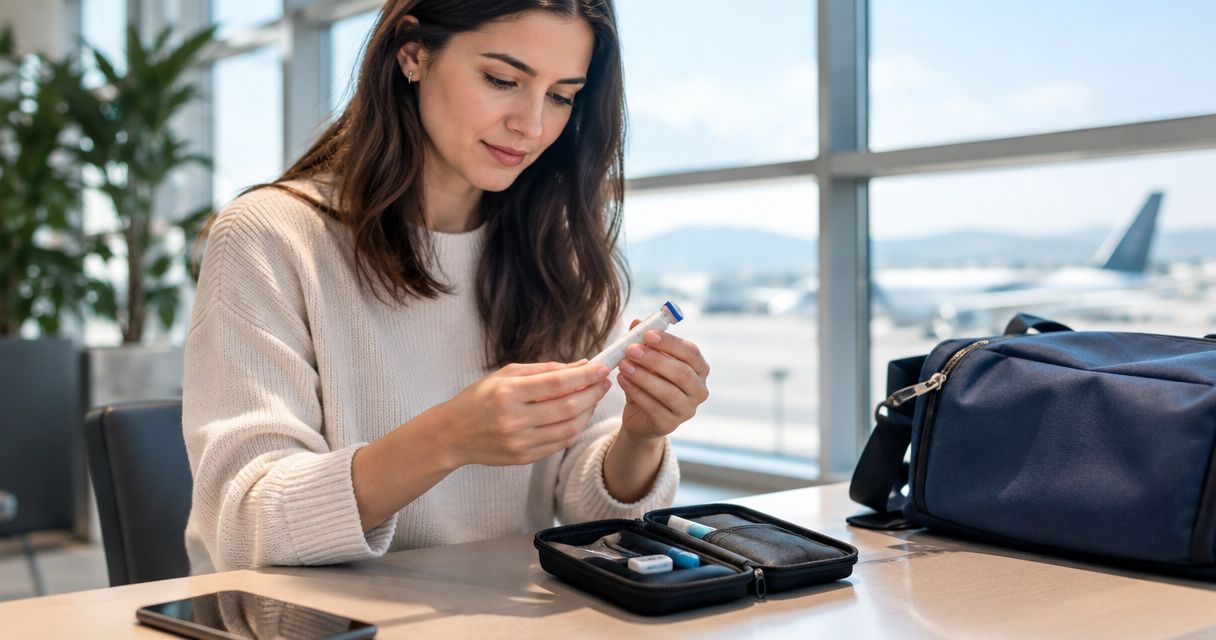
Many insulin products can stay unrefrigerated for 28 days while traveling, but the exact limit depends on the insulin and its container. That allowance applies only within the temperature limits on the product label; it does not cover a hot car, direct sunlight, or freezing. For your 2026 trip, check the instructions for your exact vial or pen before deciding whether you need continuous refrigeration.
- How long can insulin stay unrefrigerated while traveling? Many products allow 28 days; your exact product label controls.
- Lantus allows 28 days below 86°F; Tresiba allows 56 days at temperatures up to 86°F under labeled conditions.
- Refrigerating insulin again does not restart its room-temperature storage allowance.
- MyAbroadMDs suits travelers preparing an English-speaking doctor directory before departure; it does not provide insulin or insurance.
Why this matters
An insulin storage allowance is not a guarantee that every travel environment is safe. Your medicine can remain within its permitted number of days and still experience temperatures outside its labeled limits.
Separate two questions before departure: how long the insulin can remain outside refrigeration, and how you will keep it within its permitted temperature range. A travel case for insulin and injectable medications addresses the packing question, but the product label determines the storage limit.
Plan around the medicine, not the length of the flight. Your transfer, sightseeing day, and hotel storage all belong in the same plan.
How long can insulin stay unrefrigerated while traveling?
Many commonly used insulin products have a 28-day room-temperature allowance. Others have different limits, so there is no single safe deadline for every insulin, pen, cartridge, vial, or pump reservoir.
The examples below come from the manufacturers’ U.S. prescribing information and patient storage instructions for Lantus and Tresiba. For 2026 travel planning, check the current instructions supplied with your exact product, especially if your prescription was dispensed outside the United States.
| Insulin and container | Labeled unrefrigerated limit | Temperature condition | Important distinction |
|---|---|---|---|
| Lantus U-100 vial | 28 days | Below 86°F, or 30°C | An opened vial can also be refrigerated; discard after its labeled in-use period |
| Lantus SoloStar pen | 28 days | Below 86°F, or 30°C | An in-use pen must not be refrigerated |
| Tresiba U-100 vial or FlexTouch pen; U-200 FlexTouch pen | 56 days | Up to 86°F, or 30°C | Follow the storage instructions for the exact presentation and whether it is in use |
These are product examples, not interchangeable treatment choices. Do not switch insulin, concentration, or delivery device to gain a longer storage window without your prescriber’s instructions.
For unopened supplies, the expiration date on the package applies only when the required storage conditions have been maintained. Once you begin room-temperature storage, follow the applicable room-temperature deadline rather than assuming the printed expiration date still controls.
Lantus: 28 days below 86°F
Lantus has a 28-day room-temperature limit below 86°F, equivalent to 30°C. Sanofi’s U.S. Lantus instructions distinguish between vials and SoloStar pens, including whether an opened container can return to the refrigerator.
An opened Lantus vial can be stored in the refrigerator or below the stated room-temperature limit. An in-use Lantus SoloStar pen must be kept out of the refrigerator and protected from heat and light.
The practical benefit is that a labeled room-temperature allowance can simplify daily travel. The limitation is that “room temperature” does not include every place you carry a bag, particularly a parked vehicle or a sun-exposed compartment.
Best for planning: use the Lantus instructions matching your vial or SoloStar pen. Do not apply a vial’s refrigeration instructions to a pen simply because the insulin name is the same.
Tresiba: 56 days at temperatures up to 86°F
Tresiba has a 56-day storage allowance at temperatures up to 86°F, equivalent to 30°C, under its U.S. labeling. Novo Nordisk’s instructions cover its U-100 vial and its U-100 and U-200 FlexTouch pens.
That longer labeled allowance does not make Tresiba heatproof. Protection from excessive heat, direct light, and freezing still matters throughout your itinerary.
A longer storage window offers more time outside refrigeration under the specified conditions. Its limitation is unchanged: the allowance cannot validate an unknown temperature excursion or replace instructions for another insulin.
Best for planning: if Tresiba is already prescribed to you, record its applicable storage deadline before departure. Do not treat its 56-day allowance as a rule for all long-acting insulin.
Why insulin’s unrefrigerated limit varies
Your safe storage plan depends on more than the name printed on your prescription. Check these factors against the instructions for the medicine you actually carry:
- Insulin formulation: different insulin products have different labeled stability and storage requirements.
- Container: a vial, disposable pen, cartridge, and pump reservoir can have different instructions.
- Opened status: unopened refrigerated stock and an in-use container do not necessarily share the same deadline.
- Temperature exposure: permitted storage time applies only within the specified temperature conditions.
- Handling history: freezing, direct sunlight, or an uncertain storage history requires separate assessment.
Use the most specific instructions available. A general insulin travel guide cannot override your product’s patient leaflet, pump instructions, or advice from a pharmacist assessing a particular storage incident.
How to prepare insulin for your 2026 itinerary
Build your storage plan before you choose your packing setup. Start with the prescription, then match the equipment and destination arrangements to it.
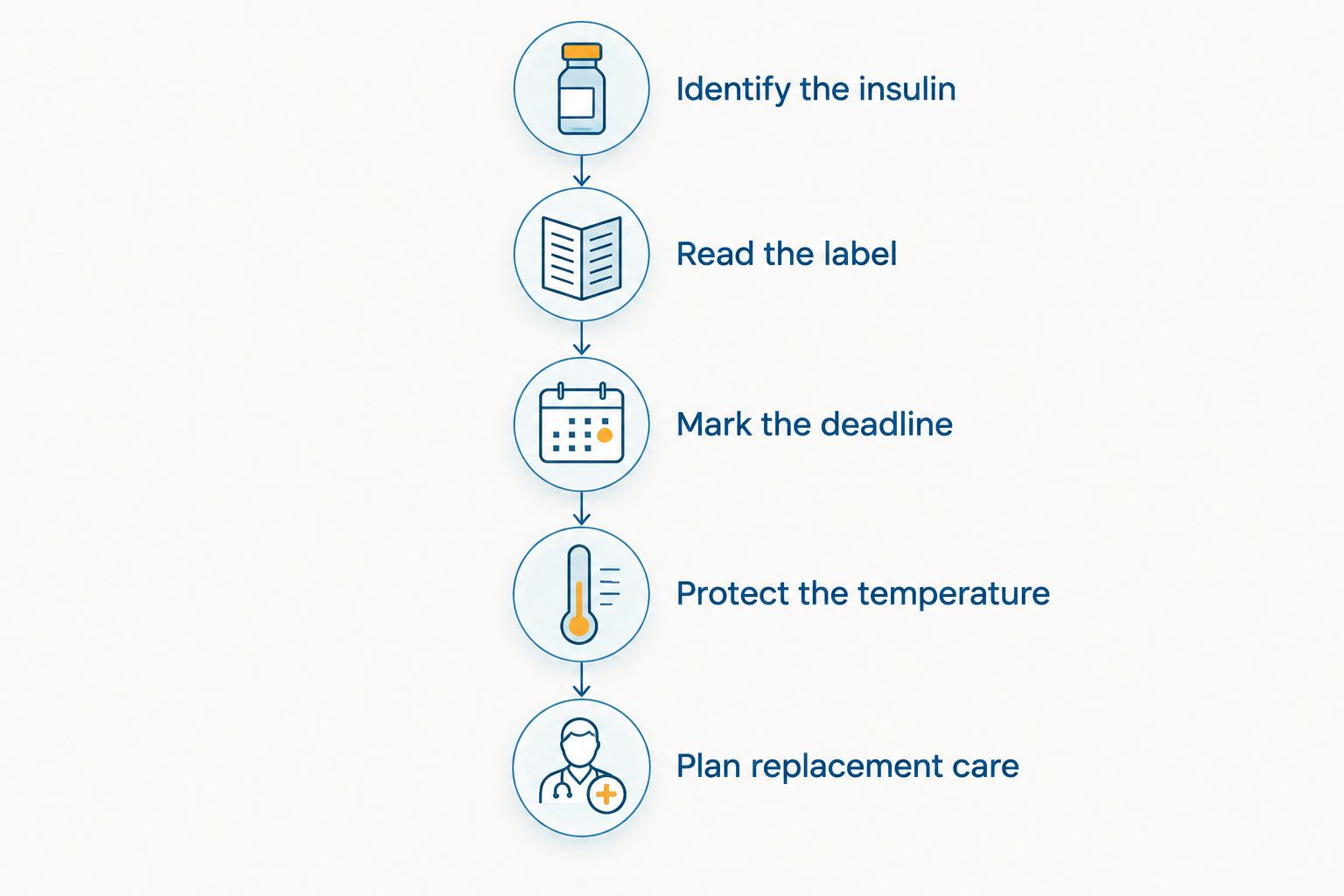
- Identify the insulin. Record the full name, concentration, and container type. Photograph the pharmacy label and package details so you can show a clinician or pharmacist exactly what you use.
- Read the label. Find the unopened, in-use, refrigeration, and room-temperature instructions. Ask your pharmacist to explain any difference between the vial and pen directions.
- Mark the deadline. Record when the applicable storage period starts and the corresponding discard date. Keep that information with the medicine rather than only in your memory.
- Protect the temperature. Choose a packing method that prevents both overheating and freezing. If refrigeration is necessary, check how it will work during transfers as well as at your destination.
- Plan replacement care. Ask your diabetes team what to do if insulin is lost, damaged, or exposed to an uncertain temperature. Carry the contact details and treatment information needed to seek local help.
A useful 2026 packing check is whether your plan still works during an unexpected delay. Access to a refrigerator at your final hotel does not resolve a long transfer in hot weather.
How should you carry insulin on a flight?
Keep insulin and essential diabetes supplies in your carry-on baggage. Checked baggage can become separated from you, and its storage conditions are outside your control.
Keep the medicine accessible rather than packing it beneath items you cannot easily move. Preserve the identifying packaging or pharmacy label, and check departure, transit, and destination requirements before your 2026 flight.
If your insulin requires cooling, prevent direct contact with frozen packs. A cooling setup that freezes the medicine defeats its purpose; an insulated pouch by itself also does not prove that the temperature stayed within the labeled range.
Ask your pharmacist how to position your specific medicine within your chosen cooler. For journeys requiring controlled storage, a suitable thermometer helps you check conditions instead of judging them by how the bag feels.
Can insulin go back in the refrigerator after traveling?
Returning insulin to a refrigerator does not restart its room-temperature allowance. Follow your product’s instructions about whether returning it to refrigeration is permitted at all.
The distinction matters with Lantus: an opened vial can be refrigerated, while an in-use SoloStar pen must not be refrigerated. Keep the original applicable discard deadline even when refrigeration is allowed.
At your accommodation, check the actual storage temperature rather than assuming every minibar is suitable. Keep insulin away from freezer compartments and surfaces where it can freeze, and do not leave it in a room refrigerator without a way to assess whether that storage meets its instructions.
What if insulin gets too hot or freezes abroad?
Insulin that has frozen must not be used, even after it thaws. For suspected overheating, note the product, approximate exposure, duration, and any temperature reading, then contact a pharmacist or the manufacturer for product-specific guidance.
Appearance alone cannot establish that insulin remains effective. Follow the product’s appearance instructions, but do not assume that normal-looking insulin has survived an uncertain temperature excursion.
Do not create a treatment gap while trying to solve a storage problem. Contact your diabetes team or local medical care promptly for a replacement and dosing plan; do not make unsupervised dose changes to compensate for suspected loss of potency.
Follow your prescribed sick-day and ketone-testing plan if glucose rises unexpectedly. Vomiting, abdominal pain, deep or difficult breathing, confusion, or other signs of diabetic ketoacidosis require urgent medical assessment, not a search for a better cooler.
Who can help if you need insulin abroad?
A local clinician or pharmacist can help assess replacement options and the prescription requirements at your destination. Bring the insulin’s full name, concentration, device details, and your current treatment instructions; do not rely on a familiar brand name being sufficient.
MyAbroadMDs is best for travelers who want a personalized directory of English-speaking healthcare providers before departure. Its travel healthcare preparation memberships provide curated provider directories across 100+ countries, not insulin supplies or medical treatment.
MyAbroadMDs is not insurance, telehealth, or a booking service. A provider directory helps you prepare contacts; it does not replace your diabetes team’s storage advice, arrange a visit, or guarantee a replacement prescription.
For your 2026 departure, use MyAbroadMDs travel healthcare preparation alongside a medicine-specific plan. Confirm the clinical and pharmacy arrangements separately. Before you pack. Not after a storage problem interrupts the itinerary.
FAQ
How long can insulin stay unrefrigerated while traveling?
Many insulin products allow 28 days outside refrigeration within their labeled temperature limits, but the exact deadline depends on the product and container. Check your specific patient leaflet; a room-temperature allowance does not cover overheating or freezing.
Can unopened insulin stay out of the refrigerator?
Some unopened insulin products have a labeled room-temperature storage allowance. Follow the exact product instructions and applicable deadline rather than relying only on the printed expiration date.
Does putting insulin back in the fridge reset the clock?
No, putting insulin back in the refrigerator does not restart its room-temperature storage allowance. Some in-use products, including Lantus SoloStar pens, must not be refrigerated.
Can I use insulin that froze and then thawed?
No, insulin that has frozen must not be used after thawing. Contact your diabetes team or local medical care promptly for replacement and treatment instructions so you do not interrupt essential insulin therapy.
Is an insulin travel cooler enough for a hot destination?
A travel cooler alone does not establish that insulin stayed within its labeled temperature range. Match the cooling setup to the medicine’s instructions, prevent freezing, and check temperatures when controlled storage is required.
Can insulin go in my checked suitcase?
Keep insulin in your carry-on baggage rather than your checked suitcase. This keeps essential treatment with you and avoids relying on baggage storage conditions or timely baggage arrival.
Can I switch to an insulin with a longer unrefrigerated limit?
Do not switch insulin, concentration, or delivery device without your prescriber’s instructions. A longer labeled storage allowance is not a reason to change your treatment independently.
One last thing
Your insulin has two separate limits: time and temperature. Meeting the time limit does not cancel a temperature problem, and keeping it cool does not erase an applicable discard deadline.
Before your 2026 departure, write the full product name, permitted temperature, and discard date together. That small record is more useful than remembering that insulin is generally good for “about a month.” Keep a copy with your medication and another with your travel health documents.