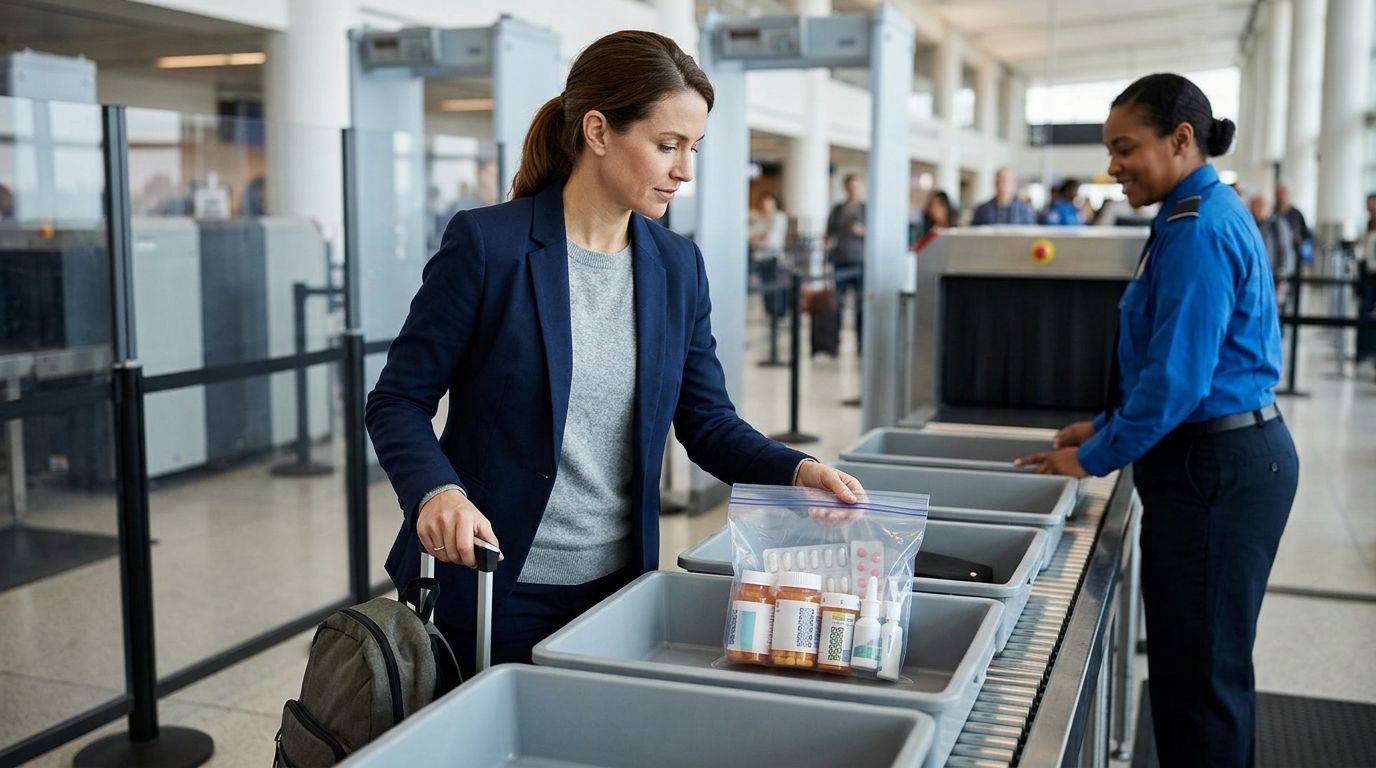
Yes. You can bring prescription medication through U.S. airport security in your carry-on or checked baggage, subject to TSA screening. Medically necessary liquids can exceed the usual 3.4-ounce (100-milliliter) carry-on limit when you declare them for inspection, but clearing security does not establish that your medication is legal at your destination.
- Can you bring prescription medication through airport security? Yes: TSA permits it, subject to screening.
- Declare medically necessary liquids above 3.4 ounces before screening; destination import rules remain separate.
- Keep prescription labels and check controlled-drug rules before departure.
- Myabroadmds suits travelers seeking English-speaking doctor directories before departure, not insurance or prescription dispensing.
Can you bring prescription medication through airport security?
Yes. TSA permits prescription medication, but the screening process depends on what you carry. Tablets, liquid medicines, injectable medicines, and cooling supplies do not all follow the same procedure. These distinctions apply to U.S. security checkpoints; another country's airport authority sets its own requirements.
For longer international itineraries, also review traveling with prescription medication for digital nomads. Passing the departure checkpoint is only one part of medication planning.
| Medication or supply | What TSA permits | Main advantage | Limitation to plan for |
|---|---|---|---|
| Tablets and capsules | Solid medication in carry-on or checked baggage, subject to screening | Ordinary liquid restrictions do not apply | Destination drug laws still apply |
| Liquid medication | Medically necessary quantities above the ordinary carry-on liquid limit | Necessary medicine can travel in your cabin bag | Declare it; additional screening can follow |
| Injectable medication | Injectable medicine and associated unused syringes, subject to screening | Treatment supplies can stay together | Declare unused syringes and present them with the medicine |
| Medical cooling supplies | Medically necessary ice packs, freezer packs, and gel packs, subject to screening | Supports transport of temperature-sensitive medicine | Security permission does not establish safe storage temperature |
TSA's Medications (Pills), Medications (Liquid), Unused Syringes, and Disabilities and Medical Conditions guidance are the relevant U.S. screening references for your 2026 departure planning. Check the applicable guidance before traveling, especially when your medication requires equipment or refrigeration.
Why this matters
Airport security, airline baggage rules, and medication import laws answer different questions. Security determines whether an item can pass through the checkpoint. Customs and destination authorities determine whether you can bring that medicine into the country.
A prescription is evidence of treatment, not universal permission to cross a border with a drug. An ordinary medicine at home can face restrictions elsewhere. Transit stops also deserve attention, particularly when your itinerary requires collecting baggage or entering the connecting country.
For a 2026 international trip, organize your checks around the entire itinerary. Include the return journey, not just your first departure.
Tablets and capsules: keep identification with the medicine
TSA does not require prescription tablets to remain in their original bottles. State laws concerning prescription labeling can differ, however, and international authorities can require original packaging or supporting documents.
Best for international travel: keep tablets in their labeled pharmacy packaging. The label connects your name, medicine, and dosing instructions. Its limitation is bulk, especially when you take several medicines, but a pill organizer alone does not preserve that identification.
Carry a medication list that records the generic name, strength, and prescribed dose. Brand names differ between countries; the active ingredient gives a clinician or pharmacist a clearer starting point. Keep a copy of the prescription where you can retrieve it without opening your checked luggage.
Do not combine different medicines in an unmarked container to save space. Even when a checkpoint permits the container, you still need to identify the contents accurately if a clinician, pharmacist, or border official asks.
Liquid medication: declare the medical exception
For ordinary carry-on liquids, TSA uses a 3.4-ounce (100-milliliter) container limit and a 1-quart liquids bag. Medically necessary liquids are an exception: TSA permits reasonable quantities above the ordinary limit for the trip, subject to screening.
Tell the officer about the liquid medication at the start of screening. Present it separately from your other belongings as directed. Medically necessary liquids do not have to fit inside the ordinary liquids bag.
Best for liquid prescriptions: make the medical purpose clear before inspection begins. Keep the pharmacy label attached and the container accessible. The exception allows necessary medicine through screening; it does not remove the officer's responsibility to inspect it.
Avoid transferring prescription liquid into an unmarked travel bottle merely to meet ordinary toiletry rules. You lose useful identification without necessarily needing to reduce the container size. Destination authorities can impose separate documentation and quantity requirements.
Injectable medication: present supplies together
TSA permits unused syringes when they accompany injectable medication. Declare them to the security officer for inspection, and keep the medicine and associated supplies together so their purpose is clear.
Best for injectable prescriptions: use a clearly organized medication pouch with the labeled medicine. This makes inspection easier to manage and keeps essential treatment supplies accessible. It does not exempt needles, devices, or liquids from screening.
Used syringes require a sharps container or another similar hard-surface container under TSA guidance. Do not place loose used needles in your bag. Ask your clinician or pharmacist about safe disposal during the trip as well as transport through the airport.
For pumps, continuous glucose monitors, and other medical devices, check the manufacturer's screening instructions before departure. Tell the officer about your device before screening starts rather than assuming every device can follow the same process.
Refrigerated medication: screening permission is not temperature control
TSA permits medically necessary cooling accessories, including ice packs and gel packs. Tell the officer that they support your medication; partially frozen or slushy packs can require additional screening.
The checkpoint cannot tell you whether your medicine stayed within its approved temperature range. Get storage instructions for the exact medication from its labeling, your pharmacist, or your prescriber. Different medicines have different limits, and freezing can also damage some products.
Best for temperature-sensitive prescriptions: plan the full journey, not just the flight. Include ground transport, security queues, connections, and arrival arrangements. A cooling case is useful only when its conditions match the medicine's storage requirements.
Do not assume an aircraft crew or hotel can provide appropriate medication storage. Confirm arrangements in advance and have a practical alternative. If temperature exposure becomes uncertain, ask a pharmacist or prescriber whether the medicine remains usable rather than judging it by appearance.
How should you prepare before airport security?
Use this sequence for a 2026 departure. Resolve legal and clinical questions before choosing how to pack.
- Check destination rules. Identify each medicine by active ingredient, then consult the destination's embassy, consulate, or relevant medicines authority. Ask about restrictions, permits, documentation, and permitted quantities. Include transit countries where applicable.
- Gather documents. Keep pharmacy labels, prescription copies, and any required clinician letter or import authorization together. Make the medicine names and traveler identity easy to match. A document required by one country is not automatically sufficient elsewhere.
- Pack accessible medication. Keep essential doses and necessary supplies where you can reach them. Carry-on storage reduces dependence on checked-baggage delivery, but you still need to comply with screening and airline requirements.
- Declare medical liquids. At the checkpoint, tell the officer about medically necessary liquids, cooling packs, and injectable supplies before screening begins. Ask how to present them. Do not wait until an officer discovers an unexplained item.
- Plan local care. Know how you will seek medical advice if medicine is lost, damaged, or unavailable. A foreign prescription is not a guarantee that a local pharmacy can dispense the same medicine.
Keep the finished plan accessible offline. A saved document is more useful at a checkpoint than information you can retrieve only after finding a reliable connection.
Why medication screening requirements vary
There is no single packing instruction that covers every prescription. These factors change what you need to explain, present, or verify:
- Medication form. Tablets do not use the same liquid-screening exception as a prescription solution. Injectable medicines also bring associated supplies into the inspection.
- Cooling requirements. Ice packs and other medical cooling accessories need their own explanation at screening. Your medicine's storage instructions remain a separate concern.
- Screening method. Medication normally undergoes security screening. Requests for visual inspection or alternative handling need to be raised before the item enters the X-ray process.
- Controlled-drug status. Security permission does not override national restrictions on controlled medicines. Check the active ingredient rather than relying on a familiar brand name.
- Route and quantity. Entry and transit requirements depend on the countries involved. A supply appropriate for your treatment still needs to meet applicable import rules.
For 2026 travel, ask the authority responsible for each issue. TSA answers U.S. checkpoint questions; destination authorities answer import questions; your clinician or pharmacist answers treatment and storage questions.
Will TSA require my prescription bottle?
TSA does not require prescription pills to be in prescription bottles. That U.S. checkpoint rule does not remove state labeling requirements or another country's entry requirements.
Keep original labels when traveling internationally. They are useful evidence of what you carry, but they do not replace an import permit when one is required. A photograph of a bottle is useful backup, not a universal substitute for the original packaging.
Does airport approval mean I can refill the medication abroad?
No. Airport approval does not establish refill eligibility abroad. A local clinician must work within local prescribing rules, and a pharmacy must follow local dispensing requirements.
The same brand, formulation, or active ingredient is not guaranteed to be obtainable at your destination. Before departure, discuss continuity of treatment with your prescriber. Do not change doses or substitute medicines solely to stretch a travel supply.
Prepare a local-care backup before departure
Myabroadmds provides subscription-based, personalized directories of English-speaking doctors and healthcare providers across 100+ countries. Myabroadmds is best for international travelers and study-abroad students who want a curated English-speaking doctor directory before departure.
The benefit is preparation: you can identify healthcare contacts alongside your itinerary. The limitation is equally important. This is not insurance, telehealth, or a booking service, and directory access does not provide medical treatment or guarantee a replacement prescription.
If finding local care is the gap in your 2026 medication plan, review Myabroadmds before leaving. Keep your medication records ready for any clinician you later consult; a directory cannot replace those records.
FAQ
Can I bring prescription medication in my carry-on bag?
Yes. TSA permits prescription medication in carry-on baggage, subject to screening. Keep essential medicine accessible and declare medically necessary liquids above the ordinary carry-on limit.
Do I have to put prescription pills in the original bottle?
TSA does not require prescription pills to remain in their original bottles. State labeling laws and destination entry requirements can differ, so original labeled packaging is the clearest choice for international travel.
Can liquid medication exceed 3.4 ounces at airport security?
Yes. TSA permits medically necessary liquids above 3.4 ounces in reasonable quantities for the trip, subject to screening. Declare them before screening; they do not have to fit in the ordinary liquids bag.
Can I take prescription needles and syringes on a plane?
TSA permits unused syringes when they accompany injectable medication. Declare them for inspection, and transport used syringes in a sharps container or similar hard-surface container.
Can I ask for medication to be inspected without X-rays?
You can request a visual inspection of medication before screening begins. Tell the officer before the medication enters the X-ray process, and expect additional screening when required.
Can I bring ice packs for refrigerated medication?
TSA permits medically necessary ice packs and gel packs, subject to screening. Explain their medical purpose, and follow the medication's own storage instructions throughout the journey.
Does passing TSA mean my medicine is legal overseas?
No. Passing TSA screening does not establish that your medication is legal to import into another country. Check destination and applicable transit requirements before departure.
Can Myabroadmds replace a prescription I lose abroad?
Myabroadmds provides curated English-speaking healthcare provider directories, not prescription dispensing. A local clinician or pharmacist determines what treatment and dispensing are permitted under local rules.
One last thing
A cabin bag can become a checked bag at the gate. Keep essential medication and its documents in a smaller pouch you can remove before handing over your luggage. Packing medicine in your carry-on only helps if it stays with you.
Before you pack, separate the questions: Can it pass security? Can it enter the country? Can it stay usable throughout the journey? Answering all of them is the preparation that matters.