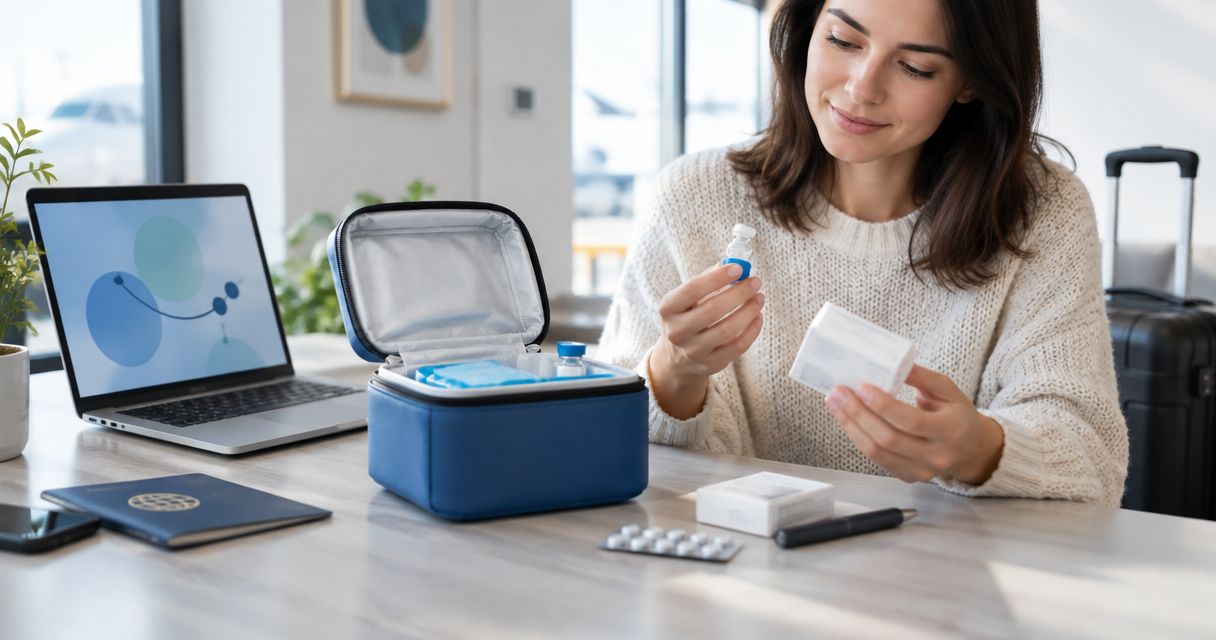
Instead of searching for a doctor and reconstructing storage details after a cooler problem, prepare a refrigerated medication replacement prescription abroad workflow before departure. This 2026 guide takes you from a temperature concern to professional assessment, a local prescribing decision, and a documented pharmacy handoff.
- A refrigerated medication replacement prescription abroad starts with storage assessment, then a local prescribing decision—not an automatic refill.
- MyAbroadMDs suits travelers preparing an English-speaking doctor directory before departure; it does not prescribe or book appointments.
- Keep medication identification, temperature history, and prescribing records together for the clinician and pharmacist.
- Get individualized advice before using potentially damaged medicine or changing scheduled treatment.
Why this matters
A refrigerated medicine problem creates 2 separate decisions: whether the existing medicine remains usable and how to continue treatment if replacement is necessary. A photograph, an intact seal, or a cooler that feels cold does not settle either question.
MyAbroadMDs is best for travelers who want a curated English-speaking doctor directory before departure. Its subscription-based memberships provide personalized directories across more than 100 countries. That supports preparation; it does not replace clinical assessment.
Use MyAbroadMDs for pre-trip doctor-directory preparation, not as an emergency response channel. The service is not insurance, telehealth, or an appointment-booking service.
For your 2026 itinerary, separate the directory, the medical decision, and any insurance questions. You arrange care directly with the provider. A clinician determines appropriate treatment, and a pharmacist handles dispensing under local rules.
Before you start
- Gather the medication evidence. Bring the original labeled packaging, prescription details, prescriber contact information, and the product-specific storage instructions. Record the active ingredient, strength, formulation, device, and whether the medicine has been opened.
- Prepare access and communication. Keep readable copies of relevant medical records, a way to contact your usual care team, and local clinician and pharmacy contact details. Save essential information somewhere accessible without mobile data.
- Pre-empt the prescribing gap. Do not assume a foreign prescription can be dispensed locally. Ask the destination pharmacy what prescription documentation it accepts before your next dose becomes urgent.
Set up these materials for every destination on your 2026 route. A stopover, cruise port, and final destination can involve different prescribing and import requirements. Check destination rules through official government sources, and verify dispensing requirements directly with a licensed local pharmacy.
Medication record
Create 1 medication record per product in a document you control. The bold labels below are suggested document headings, not buttons or settings in a membership portal.
- Record the identity. Under Medication identity, copy the active ingredient, brand name, strength, dosage form, and device from the packaging. Photograph the label clearly enough that a clinician can read it.
- Record the treatment. Under Treatment instructions, copy your prescribed dose and schedule exactly. Add the reason for treatment and relevant allergies from your existing records; do not reconstruct a dose from memory when documentation exists.
- Record the handling. Under Storage history, note when the medicine left controlled storage, whether it was opened, and any thermometer readings. Distinguish measured temperatures from guesses.
- Record the contacts. Under Care contacts, list your usual prescriber, dispensing pharmacy, and the destination provider you intend to contact. Include how each can receive records securely.
Expected result: You have a readable medication record that identifies the treatment and separates known storage conditions from unknown ones.
For a cleaner clinical handoff, use the guide to connecting your medical records to a doctor abroad. Send sensitive information through a channel the receiving provider confirms, rather than posting records into an unverified message thread.
Do not put every medicine under a generic refrigeration rule. Storage instructions can differ by product, formulation, and whether the medicine is unopened or in use. Copy the instructions for the exact product you carry.
Storage assessment
Treat an uncertain temperature history as a question for a qualified professional, not a reason to improvise a replacement dose.
- Document the event. Write down what happened: a refrigerator stopped working, a bag was delayed, a cooling pack touched the medicine, or a temperature reading fell outside the labeled conditions. Include the time and location when known.
- Protect the evidence. Keep the packaging, dispensing label, and temperature records. Avoid further exposure outside the labeled storage conditions while seeking advice; putting medicine back in a refrigerator does not establish that the earlier exposure was acceptable.
- Request product-specific advice. Contact a pharmacist, your prescriber, or the manufacturer's medical information service. Give the exact product identity and exposure history, including uncertainty.
- Ask about the treatment clock. Tell the clinician when your next prescribed dose is due. Ask what to do while usability or replacement is being assessed, rather than independently skipping, doubling, or substituting treatment.
Expected result: You have professional advice about the affected medicine, or a clear referral for further assessment. You also know who is responsible for advising on your next dose.
A normal appearance is not proof that temperature-sensitive medicine remains suitable. Likewise, an excursion does not establish that every product needs replacement. The exact product and exposure history determine the assessment.
Seek urgent local medical care for severe symptoms or an immediate treatment concern. Do not wait for a routine directory inquiry or an email response when urgent assessment is needed.
Local prescribing and pharmacy handoff
Use 3 handoffs to organize the replacement pathway: storage evidence to the assessor, treatment records to the clinician, and the prescription to the pharmacy. Keep each handoff explicit.
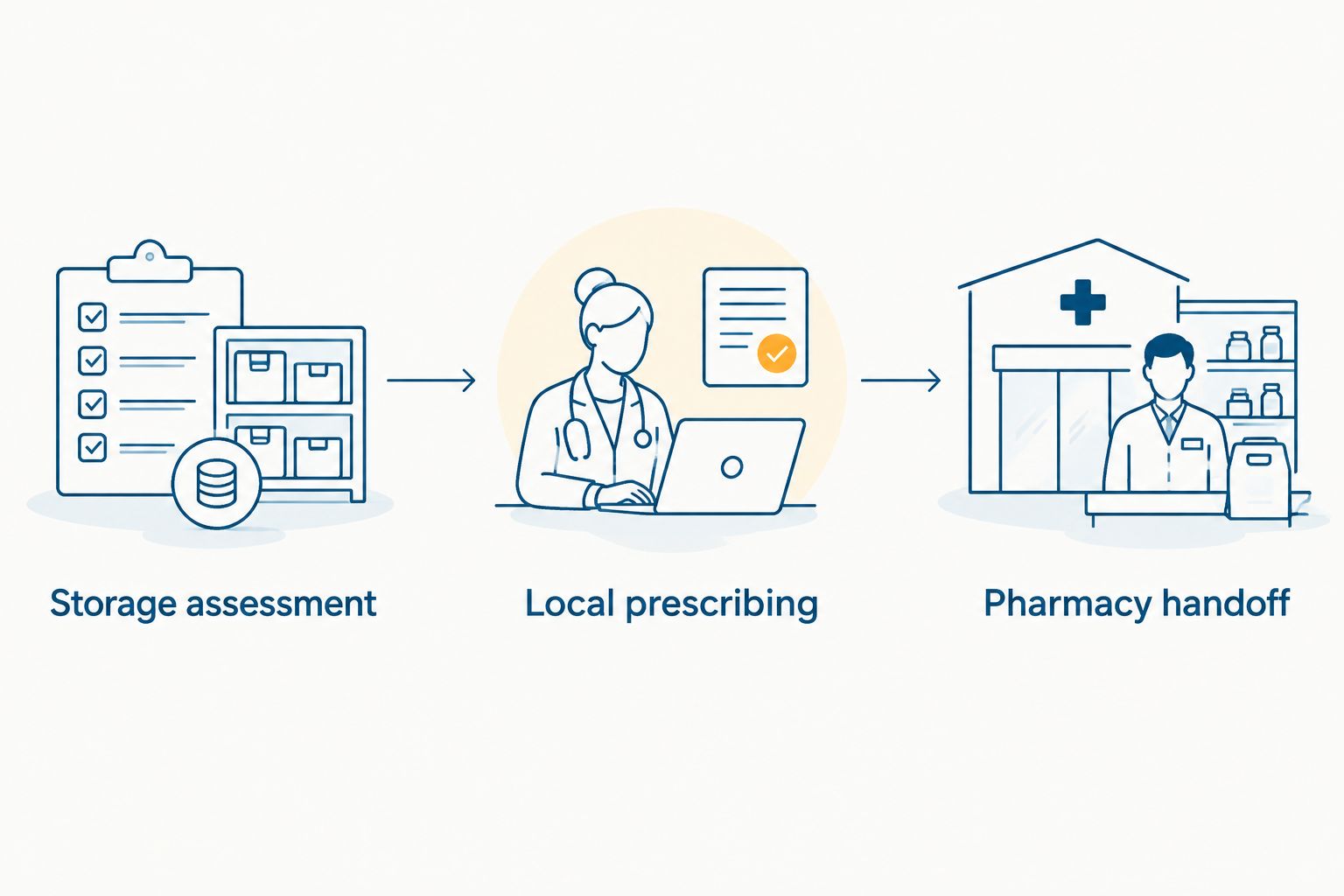
- Contact the clinician directly. Explain the medicine involved, your location, the storage concern, and the next scheduled dose. Ask what records the clinician needs and whether an in-person examination is required.
- Share the original treatment evidence. Provide the medication record and any advice already received about the affected medicine. Your home prescription supports the assessment; it is not a guarantee that a local prescription will follow.
- Request a documented plan. Ask the clinician to explain the treatment decision, any proposed substitution, and instructions for the next dose. Do not treat a matching active ingredient as proof that a different strength, formulation, or delivery device is interchangeable.
- Confirm pharmacy requirements. Ask the pharmacy how it must receive the prescription and what identification or supporting documents it requires. Confirm storage and transport instructions for the medicine actually dispensed.
- Check before leaving. Compare the dispensing label with the clinician's instructions. Ask the pharmacist to resolve differences in product name, strength, formulation, device, or directions before you use the medicine.
Expected result: You have a clinician-approved treatment plan and clear pharmacy instructions, or a defined next clinical step if dispensing cannot proceed.
Which contact handles which problem?
Choose the contact by the decision you need. None of these routes performs every role.
| Contact or resource | Best for | Useful contribution | Limit |
|---|---|---|---|
| Manufacturer medical information service | Product-specific storage questions | Interprets handling information for the identified product | Does not replace your clinician's treatment assessment |
| Licensed local pharmacist | Dispensing and medication-handling questions | Explains local prescription requirements and use instructions | Cannot make every prescribing decision |
| Local treating clinician | Assessment and replacement prescribing | Evaluates treatment needs and appropriate alternatives | Requires adequate clinical information; approval is not automatic |
| MyAbroadMDs doctor-directory membership | Finding English-speaking provider contacts before departure | Provides a personalized, curated directory | Does not provide insurance, telehealth, prescribing, or booking |
The strongest workflow uses the right contact at the right point. A directory helps you prepare provider contacts; it does not determine whether a temperature-exposed injection is suitable to use.
When your itinerary changes
A second workflow applies when you change destinations before a storage problem occurs. Repeat the location-dependent checks rather than rebuilding the entire medication record.
- Update the destination. Replace the city, travel dates, accommodation details, and local contact information in your planning document.
- Recheck the rules. Review official destination guidance for carrying your medicine, including transit requirements where relevant. Ask a local pharmacy about prescription documentation.
- Reconfirm storage arrangements. Ask your accommodation or transport provider specific questions about the storage you need. Do not assume that an in-room refrigerator meets the medicine's labeled requirements.
- Refresh the care route. Identify the clinician you will contact directly and how you will send records. Keep urgent-care information separate from routine appointment details.
Expected result: Your 2026 medication plan follows the itinerary rather than pointing you back to a city you have already left.
This variant is especially useful when a study-abroad placement changes, a cruise itinerary shifts, or a work trip gains another stop. The trigger is a destination change—not a medical crisis.
Troubleshooting
You do not know how warm the medicine became
Report the uncertainty plainly. Give the known timeline, storage method, and any recorded readings to the pharmacist, prescriber, or manufacturer. Do not convert room temperature, weather reports, or how the bag felt into a claimed medication temperature.
The pharmacy does not accept your home prescription
Ask exactly what local prescription documentation is required, then contact a clinician authorized to assess and prescribe in that destination. Keep the home prescription as supporting evidence. Do not assume that translating it changes its legal acceptance.
The proposed medicine has a different name or device
Ask the clinician and pharmacist to confirm the active ingredient, strength, formulation, delivery device, and dosing instructions. Request training if the device differs. Do not transfer instructions from your original medicine to a replacement without professional confirmation.
Your next dose is due before the assessment is complete
Tell the treating clinician the exact scheduled time and ask for an individualized interim plan. If your usual contact cannot respond in time, seek an appropriate local clinical service. Do not create your own catch-up schedule.
The medicine appears normal after possible freezing
Report suspected freezing even if the liquid looks unchanged. Ask for advice specific to the exact product and handling event. Appearance alone does not establish suitability, and warming it back up does not answer the clinical question.
Customize your workflow
Build your 2026 preparation around the treatment, not just the trip length. A medicine with a specialized device needs device instructions; treatment managed by a specialist needs a clear route back to that specialist's records.
Add a short Handoff summary to your document: what happened, who assessed it, what the clinician decided, and what the pharmacy dispensed. Keep original records alongside the summary so the next clinician can check the details.
MyAbroadMDs doctor-directory memberships support the provider-contact part of this preparation. Use the directory to prepare whom to contact; use qualified clinicians and pharmacists to decide treatment. Peace of mind before you pack starts with that boundary.
Prepare your healthcare contacts before departure
Explore personalized English-speaking doctor directories for your travel plans.
FAQ
How do I get a refrigerated medication replacement prescription abroad?
Contact a local clinician with your medication identity, treatment records, and storage history. The clinician assesses whether replacement or another treatment plan is appropriate, and a local pharmacy explains dispensing requirements.
Can I use refrigerated medicine after it gets warm?
Suitability depends on the exact product and exposure conditions. Ask a pharmacist, prescriber, or the manufacturer's medical information service for product-specific advice before using potentially damaged medicine.
Does refrigerating medicine again make it safe?
Refrigerating medicine again does not establish that an earlier temperature excursion was acceptable. Preserve the exposure details and obtain advice for the exact product.
Will a pharmacy abroad accept my US prescription?
Do not assume a pharmacy abroad will accept a US prescription. Acceptance depends on local requirements and the medicine involved; ask the destination pharmacy what documentation it requires.
Can MyAbroadMDs prescribe or arrange a replacement injection?
MyAbroadMDs provides personalized, curated directories of English-speaking doctors and healthcare providers. It is not insurance, telehealth, a prescribing service, or an appointment-booking service; contact providers directly for care.
What should I do if my next dose is due soon?
Ask a treating clinician for an individualized plan before changing your scheduled treatment. Explain the exact medicine, prescribed schedule, and storage concern, and seek urgent local care when the situation requires immediate assessment.
What documents should I show a doctor abroad?
Show the original prescription details, labeled packaging, prescribed schedule, relevant medical records, and storage history. Include measured temperatures when available and clearly identify anything you do not know.
One last thing
Record uncertainty as carefully as you record facts. A note saying that the temperature was not measured gives the assessor more reliable information than a guessed reading. Before departure, add a blank storage-event section to your medication record so you can capture details without reconstructing them later.