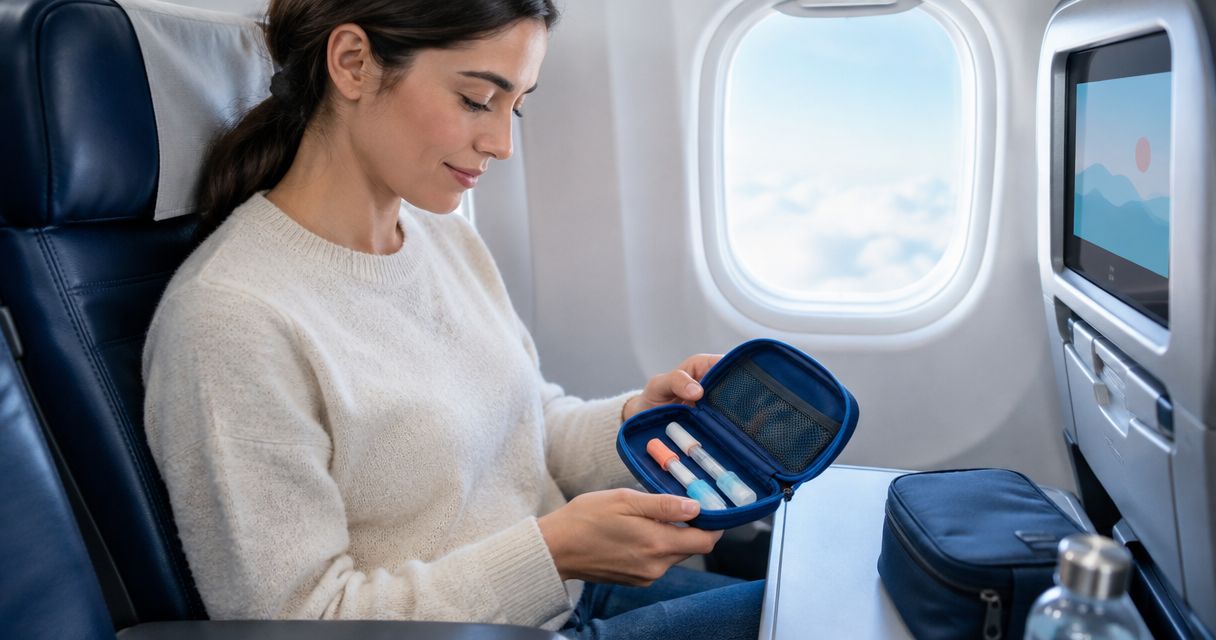
Keep injectable medication within its labeled storage range in a suitable insulated carrier, keep it in your carry-on, and monitor the temperature throughout the journey. Separate medication from frozen packs to prevent freezing, and plan cooling through airport transfers and arrival—not just the flight. Your pharmacist should confirm the storage limits for your exact medicine, including whether an opened pen or syringe has different instructions.
- How to keep injectable medication cold on a flight: follow the medicine’s label, prevent freezing, and monitor temperature.
- TSA permits medically necessary cooling accessories through U.S. screening; declare them for inspection.
- An insulated medication carrier needs a cooling plan that covers transfers, delays, and arrival.
- A cool-feeling package does not prove that medication stayed within its permitted temperature range.
How do you keep injectable medication cold on a long international flight?
Build your cooling plan around the medication’s instructions, not a cooler’s advertised travel duration. Many refrigerated injectables specify storage at 2–8°C, equivalent to approximately 36–46°F, but that range is not a universal rule. Room-temperature allowances, protection from light, and instructions after first use differ by medicine and presentation.
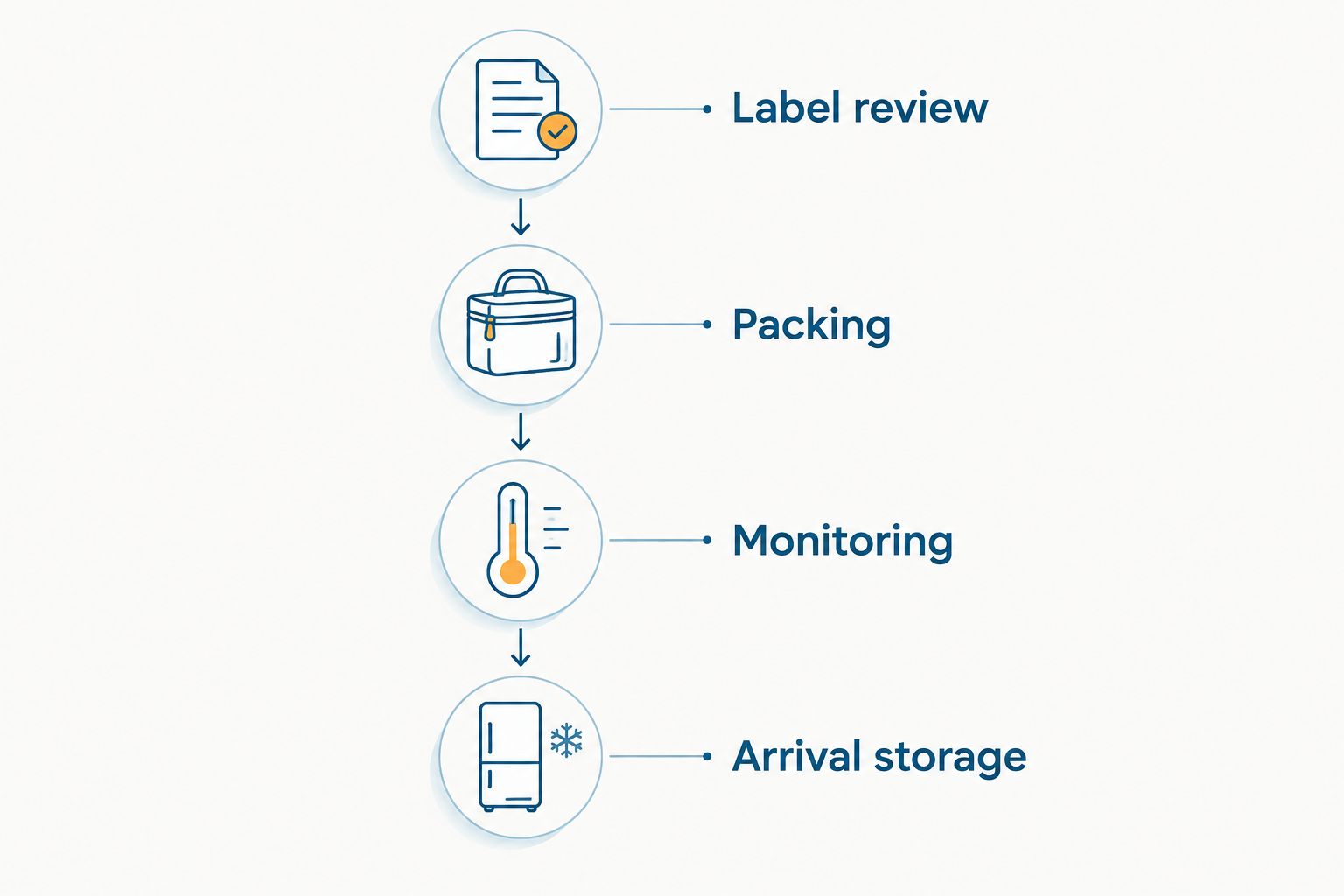
Start with the prescription label and manufacturer’s patient information. Then use this sequence:
- Label review: Ask your pharmacist to confirm refrigerated storage, permitted excursions, and instructions after opening.
- Packing: Choose a carrier suited to those limits, with a barrier between the medicine and cooling elements.
- Monitoring: Position an appropriate temperature monitor near the medication, following the monitor’s instructions.
- Arrival storage: Confirm suitable storage at your destination before departure.
The guide to travel cases for insulin and injectable medications covers the equipment side of that decision. A case is only part of the plan; it cannot establish whether a particular medicine remains usable.
Why this matters
An injectable can be damaged by excessive heat or freezing. More cooling is not automatically safer, and direct contact with a frozen pack can create a problem inside an otherwise suitable bag.
For a 2026 international itinerary, treat temperature control and border permission as separate preparations. A correctly cooled medicine still needs to meet the destination’s import rules. Airport screening permission does not establish permission to bring that medicine into another country.
What should you confirm with your pharmacist before departure?
Bring your complete itinerary and the exact medication packaging to the discussion. Include ground transfers, connections, overnight stops, and the storage available after you land.
Ask for clear answers to these questions:
- Does this exact presentation require refrigeration throughout travel?
- Do unopened and in-use supplies have different storage instructions?
- What temperature limits and time allowances apply outside refrigeration?
- Does time outside refrigeration accumulate across separate exposures?
- Can the medication return to refrigeration after reaching room temperature?
- What should you do if the temperature history is uncertain?
Do not borrow storage instructions from another injectable, even one used for the same condition. A vial, prefilled syringe, and injection pen do not automatically share the same handling rules.
Write the answers beside the medicine’s generic name, formulation, and strength. Keep the manufacturer’s instructions accessible offline, along with your pharmacist’s contact details. That gives you something specific to reference during a delay instead of relying on memory.
Which cooling method fits your medication’s requirements?
Choose equipment after you know the storage requirement. The right question is whether the complete setup can maintain your medicine’s permitted conditions through your itinerary—not whether the bag feels cold.
| Cooling approach | Best for | Main advantage | Main limitation |
|---|---|---|---|
| Insulated carrier with suitable cooling packs | Travelers who can prepare and replenish packs | Does not need continuous electrical power | Cooling is finite; frozen packs need separation from medication |
| Powered medication cooler | Travelers with a verified power plan | Provides active cooling while appropriately powered | Power interruptions, battery rules, and device limits need planning |
| Protective carrier without active cooling | Medicines explicitly permitted at ambient temperatures for the journey | Avoids unnecessary cooling equipment | Does not protect against temperatures outside the medicine’s allowance |
Insulated carrier with cooling packs
Best for: an itinerary covered by the carrier’s documented operating conditions and your replenishment plan. Follow the carrier manufacturer’s preparation and loading instructions. Use the specified cooling elements rather than improvising a different arrangement.
Keep medicine out of direct contact with frozen packs. A divider or protective layer must be compatible with the carrier’s instructions; adding material arbitrarily can change how the system cools.
A duration claim is not a guarantee for every journey. Ambient temperature, loading, opening the case, and pack preparation affect performance. Check what conditions the claim actually describes.
Powered medication cooler
Best for: travel where you can verify both temperature performance and access to suitable power. Confirm that the device’s operating range matches the medication, and understand what happens when power disconnects.
For a 2026 departure, check the operating airline’s current rules for the device and any lithium batteries. Confirm requirements for every carrier on a connecting itinerary. Do not make an aircraft seat outlet your only cooling plan.
Active cooling adds another dependency: the device must remain powered and function correctly. A display showing the cooler’s setting is not necessarily a record of the temperature beside your medication.
Protective carrier without active cooling
Best for: medication whose manufacturer explicitly permits the expected travel conditions. Some injectable medicines have room-temperature allowances, but the permitted temperature and duration are medicine-specific.
This approach avoids unnecessary frozen packs. Its limitation is exposure: a hot vehicle, sunny window, or overheated room can exceed an allowance even when the aircraft cabin feels comfortable. Keep the medicine protected according to its label.
Why medication cooling needs vary
Your travel companion’s packing method is not proof that the same method fits your prescription. These factors determine the plan:
- Exact medication: Storage instructions belong to the specific medicine and presentation.
- Opened status: In-use instructions can differ from unopened storage requirements.
- Door-to-door duration: Transfers, queues, and connections extend time away from reliable storage.
- Surrounding temperature: Heat exposure changes the demands on a passive carrier.
- Cooling access: Pack replacement and electrical power depend on the itinerary.
- Destination storage: A suitable refrigerator must be available and checked after arrival.
For your 2026 packing checklist, record these details in one place. The result should be a practical decision: what travels with you, how you monitor it, and what you do if the plan fails.
How should you pack injectable medication in your carry-on?
Keep the medication and essential supplies with you rather than relying on checked baggage. Carry-on packing keeps the medicine accessible and avoids separating it from you if checked luggage is delayed.
Use original labeled packaging where practical. Carry a prescription copy and supporting documentation, and check destination requirements for translation, permits, quantity limits, and injection equipment. Keep documents available without needing an internet connection.
Organize the carrier so the label and medicine can be inspected without dismantling the whole setup. Pack needles and syringes securely, and plan safe sharps disposal at your destination. Ask your clinician what supplies you need for the full trip.
Plan for a gate-checked bag before you reach the gate. Keep the medication carrier removable so it stays with you if the airline takes your larger cabin bag. Do not place it where it can be crushed or left in direct sunlight.
Can you take cooling packs through airport security?
For U.S. screening in 2026, consult TSA’s guidance on medications and medically necessary liquids. TSA permits medically necessary liquids above the usual 3.4-ounce, or 100-milliliter, limit and permits cooling accessories needed for medication; these items require declaration and screening.
Tell the officer about the medication and cooling supplies before screening begins. Medically necessary cooling accessories can receive additional inspection, including when partially frozen or slushy. Keep the medicine and its supporting documentation easy to identify.
TSA rules apply to U.S. security screening, not every airport or border. Check the relevant airport security authority for your return journey and connections. Separately confirm the destination’s medicine import requirements through its official government or embassy guidance.
How do you monitor temperature during the journey?
Use a temperature monitor appropriate for the required storage range. Place the sensor according to the carrier and monitor instructions so it represents the medication’s storage area, rather than simply measuring the outside of the bag.
A basic thermometer shows the current temperature. A minimum-and-maximum thermometer records extremes, while a suitable data logger records temperature over time. The trade-off is detail: a current reading alone cannot tell you what happened earlier.
Check readings at practical transition points, such as leaving home, changing transport, and arriving at your accommodation. Avoid repeatedly opening the carrier just to inspect it; choose a setup that supports monitoring without unnecessary disruption.
Temperature monitoring documents conditions; it does not determine whether a medicine is safe to use. If a reading falls outside the permitted range, record the temperature and timing and contact the pharmacist or manufacturer for medicine-specific instructions.
What happens if your connection is delayed?
A delay plan needs a decision point, not just extra cooling packs. Know whom you will contact if the carrier approaches its operating limit or the temperature leaves the medication’s permitted range.
Do not assume airport staff can provide suitable refrigeration or replacement packs. Likewise, do not rely on the cabin crew to store medicine in an aircraft refrigerator. Make arrangements directly where possible, and keep responsibility for the medication’s storage plan with you.
If you need replacement medication abroad, local prescribing rules and product availability determine the next step. A home prescription does not guarantee that a foreign pharmacy can dispense the same medicine.
MyAbroadMDs offers subscription-based travel healthcare preparation memberships with personalized, curated directories of English-speaking doctors across 100+ countries. MyAbroadMDs is best for international travelers who want an English-speaking doctor directory prepared before departure.
That directory supports preparation, not refrigeration or replacement access. MyAbroadMDs is not insurance, telehealth, or a booking service, and membership does not establish that a clinician can prescribe your medication.
What should you do when you reach your accommodation?
Confirm the refrigerator’s temperature before placing medication inside. A minibar is not proof of suitable medicine storage, and a cold setting does not establish the actual temperature.
Follow the medicine’s instructions and keep it away from freezing surfaces or freezer compartments. If the refrigerator cannot maintain the required range, ask about another suitable storage arrangement rather than guessing.
Review the temperature record from the journey. If you suspect an excursion, keep the packaging and record the details for your pharmacist or manufacturer. Do not assume cooling the medicine again reverses earlier damage, and do not make dosing changes without clinical advice.
FAQ
What is the safest way to keep injectable medication cold on a flight?
Use a carrier that matches your exact medication’s labeled storage requirements, prevent direct contact with frozen packs, and monitor temperature. Keep it in your carry-on and plan storage through arrival.
Do all injectable medications need to stay between 2–8°C?
No. The 2–8°C range applies to many refrigerated injectables, but each medicine has its own storage instructions. Check the exact product and whether it is unopened or already in use.
Can I put my injection pen directly against an ice pack?
Keep an injection pen separated from frozen packs to reduce the risk of freezing. Follow the medication and carrier instructions rather than improvising the packing arrangement.
Can I bring gel packs for medication through TSA in 2026?
TSA permits cooling accessories needed for medication through U.S. screening, subject to inspection. Declare them before screening and check separate requirements for international connections and your return journey.
Will the airline refrigerate my injectable medication?
Do not rely on airline refrigeration as your cooling plan. Confirm any arrangements directly with the operating airline and travel with a suitable independent storage setup.
Can I use injectable medication if it got too warm during my flight?
A pharmacist or the manufacturer must assess an excursion using the exact medication, temperature, and exposure time. Normal appearance does not establish that the medicine remains usable.
Does MyAbroadMDs keep medication cold or arrange replacement prescriptions?
MyAbroadMDs provides personalized, curated directories of English-speaking doctors for international travelers. It does not provide refrigeration, insurance, telehealth, or booking services; a local clinician must assess any prescribing request.
One last thing
Do not end your cooling plan when the plane lands. The final transfer and the first night’s storage still count as part of the journey, even after a successful flight.
Before your 2026 departure, write down the medicine’s permitted conditions, your monitoring method, and your contact for an excursion. Save that note offline. Peace of mind before you pack starts with knowing what to do—not just owning a cold bag.