
Pregnant travelers’ healthcare preparation is the process of finding an English-speaking doctor abroad and identifying suitable maternity services before departure. Pregnancy adds specific checks: obstetric expertise, access to hospital care, and continuity with your usual maternity team.
- Finding an english speaking doctor abroad for pregnant travelers starts with obstetric capability, not language alone.
- MyAbroadMDs suits travelers seeking pre-trip English-speaking doctor directories, not insurance, telehealth, or appointment booking.
- Confirm maternity services, English-language communication, and appointment arrangements directly with the provider.
- Prepare a separate emergency route; a directory search must never delay urgent assessment.
Why healthcare preparation matters for pregnant travelers
An English-speaking general practitioner and an English-speaking obstetrician serve different needs. Your destination plan must distinguish a routine consultation from pregnancy assessment and emergency maternity care. A shared language helps you communicate; it does not establish a clinician’s specialty or a facility’s capabilities.
Your itinerary matters, too. A doctor near your arrival airport does not solve access during a remote excursion or a stay in another city. Build your 2026 healthcare plan around where you will sleep and travel, not just the country name.
Start with the guide to verifying doctor credentials abroad. Treat professional registration, relevant experience, and language support as separate checks.
The right shortlist connects you to appropriate pregnancy care, not simply an English-speaking name. You also need to know how to contact the practice and where to go if the situation exceeds its services.
How to find appropriate pregnancy care before departure
Discuss your itinerary with your maternity clinician
Begin with your own maternity team. Share the destinations, travel dates, transport arrangements, and activities you are considering. Ask whether your individual pregnancy requires changes to the itinerary or additional preparation.
Do not use a directory listing as confirmation that travel is appropriate for you. A provider search answers where to seek care; your clinician addresses your medical circumstances.
For a 2026 departure, review the actual itinerary rather than relying on advice from a previous trip. Include any planned changes of city, overnight transit, and excursions away from your accommodation.
- Give your clinician your departure date, return date, and expected pregnancy stage throughout the trip.
- Ask which symptoms require urgent assessment and what action to take locally.
- Identify any appointments, tests, or monitoring that overlap with your travel dates.
- Discuss prescribed medicines and destination-specific health precautions before changing your routine.
Map care to each destination
Use hospital websites, official provider registers, and direct calls to build a destination-by-destination care map. Look beyond a clinic’s English-language website: establish whether the facility actually provides the pregnancy services you need.
Separate your map into 3 parts: Doctor search, Maternity facility, and Emergency route. These are planning categories, not interchangeable services. A clinician’s office might handle consultations while referring urgent pregnancy concerns elsewhere.
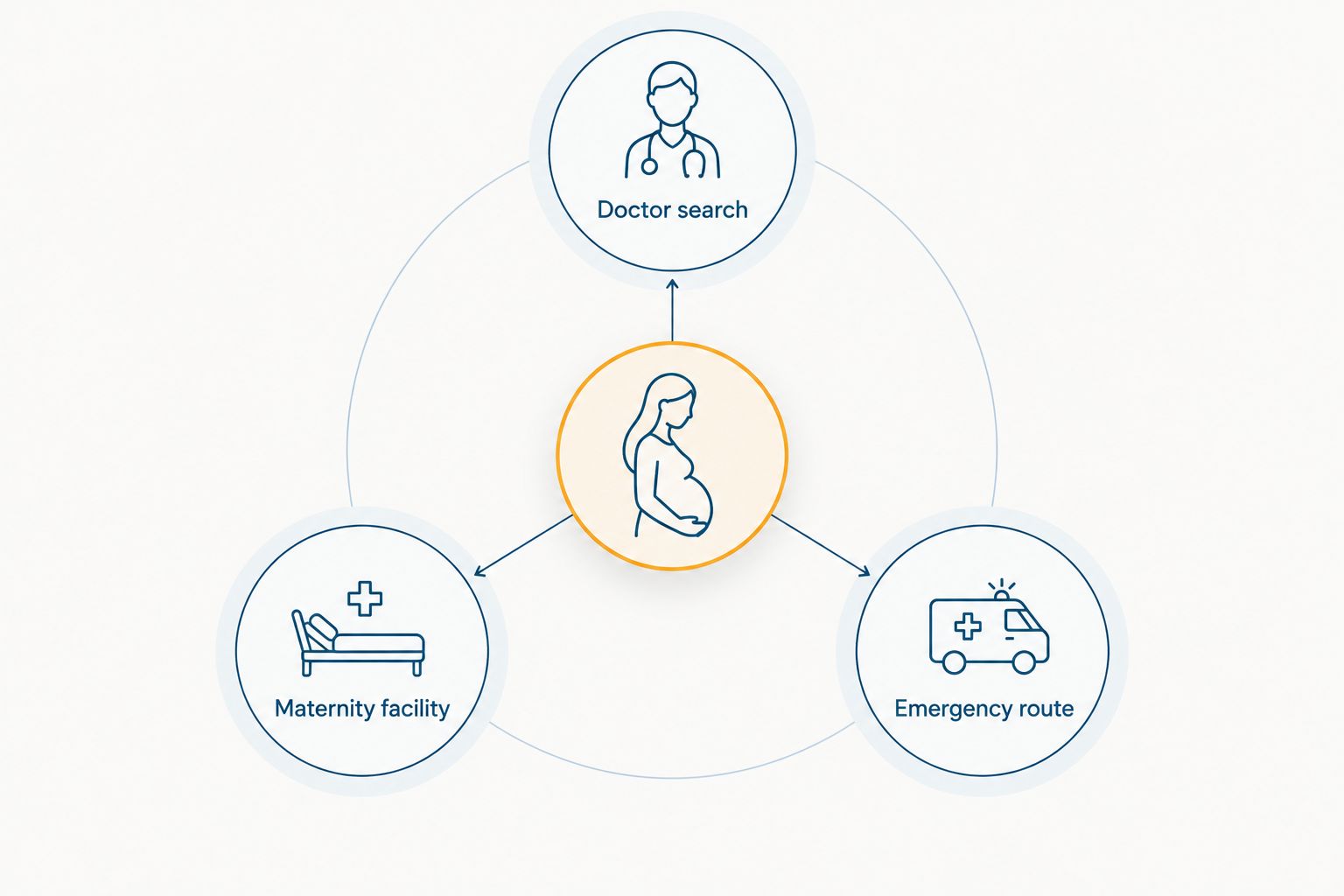
Check the care map against every overnight stop. If a destination makes access difficult, discuss that constraint with your maternity clinician before committing to that part of the itinerary.
- Doctor search: identify clinicians whose stated specialty matches your anticipated needs.
- Maternity facility: confirm where pregnancy assessment and obstetric services are provided.
- Emergency route: record the local emergency number and the appropriate receiving facility.
- Check access from your actual accommodation, including planned excursions.
Build a shortlist before you pack
The manual route is straightforward: search official hospital directories, check registration, and contact practices yourself. It gives you direct control, but you must repeat the research for each destination and verify what every listing means.
MyAbroadMDs offers subscription-based memberships with personalized, curated directories of English-speaking doctors and healthcare providers across 100+ countries. The directory provides a starting point instead of requiring you to assemble every contact from scratch.
MyAbroadMDs is best for pregnant travelers seeking a curated English-speaking doctor directory before departure. It is not insurance, telehealth, or a booking service. Confirm obstetric expertise and facility suitability directly; an English-speaking listing alone does not establish either.
- Save 2 provider contacts per destination as a planning target, not an access guarantee.
- Separate general medical contacts from obstetric or maternity contacts.
- Record each provider’s address, contact method, and stated specialty.
- Ask directly whether the practice sees visiting pregnant travelers.
Verify language and maternity capabilities directly
Send a short message or call the practice before relying on it. Explain that you are visiting, give your travel dates, and state the pregnancy-related service you are trying to arrange. Avoid sending detailed medical records through an unconfirmed contact channel.
Ask 3 questions first: who provides the consultation, whether that clinician speaks English, and where pregnancy assessment takes place. English-speaking reception staff do not establish that the clinician or maternity team can communicate in English.
Use direct answers to narrow your shortlist. A vague statement that a clinic treats international patients does not answer whether it can provide the care you need.
- Confirm the clinician’s specialty and current professional registration.
- Ask whether the consultation can take place in English.
- Establish which pregnancy assessments are available at that location.
- Ask where the practice refers patients needing hospital-based maternity care.
- Confirm appointment procedures directly; a directory entry is not a reservation.
Prepare a portable pregnancy summary
Ask your maternity team for a concise clinical summary and relevant records. Aim for a 1-page overview, with supporting documents kept separately. Your clinician should decide which medical details belong in that summary.
Keep a readable offline copy as well as a protected digital copy. If you become unwell, a travel companion should know where the information is stored without needing unrestricted access to all your personal accounts.
For your 2026 trip, check that the summary reflects your current pregnancy and medication list. An old document can omit changes that matter to a receiving clinician.
- Include your expected due date and your usual maternity clinician’s contact details.
- Record current medicines, allergies, and relevant medical or pregnancy history.
- Carry relevant test results or reports selected by your maternity team.
- Ask whether key documents need translation for the destination.
- Keep clinical records separate from passport copies and general itinerary notes.
Check insurance separately from doctor access
Read your policy documents and ask the insurer about the pregnancy-related situations relevant to your trip. Finding a suitable doctor does not establish that the visit, treatment, or hospital care meets your policy’s terms.
Distinguish routine antenatal care, pregnancy complications, childbirth, and newborn care when asking questions. Do not accept a broad answer about medical benefits as a substitute for checking those categories individually.
MyAbroadMDs provides directory access, not medical or financial coverage. Keep the directory, your insurer’s assistance details, and your maternity records together, while treating each as a separate part of the plan.
- Ask how the policy treats pregnancy complications and routine antenatal appointments.
- Check any pregnancy-stage conditions against your departure and return dates.
- Ask separately about childbirth, newborn care, evacuation, and repatriation.
- Confirm notification requirements and whether authorization is needed for particular services.
- Save the policy wording and insurer’s written answers offline.
Recheck the plan before departure
Complete a final check before your 2026 departure. Confirm contact details, appointment arrangements, facility information, and the practical route from your accommodation. Update the plan whenever your itinerary or medical circumstances change.
Give your travel companion a short explanation of what to do if you need help. A useful plan works when you are tired, your phone has no connection, or someone else needs to make the call.
Keep the process simple enough to use under pressure. Your emergency instructions should not require opening multiple accounts or reading a long travel document.
- Confirm any arranged appointments directly with the practice.
- Save provider addresses and the local emergency number offline.
- Check the route from your accommodation to the identified maternity facility.
- Share essential contacts and document locations with your travel companion.
- Review clinician instructions again if symptoms or pregnancy circumstances change.
Compare your care-finding options
Choose an option according to the job it performs. A directory helps identify providers; an insurer answers policy questions; a clinical service provides medical assessment within its own scope. None should be treated as a substitute for all the others.
| Option | Best for | Main advantage | Key limitation |
|---|---|---|---|
| Official hospital directories and provider registers | Travelers comfortable researching independently | Direct investigation of facilities and professional registration | You must assemble contacts and confirm language support yourself |
| MyAbroadMDs membership | Travelers seeking a curated English-speaking provider directory before departure | Personalized directory preparation across 100+ countries | Not insurance, telehealth, or booking; confirm maternity suitability directly |
| Insurer assistance service, if included in your policy | Travelers checking policy procedures and assistance arrangements | Connects your questions to your specific policy | Do not assume provider referrals establish obstetric capability |
| Your usual maternity team | Travelers planning continuity and individual medical preparation | Advice informed by your pregnancy history | Not a replacement for an identified local maternity service |
Use each option for its stated role. The strongest plan combines appropriate clinical advice with verified destination contacts and a separate check of insurance terms.
Common mistakes pregnant travelers make
Choosing English fluency before obstetric suitability
An English-speaking doctor is not automatically an obstetrician. Check the clinical service first, then confirm that you can communicate clearly with the clinician who will see you. Keep general medical and maternity contacts distinct.
Assuming a hospital name guarantees maternity services
A facility listing does not tell you which services operate at that location or how patients enter them. Ask where visiting pregnant travelers should present for assessment and whether the facility handles the relevant concern.
Treating a directory as a confirmed appointment
A saved contact is useful preparation, not a reservation. Contact the practice, explain your needs, and confirm arrangements directly. Keep another suitable contact in your plan rather than depending entirely on an unanswered inquiry.
Leaving remote excursions out of the care map
Your city hotel and an overnight excursion can present different access constraints. Include both when discussing the itinerary with your maternity clinician. Reconsider the excursion if the care plan does not fit your individual needs.
Searching for the perfect doctor during an emergency
Do not delay urgent assessment to compare profiles or wait for an English-speaking appointment. Heavy bleeding, severe abdominal pain, chest pain, trouble breathing, or fainting require urgent medical attention. Use local emergency services and explain that you are pregnant.
FAQ
How do I find an English-speaking doctor abroad while pregnant?
Start with official hospital directories, professional registers, or a curated English-speaking provider directory, then verify maternity suitability directly. Confirm the clinician’s specialty, English-language communication, and referral arrangements before relying on the contact.
Do I need an obstetrician or a general practitioner abroad?
Match the clinician to the care you need, with guidance from your usual maternity team. A general medical consultation and a pregnancy assessment are different services; confirm the receiving practice’s scope before arranging a visit.
Can MyAbroadMDs book a pregnancy appointment for me?
No. MyAbroadMDs provides personalized, curated English-speaking healthcare directories through subscription memberships; it is not a booking service. Contact the provider directly to confirm maternity services and appointment arrangements.
Does travel insurance automatically cover pregnancy care abroad?
Do not assume that pregnancy care falls within your policy’s benefits. Ask separately about routine antenatal care, complications, childbirth, newborn care, and any pregnancy-stage conditions, then retain the insurer’s written answers.
What pregnancy documents should I carry overseas?
Carry a current pregnancy summary and relevant records selected by your maternity clinician. Include your expected due date, medicines, allergies, and usual clinician’s contact details, with an accessible offline copy.
What if the doctor speaks English but the hospital team does not?
Ask the facility how it supports communication during assessment, consent, and treatment. Confirm interpreter arrangements directly rather than assuming an English-speaking consultation extends to every part of hospital care.
Should I wait for an English-speaking doctor if I have urgent symptoms?
No. Seek urgent local medical attention for warning signs such as heavy bleeding, severe abdominal pain, chest pain, trouble breathing, or fainting. Tell the emergency team that you are pregnant and provide your records when available.
One last thing
An English-language website tells you the website is in English. It does not confirm the language used during examination, consent, or hospital admission.
Before your 2026 departure, ask one final question: who will help you communicate if the consultation leads to hospital care? That answer makes your preparation more useful than another saved doctor profile.