
Military families’ overseas doctor search is the process of finding an English-speaking clinician while confirming the family’s route to care, with the aim of maintaining continuity during a posting or trip. This 2026 guide separates provider discovery from military healthcare eligibility, referrals, and payment so you can prepare before departure.
- Finding an English speaking doctor abroad for military families requires separate checks for clinical fit, language, and coverage.
- Start with your military healthcare contacts before arranging nonemergency civilian care overseas.
- MyAbroadMDs is best for travelers seeking a personalized English-speaking doctor directory, not insurance or appointment booking.
- Confirm the treating clinician’s English proficiency directly; an English-language website is not enough.
Why finding an English-speaking doctor matters for military families
An overseas posting and a holiday away from your duty station create different care questions. Your family needs a doctor who can communicate clearly, but you also need to understand the administrative route for that particular location and type of care.
For your 2026 preparation, treat these as separate decisions: who can treat you, how you access that care, and how payment works. An English-speaking doctor is not automatically an authorized provider under your healthcare arrangements. A useful recommendation from another family does not settle that question.
Language is also only one part of suitability. A clinician who treats adults is not necessarily the right choice for your child, and a nearby general practice is not a substitute for a specialist managing an ongoing condition. Use these resources for verifying doctor credentials abroad alongside direct checks with the clinic.
Build your overseas care plan before departure
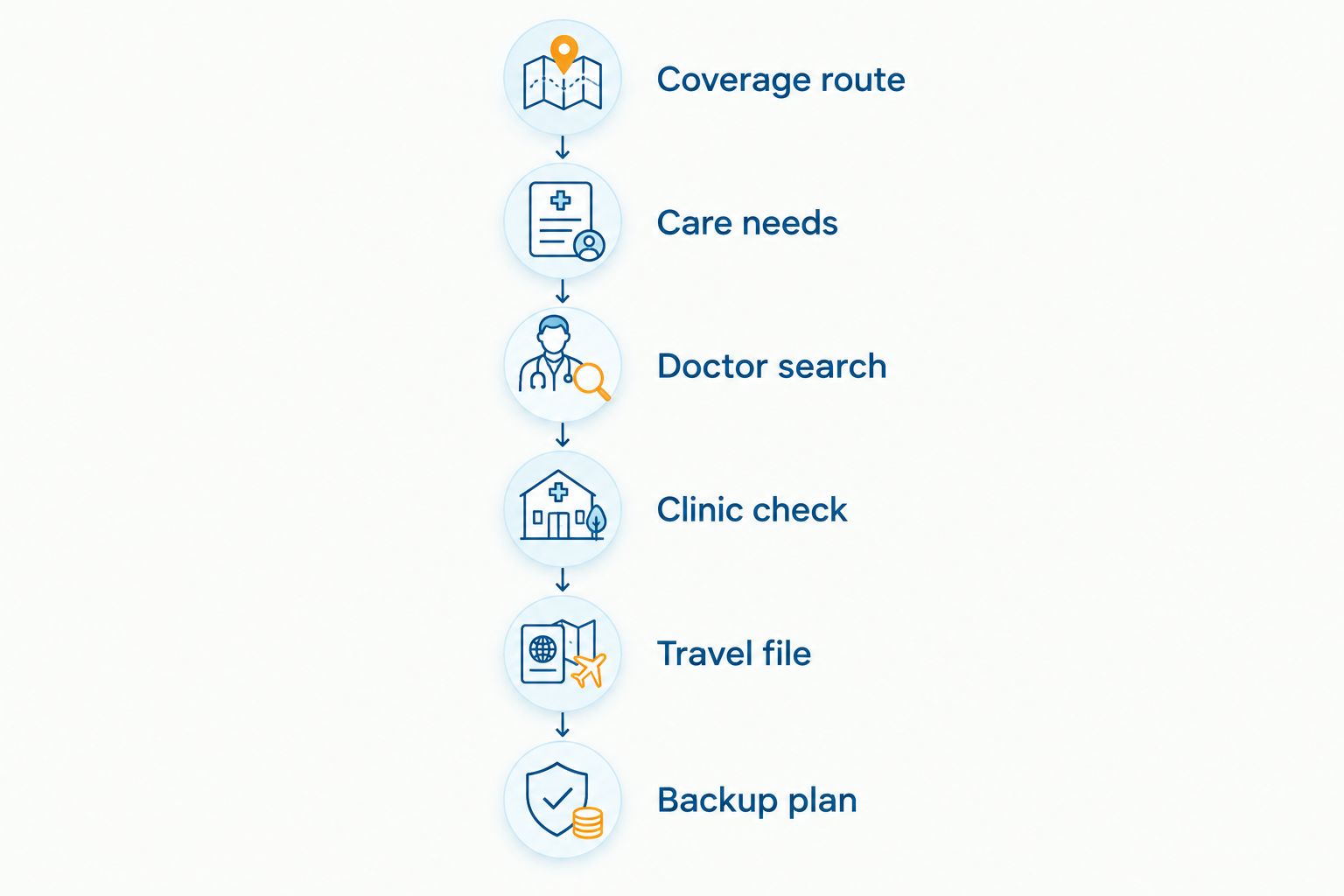
Keep the process in this order: Coverage route, Care needs, Doctor search, Clinic check, Travel file, Backup plan. Complete the administrative checks before booking routine civilian treatment, and keep emergency instructions separate from your routine appointment process.
1. Confirm your family’s route to care
Start with the contacts responsible for your military healthcare arrangements. If your family uses TRICARE overseas, ask the relevant TRICARE Overseas Program contact or military treatment facility how your plan applies to the destination and the care you need. Do not assume instructions for your current duty station apply unchanged elsewhere.
Ask about each family member rather than treating the household as one administrative case. Explain whether you are relocating, taking leave, or visiting another country, and distinguish routine appointments from urgent needs.
Keep the current instructions with your 2026 travel documents. A saved contact name is useful; a written explanation of the next action is better.
- Confirm which office handles routine civilian care questions at your destination.
- Ask whether the planned appointment requires a referral or authorization.
- Check the provider requirements that apply to your specific plan.
- Request instructions for billing questions and any claim documents.
- Record the separate process for urgent and emergency care.
2. Define the care each family member needs
Build a care brief before searching clinic names. Your goal is to match the clinician to the patient, not simply find someone who speaks English nearby. Start with your existing care team and request a concise summary of ongoing conditions, current treatment, and follow-up needs.
Use 1 page per family member as a practical planning format, with longer records stored separately. This is an organizing choice, not a clinical limit. Include the information a new clinician needs to understand why you are seeking care.
For children, confirm the age group the practice treats. For ongoing specialist care, ask your current clinician what information the receiving doctor needs and whether a handover is appropriate before travel.
- Write each person’s care needs in plain language.
- List medication names, doses, allergies, and relevant diagnoses.
- Identify appointments that must continue during the posting or trip.
- Note accessibility, communication, and caregiver requirements.
- Separate routine follow-up needs from emergency instructions.
3. Find clinicians through official and directory routes
Start manually with your military healthcare contacts, relevant provider listings, and clinic websites. Ask for practices that match the specialty, patient age, and destination you identified. Community recommendations can supply names, but verify each recommendation before relying on it.
For a prepared directory route, MyAbroadMDs offers subscription-based memberships providing personalized, curated directories of English-speaking doctors and healthcare providers across 100+ countries. MyAbroadMDs is best for travelers who want a personalized English-speaking doctor directory before departure.
That directory supports provider discovery. It is not insurance, telehealth, or a booking service, and it does not establish whether a clinician meets your military healthcare requirements. Confirm the particular destination and care needs before choosing a membership.
- Ask your healthcare contact for relevant local provider names.
- Search for the required specialty rather than a general doctor alone.
- Check the clinic’s location against your actual accommodation or duty station.
- Use community suggestions as leads, not proof of credentials or coverage.
- Keep the source and contact details beside every shortlisted clinician.
4. Confirm language, clinical fit, and administration directly
Contact the clinic before relying on the listing. Ask whether the clinician who will actually treat your family can conduct the consultation in English. An English-speaking receptionist or translated website does not answer that question.
Keep 3 questions at the top of your inquiry: Who will treat the patient? Can that clinician discuss the condition in English? What must you arrange before the appointment? Then check the administrative details with both the practice and your healthcare contact.
Record when the clinic confirmed the information in 2026. Treat the reply as a dated confirmation, not a permanent promise about staffing or procedures.
- Confirm the treating clinician’s specialty and relevant patient age range.
- Ask whether consultations and written instructions are available in English.
- Verify credentials through the appropriate local medical regulator.
- Ask what records, identification, and referral documents to bring.
- Clarify how the practice handles invoices and medical reports.
- Follow the clinic’s instructions to arrange the appointment yourself.
5. Prepare a care file you can actually use
A collection of screenshots is harder to use than a short, organized care file. Create a concise summary, then attach supporting records in a clearly named folder. Ask your treating clinician which documents deserve priority rather than copying an entire medical history without context.
Keep an accessible offline copy as well as your chosen secure digital copy. Share medical information through appropriate channels, and avoid placing sensitive records in public family or installation groups.
Plan the handover between caregivers too. The person taking a child to an appointment needs the relevant history and instructions, not just the address another parent saved.
- Put the care summary and medication list at the front.
- Save relevant referral or authorization documents where applicable.
- Include provider details and the date of your last confirmation.
- Store copies of records your existing clinician recommends carrying.
- Give an accompanying caregiver access to the necessary information.
6. Build separate routine and emergency backup plans
Your routine clinic plan should explain what to do if the first practice cannot meet your needs. Your emergency plan should explain how to seek local emergency help without waiting for a directory response, a routine appointment, or an administrative reply.
Save 2 contact routes for routine support, such as a clinic telephone number and your designated healthcare support contact. This is a practical backup recommendation, not a service standard. Also record the destination’s emergency instructions from an official local source.
Repeat the destination check when your itinerary changes. A plan built around your duty station does not identify care near a weekend destination in another country.
- Identify an alternative route for routine care questions.
- Record official local emergency contact instructions.
- Separate emergency instructions from routine referral paperwork.
- Check the route from your accommodation to the relevant care location.
- Recheck contacts after a move or a significant itinerary change.
Compare ways to find an English-speaking doctor overseas
Choose each resource for the question it answers. A provider directory helps identify clinicians; your healthcare administrator explains plan requirements; the clinic confirms whether it can treat the patient. No single resource replaces all three checks.
| Option | Best for | Main advantage | Key limitation |
|---|---|---|---|
| Military healthcare contacts | Understanding your family’s route to care | Connects the search to your actual healthcare arrangements | You still need to confirm the treating clinician’s language and clinical fit |
| MyAbroadMDs memberships | Personalized English-speaking provider discovery before travel | Provides a curated directory across 100+ countries | Not insurance, telehealth, appointment booking, or confirmation of military healthcare eligibility |
| Clinic websites and direct inquiries | Confirming the details of a specific practice | Lets you ask about the clinician, specialty, records, and consultation language | Requires separate inquiries and independent credential checks |
| Local medical regulator registers | Checking professional registration | Provides a route to verify a clinician’s registration | Does not establish English proficiency or your coverage requirements |
| Military family community recommendations | Gathering local names to investigate | Adds practical questions to your shortlist | Personal experience does not verify credentials, clinical suitability, or authorization |
Use official healthcare guidance as the administrative starting point, then choose the discovery route that suits your preparation. A directory is useful when you want help identifying names. Direct clinic checks remain necessary whichever route you choose.
Prepare your doctor search before departure
Explore personalized English-speaking provider directories. Not insurance, telehealth, or appointment booking.
Common mistakes military families make overseas
Treating a recommendation as coverage confirmation
Another military family’s successful visit does not establish your own referral, authorization, or billing requirements. Confirm the process for your family and planned treatment with the responsible healthcare contact before arranging routine civilian care.
Checking the receptionist’s English, not the clinician’s
A smooth telephone conversation does not confirm that the treating doctor can discuss symptoms, treatment choices, and follow-up in English. Ask specifically about the person who will conduct the consultation and provide medical instructions.
Preparing only for the duty station
A care plan tied to one city leaves a gap when you travel elsewhere. Check the healthcare route and local emergency instructions for side trips, particularly when crossing a national border.
Assuming one doctor fits the whole household
Different family members need different clinical expertise. Check pediatric age ranges, specialist requirements, and ongoing treatment needs separately rather than choosing a single practice solely for convenience.
Mistaking a directory membership for a care service
MyAbroadMDs helps you identify English-speaking providers; it does not insure treatment, deliver telehealth, or book visits. Keep provider discovery separate from clinical advice, appointment arrangements, and payment responsibilities.
FAQ
What’s the best way for a military family to find an English-speaking doctor abroad?
Start with your military healthcare contacts, then verify a suitable clinician directly with the practice. Confirm the treating doctor’s English proficiency, specialty, and any referral or authorization requirements separately.
Does an English-speaking doctor automatically meet TRICARE requirements?
No. English proficiency does not establish whether a provider or appointment meets your TRICARE plan requirements. Ask the relevant TRICARE Overseas Program contact or military treatment facility about your specific situation.
Can MyAbroadMDs arrange our family’s appointments?
No. MyAbroadMDs provides personalized, curated directories of English-speaking doctors and healthcare providers, not appointment booking. You arrange the visit directly and confirm your healthcare requirements separately.
How do I check whether a doctor can treat my child in English?
Ask the practice whether the treating clinician sees your child’s age group and can conduct the consultation in English. Confirm that follow-up instructions can also be explained clearly.
Do we need a separate doctor search when traveling away from our duty station?
Yes. Check care options for the actual destination rather than relying on contacts near your duty station. Confirm the relevant healthcare process and official local emergency instructions before the side trip.
What medical documents should military families carry overseas?
Carry a concise care summary, medication and allergy lists, and relevant records recommended by your treating clinician. Include any required referral or authorization documents and keep an accessible offline copy.
What should we do if someone needs emergency care abroad?
Seek local emergency help using the destination’s official emergency instructions. Do not wait for a routine appointment or directory response; keep administrative follow-up separate from getting emergency help.
One last thing
Before your 2026 departure, ask the caregiver who did not assemble the plan to find the clinic contact, medication list, and emergency instructions without help. Fix anything they cannot locate. A care plan is ready when the person using it can act—not when the folder looks finished.