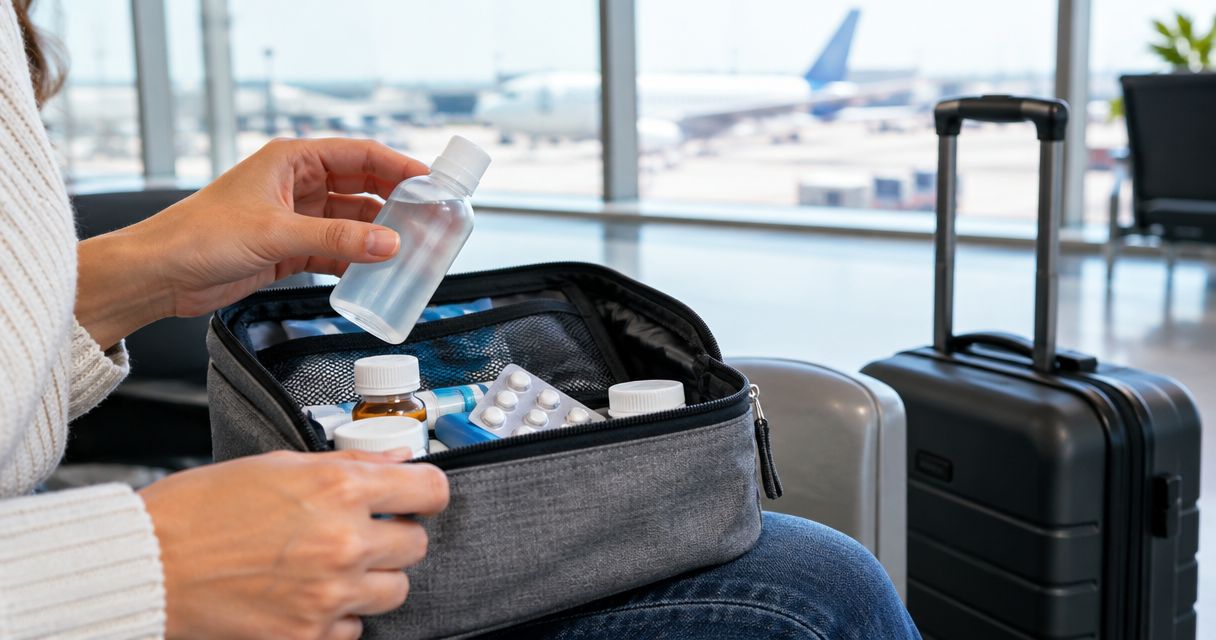
Yes. For flights departing from a U.S. airport in 2026, TSA permits medically necessary liquid medication over 3.4 ounces in your carry-on in reasonable quantities for your trip. Declare it to the officer before screening; the exemption does not remove additional inspection or destination-country medication restrictions.
- Can you bring liquid medication over 3.4 ounces on a flight? Yes, TSA permits medically necessary quantities after declaration.
- Liquid medication does not have to fit inside your quart-sized toiletries bag.
- U.S. airport screening permission does not establish permission to import medication into another country.
- MyAbroadMDs supports pre-trip healthcare preparation, not airport clearance, insurance, telehealth, or appointment booking.
Why this matters
The bottle size is not the main obstacle. The distinction between security screening and medication import rules is. You need a packing plan for the checkpoint and a separate legality check for your destination.
TSA's Traveling with Medication guidance and Liquids Rule distinguish medically necessary liquids from ordinary toiletries. For broader packing questions, see the guide to bringing prescription medication through airport security.
Can you bring liquid medication over 3.4 ounces on a flight?
Yes, at U.S. TSA checkpoints, medically necessary liquid medication can exceed the standard 3.4-ounce, or 100-milliliter, container limit. TSA allows reasonable quantities for your trip and requires you to identify the medication for screening.
The exemption concerns the medical purpose of the liquid. It is not a general exemption for every liquid packed beside your prescriptions.
| Item at a U.S. checkpoint | Standard liquids limit applies? | What you should do |
|---|---|---|
| Medically necessary liquid medication | Exempt in reasonable trip quantities | Declare it before screening and present it separately |
| Ordinary shampoo or body wash | Yes, under the standard carry-on liquids rule | Use containers no larger than 3.4 ounces in your quart-sized bag |
| Medically necessary cooling packs | Separate medical screening provisions apply | Identify them with the medication and expect inspection |
| Medication packed in checked luggage | Not subject to the carry-on liquids limit | Check storage requirements and retain needed medication with you |
Under TSA's standard toiletries rule, each container must hold no more than 100 milliliters, and the containers must fit in a 1-quart bag. Medically necessary liquids do not have to fit inside that bag.
Do not pour a prescribed liquid into smaller containers just to meet the toiletries rule. Keeping its identifying label and storage instructions intact makes your preparation clearer.
How do I take a large medicine bottle through security?
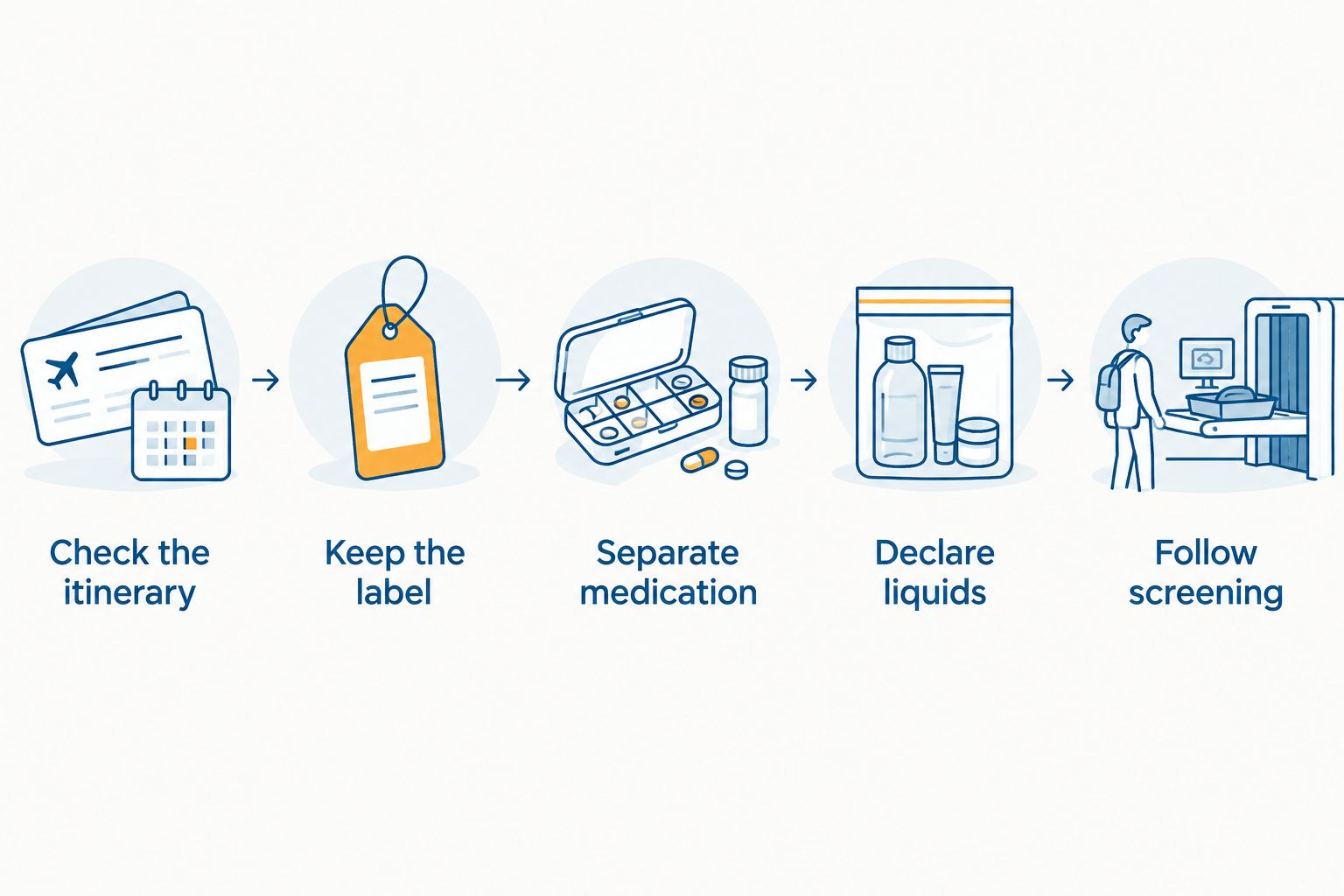
- Check the itinerary. Identify every airport where you will pass through security, including your return departure and connections requiring another screening.
- Keep the label. Pack the original labeled bottle when possible, together with your prescription information and any relevant medical documentation.
- Separate medication. Place the bottle somewhere accessible rather than underneath clothing or inside tightly packed luggage.
- Declare liquids. Tell the TSA officer you have medically necessary liquid medication before your belongings are screened.
- Follow screening. Present the medication as directed and explain any handling restrictions before inspection begins.
The sequence matters because a medical exemption still requires screening. Announcing the liquid before your bag enters the screening process gives the officer the information needed to handle it under the medical provisions.
Prescription and nonprescription liquids: medical necessity matters
TSA's liquid-medication exemption is not limited to prescription medicine. Medically necessary nonprescription liquids also qualify for the screening provisions.
That does not mean every health-related liquid receives the same treatment. Identify what the liquid is and why you need it rather than assuming the packaging makes its purpose obvious.
For your 2026 departure, keep a readable medication list alongside the bottle. Include the medicine's name, active ingredient, prescribed directions where applicable, and your clinician's contact details.
This list supports communication. It does not replace a prescription, import permit, or medical assessment when one is required.
Refrigerated medication: declare the cooling supplies too
Medically necessary ice packs, freezer packs, gel packs, and related cooling accessories have TSA screening provisions alongside medication. Tell the officer about those items, including packs that are partly melted or slushy.
Security permission does not establish a safe storage temperature. Follow the medication manufacturer's instructions and ask your pharmacist how to maintain them throughout your itinerary.
Consider the full journey: transport to the airport, screening, boarding, flight time, connections, and the trip to your accommodation. A cooler that works for the flight alone does not address the rest of that route.
Do not place medication directly against frozen packs unless its handling instructions permit that arrangement. Protecting a medicine from heat and protecting it from freezing are separate tasks.
Why liquid-medication screening varies
The medical exemption is consistent in purpose, but the inspection depends on what you present. These factors explain why another traveler's checkpoint experience is not a reliable script for yours:
- Quantity: TSA permits reasonable quantities for the trip, not an unlimited exemption for every bottle in your luggage.
- Container and packaging: Officers need to screen the liquid and its container; packaging affects how the item is presented for inspection.
- Screening method: Medically necessary liquids can receive additional inspection, including a request to open the container.
- Cooling accessories: Ice packs, gel packs, and other supplies require identification and screening alongside the medicine.
- Departure jurisdiction: TSA rules apply at U.S. checkpoints; another country's screening authority sets its own requirements.
- Security concerns: An item that raises an alarm or cannot be cleared requires further resolution before it proceeds.
Build your plan around these requirements, not a promise that a particular bottle will pass without questions. An exemption from the ordinary liquids limit is not an exemption from inspection.
What documents should I carry with liquid medication?
TSA does not require medications to be in prescription bottles, but state laws concerning prescription labeling still apply. International travel adds destination-specific requirements that are separate from TSA screening.
The practical recommendation is straightforward: retain the original labeled container whenever possible. Keep supporting information accessible rather than buried in checked luggage.
For a 2026 international itinerary, prepare the documents your route requires:
- Medication identification: The pharmacy label or original manufacturer packaging, with a readable medicine name.
- Prescription information: A copy of the prescription where applicable, including the active ingredient rather than only a brand name.
- Clinical explanation: A clinician's letter when required by the destination or useful for explaining medical supplies and handling needs.
- Import authorization: Any permit or approval required by the destination's medication rules.
- Storage instructions: The manufacturer's handling information, particularly for refrigerated medication.
A doctor's letter is supporting evidence, not universal permission. If a country requires advance authorization, carrying a letter instead does not satisfy that requirement.
Do I need to put liquid medication in my quart-sized bag?
Liquid medication over 3.4 ounces does not have to fit inside your quart-sized toiletries bag at a TSA checkpoint. Keep medically necessary liquids accessible and declare them before screening.
Separating medicine from toiletries also helps you explain which items need the medical exemption. Ordinary personal-care liquids remain subject to the standard rule.
Can I ask TSA not to X-ray my medication?
Liquid medication over 3.4 ounces still requires screening, but you can request inspection instead of X-ray screening before screening begins. TSA's medication guidance describes this option; the officer determines the inspection needed to clear the item.
Explain any concern about opening, handling, or exposing the medicine before inspection. Do not assume that a request removes the need for an alternative screening process.
Does TSA approval mean I can take the medication abroad?
Liquid medication over 3.4 ounces can satisfy TSA screening requirements without satisfying another country's import rules. Check the destination's official medication guidance and any applicable transit requirements separately.
This distinction matters especially for controlled medicines. A valid U.S. prescription does not establish that the medicine is legal everywhere on your itinerary.
How should I prepare for an international connection?
Map the journey by checkpoints, not just flight segments. A connection that requires another security inspection puts your medicine under that airport's screening rules.
For international travel in 2026, check the relevant airport or national aviation-security authority for liquid-medication requirements. Then check the destination's embassy, consulate, customs authority, or medicines regulator for import restrictions.
Keep these checks separate:
- Security screening: Can the liquid and its supplies pass through that checkpoint, and how must you present them?
- Medication import: Is the active ingredient permitted, what quantity is allowed, and is authorization required?
- Airline handling: What arrangements apply if your medical equipment or cooling setup needs carrier approval?
Do not assume cabin crew can refrigerate your medicine. Arrange a storage method that meets its instructions without depending on an unconfirmed onboard service.
Repeat the check for your return journey. Permission to depart the United States does not answer the rules at your overseas departure airport.
Keep a healthcare backup plan beside your packing plan
Passing security solves the transport question. It does not solve a lost bottle, a damaged supply, or the need to consult a clinician during your trip.
MyAbroadMDs is best for international travelers who want a personalized directory of English-speaking healthcare providers before departure. Its subscription-based healthcare preparation memberships address that planning task, rather than the checkpoint decision.
MyAbroadMDs provides curated healthcare-provider directories across 100+ countries. The benefit is preparation around your destinations; the boundary is equally important: it is not insurance, telehealth, or an appointment-booking service.
Use MyAbroadMDs healthcare preparation alongside your medication documents and destination checks, not instead of them. No directory establishes that your medicine is permitted, pays a medical bill, or guarantees a replacement prescription.
FAQ
Can I bring a full-size bottle of prescription liquid medicine in my carry-on?
Yes. TSA permits medically necessary liquid medication over 3.4 ounces in reasonable quantities for your trip. Declare it before screening and keep it accessible for inspection.
Does liquid medicine have to go in a clear plastic bag?
Medically necessary liquid medication does not have to fit inside the quart-sized toiletries bag at a TSA checkpoint. Separate it from ordinary liquids so you can present and declare it clearly.
Can I bring nonprescription liquid medicine over 100 milliliters?
Yes, medically necessary nonprescription liquid medicine can qualify for TSA's medical exemption above 100 milliliters. Identify it to the officer before screening rather than treating every health-related liquid as automatically exempt.
Will TSA make me open my medicine bottle?
TSA can require additional screening of liquid medication, including opening the container. Explain any handling restrictions before inspection and ask the officer about the screening process.
Can I bring melted ice packs for refrigerated medication?
Medically necessary cooling packs have TSA screening provisions even when partly melted or slushy. Declare them with the medication and follow the officer's instructions for inspection.
Do I need a doctor's note for liquid medication on a domestic flight?
TSA does not generally require a doctor's note for liquid medication at a U.S. checkpoint. Prescription-labeling laws and requirements outside the United States are separate, so keep the original labeling and check your route.
Can I put liquid medication in checked luggage instead?
Liquid medication can travel in checked luggage without the carry-on liquids limit, but checked baggage is not accessible during the flight. Keep medication you need with you and check the medicine's storage instructions before deciding where to pack it.
Are the liquid-medication rules the same on my return flight?
The return flight follows the rules of its departure airport's screening authority, not automatically TSA's rules. Check that authority's medical-liquid requirements and any medication import restrictions before your trip.
One last thing
Check the active ingredient, not just the name printed most prominently on the bottle. Brand names differ between countries, while medication restrictions and clinical discussions often depend on the ingredient itself.
Before your 2026 departure, save a readable medication list and the documents required for your route somewhere you can access without an internet connection. Prepare the medicine and the information together. Before you pack. Not at the checkpoint.