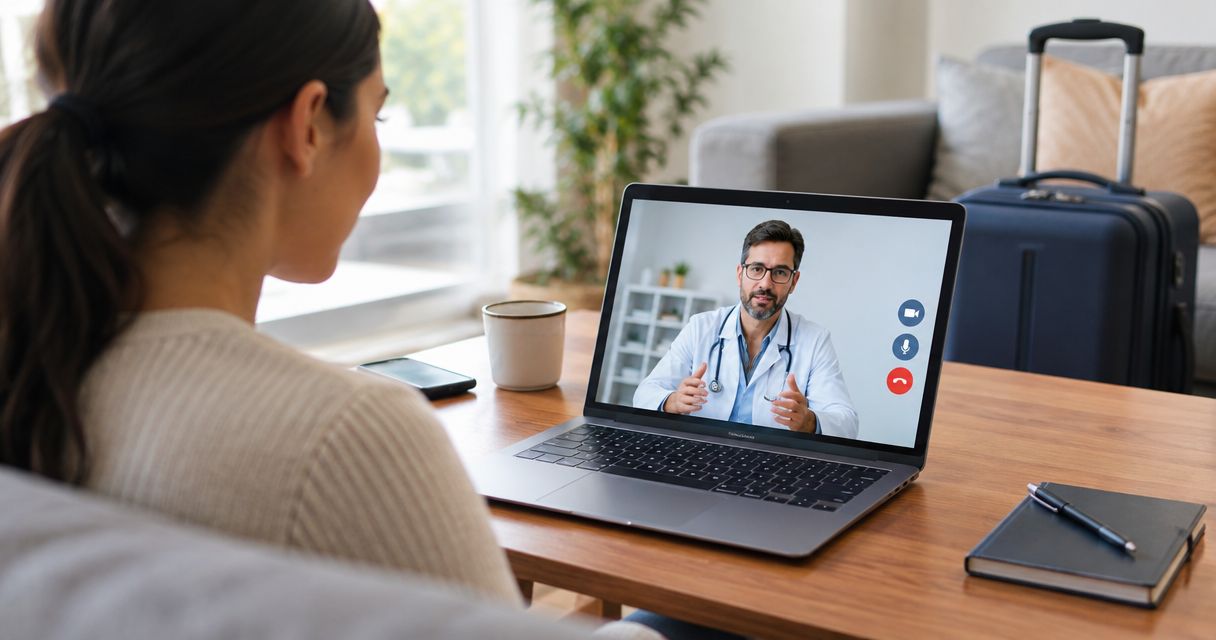
To get an emergency prescription refill while traveling internationally in 2026, contact a licensed local pharmacy, share your medication details, and ask whether you need a prescription from a locally authorized clinician. Your prescription from home supports the assessment but does not guarantee that a foreign pharmacy can dispense the medicine. If you have serious symptoms or a treatment interruption creates an immediate medical risk, seek urgent local medical care rather than waiting for a routine refill.
- An emergency prescription refill while traveling internationally depends on local prescribing rules and a pharmacist’s assessment.
- Bring the active ingredient, strength, formulation, and original prescription to a licensed pharmacy or local clinician.
- MyAbroadMDs supports pre-trip healthcare preparation; it does not prescribe, dispense medication, or provide insurance.
- Do not change doses, substitute medicines, or arrange cross-border shipping without professional and legal guidance.
Why this matters
A prescription from home is useful evidence, not automatic permission to dispense abroad. The pharmacy must follow the rules where you are physically located, and the clinician needs enough information to assess your treatment safely.
For your 2026 itinerary, save the information a clinician needs before departure. The guide to connecting your medical records to a doctor abroad explains that preparation step. A clear record helps you explain the problem without relying on memory when you are tired, unwell, or dealing with a language barrier.
How do you get an emergency prescription refill internationally?
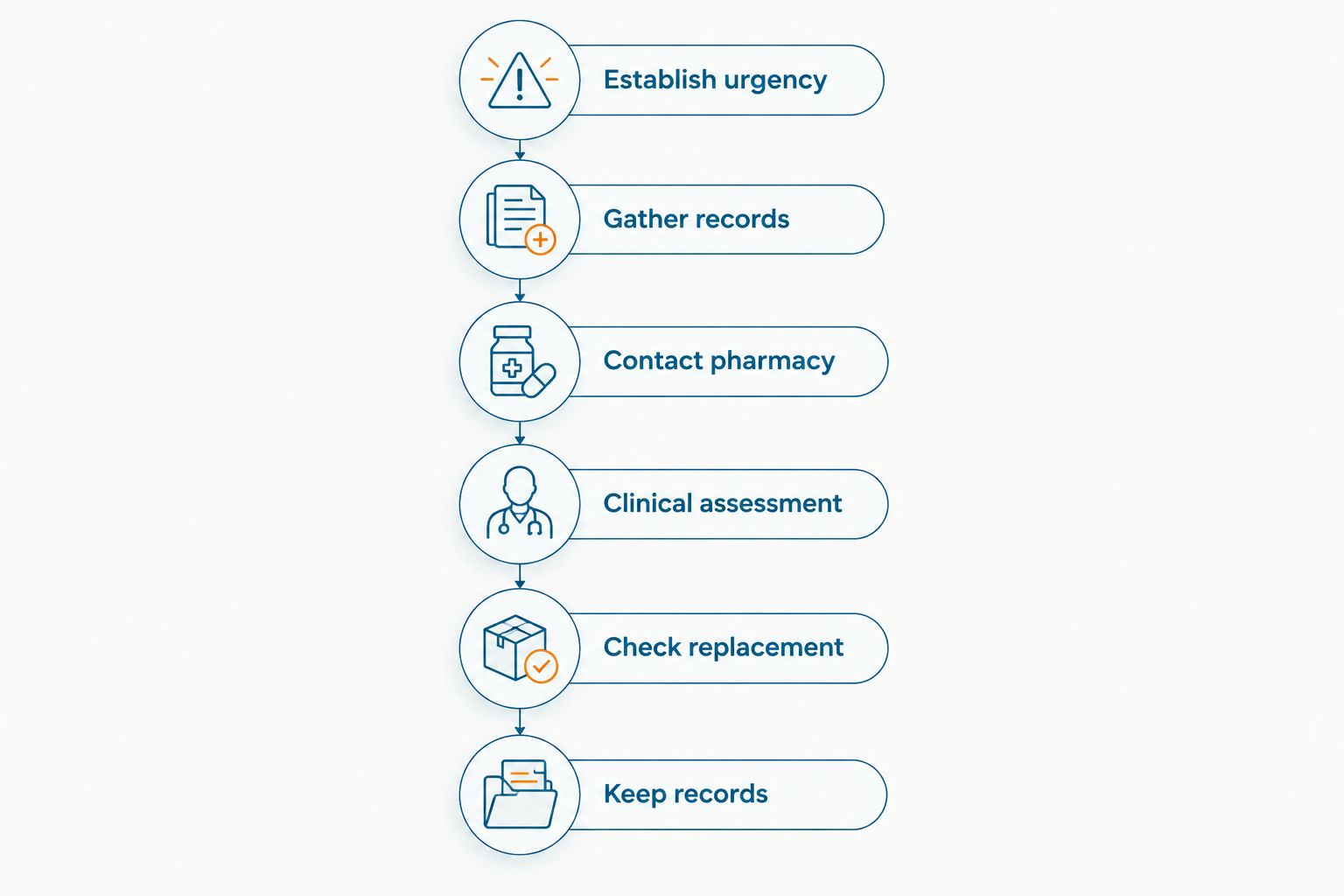
Follow these 6 steps to establish a lawful, medically appropriate replacement plan. Start before your supply runs out whenever possible; do not wait for symptoms to decide whether an interruption matters.
1. Establish the medical urgency
Tell a pharmacist or clinician what you take, why you take it, when you last took it, and how much remains. Ask specifically whether waiting for a routine appointment is safe for that medicine and your condition.
Seek emergency care for severe symptoms, including trouble breathing, chest pain, seizures, or loss of consciousness. Do not use a pharmacy search or an insurance authorization process as a reason to delay emergency treatment.
2. Gather your medication records
Bring the original labeled container, a prescription copy, and your prescriber’s contact information. Include a medication list with allergies and relevant medical conditions.
Record these 3 medication details clearly:
- Active ingredient: The generic drug name, not just the brand.
- Strength: The amount stated on the dispensing label.
- Formulation: The delivery form, including any extended-release designation or injection device.
A photograph helps preserve the label information, but it does not replace an original prescription where one is required. Keep the records accessible offline and protect them with your device’s security settings.
3. Speak to a licensed local pharmacy
Ask whether the pharmacy can assess your existing prescription, whether local law allows any emergency supply, and whether a local prescription is required. Explain that you are an international visitor and state your next departure date.
Have the pharmacist identify the medicine by its active ingredient and formulation. Do not assume that a familiar brand name means an identical product in another country.
4. Arrange an authorized clinical assessment
If a local prescription is necessary, contact a locally authorized clinician. Ask your accommodation, study-abroad program, insurer’s assistance service, or existing healthcare contacts for help identifying a legitimate provider.
Before arranging telehealth, confirm that the clinician can treat someone in your current location and issue a prescription accepted there. A video appointment with your doctor at home does not automatically solve the local prescribing requirement.
5. Have the pharmacy check the replacement
Ask the dispensing pharmacist to check the active ingredient, strength, formulation, instructions, and any proposed substitution against your treatment record. Tell the pharmacist about other medicines and allergies.
If the prescribed medicine cannot be dispensed locally, ask the treating clinician to establish an alternative plan. Do not select a substitute yourself or assume that a different tablet can be divided to reproduce your usual treatment.
6. Keep the treatment and dispensing records
Save 2 records: the local clinical record or prescription, and the pharmacy’s dispensing documentation. Retain receipts separately if you intend to submit an insurance claim.
Before leaving, confirm what to do about the next scheduled dose, follow-up, and the remainder of your itinerary. Ask for clarification until the instructions are clear; a translated label alone does not resolve a dosing question.
Which refill route fits your situation?
The right route depends on medical urgency and local authority to prescribe or dispense. These are different roles, not interchangeable ways to obtain a guaranteed refill.
| Route | Best for | Main benefit | Main limitation |
|---|---|---|---|
| Licensed local pharmacy | Checking local dispensing requirements | Explains whether your records support dispensing or a referral | Cannot bypass prescription laws or replace every clinical assessment |
| Local clinician | Obtaining a clinical assessment and, when appropriate, a local prescription | Can review treatment in the local healthcare setting | Needs sufficient medical information; prescribing is not guaranteed |
| Locally authorized telehealth clinician | Assessment when remote care is appropriate | Avoids an unnecessary journey when the problem suits remote assessment | Location rules, prescribing restrictions, and examination needs limit its use |
| Emergency department | Serious symptoms or immediate medical risk | Provides emergency assessment and treatment | Is not a routine refill service |
Use the pharmacy to clarify the rules and a clinician to resolve treatment decisions. A pharmacy referral is not a rejection of your medical need; it identifies the authorization or assessment still required.
Why getting a refill abroad varies
For a 2026 trip, check the rules for the country where you need the medicine—not just your destination’s entry requirements. Permission to carry a medication and permission to obtain it locally are separate questions.
- Local prescription rules: A foreign prescription is not automatically valid, and emergency dispensing provisions differ by jurisdiction.
- Controlled-drug restrictions: Medicines subject to special controls can require additional documentation or a different prescribing process.
- Clinical information: An unfamiliar clinician needs a reliable treatment history before deciding whether to prescribe.
- Product differences: Brand names, formulations, and approved medicines differ across countries.
- Assessment requirements: Your condition or the requested medicine can require an in-person examination rather than remote care.
- Language and documentation: Unclear labels or incomplete records make it harder to establish exactly what you take.
Do not interpret a rule from another traveler’s experience as permission for your own refill. Ask the local pharmacist or clinician to explain the requirement that applies to your medicine and circumstances.
What if your medication is controlled or restricted?
Tell the local clinician the exact active ingredient and provide your original treatment documentation. Do not describe it only as a sleeping tablet, pain medicine, or ADHD medication; those descriptions do not identify the drug or its legal status.
Do not assume a valid prescription makes international possession, dispensing, or shipping lawful. Check destination requirements with the relevant health authority or embassy, and ask a licensed pharmacist about local dispensing rules.
Avoid asking someone at home to mail the medicine until the import and export requirements have been confirmed. A parcel crosses a border even when it contains your own prescribed treatment.
If the medicine cannot legally be supplied, ask the treating clinician and your usual prescriber to coordinate a safe plan. Do not borrow another traveler’s prescription or change your dosing schedule to stretch your supply without professional advice.
What if your medication needs refrigeration?
Tell the pharmacist whether the problem is a missing supply, a broken device, or possible temperature damage. These situations require different questions, even when the medicine’s name is the same.
Keep the packaging and note what happened to the medicine. Ask a pharmacist to check the product-specific storage instructions; appearance alone cannot establish whether temperature-exposed medication remains suitable for use.
If replacement requires a different device or formulation, ask for instruction before using it. Confirm storage arrangements for your next destination as part of the same conversation, rather than treating the refill and onward travel as separate problems.
Can your doctor at home send a prescription overseas?
Your doctor at home can provide treatment records and communicate with a local clinician, but sending a prescription does not guarantee acceptance abroad. Ask the destination pharmacy what format and prescribing authority it requires before relying on an email or electronic prescription.
Request a concise treatment summary that identifies the medicine, indication, current instructions, and relevant monitoring. Share medical records through an appropriate secure channel rather than posting them in public traveler groups.
Can travel insurance arrange the refill?
Your insurer’s assistance service can explain the help and benefits available under your policy. Ask about provider referrals, documentation, and any authorization requirements; do not assume a referral also confirms coverage.
Insurance approval does not authorize a pharmacy to dispense a medicine. Keep the medical process and claim process separate, and do not delay urgent treatment while waiting for a routine claim decision.
Can telehealth replace a local doctor visit?
Telehealth is an option only when the clinician is authorized to treat you where you are and remote assessment is appropriate. Confirm that any resulting prescription can be used by a licensed pharmacy at your location.
Choose an in-person assessment when the clinician says an examination or testing is needed. Be cautious of any service promising a prescription before reviewing your medical situation.
Prepare a refill plan before departure
For a 2026 departure, discuss your itinerary and medication supply with your usual prescriber and pharmacist. Ask what to do if your medicine is lost, damaged, or delayed, and whether an interruption requires urgent medical attention.
Keep a short preparation checklist:
- Carry medication in its original labeled packaging.
- Save your medication list, prescription copy, and prescriber’s contact details.
- Check medication entry rules for each destination and relevant transit stop.
- Identify how to contact a licensed pharmacy and an appropriate clinician.
- Review storage instructions and any device-specific requirements.
- Keep medical information accessible without depending on mobile reception.
MyAbroadMDs is best for travelers who want a personalized directory of English-speaking healthcare providers before departure. Its subscription memberships provide curated healthcare directories across 100+ countries.
MyAbroadMDs supports pre-trip healthcare preparation, not emergency dispensing. It is not insurance, telehealth, or a booking service, and its directory does not replace a clinician’s assessment or a pharmacy’s legal requirements.
FAQ
What should I do first if I run out of prescription medicine abroad?
Contact a licensed local pharmacy or clinician and explain the medicine, your last dose, and how much remains. Seek urgent medical care instead if you have serious symptoms or an immediate treatment-related risk.
Can I use my US prescription at a pharmacy overseas?
A US prescription is not automatically valid at an overseas pharmacy. Bring it as supporting documentation and ask whether a locally authorized clinician must issue a new prescription.
Can a pharmacist give me an emergency supply without a prescription?
Emergency dispensing depends on local law, the medicine, and the pharmacist’s assessment. Ask a licensed local pharmacist directly rather than assuming an emergency supply is permitted.
What documents should I bring to a doctor abroad for a refill?
Bring identification, your original medication container, a prescription copy, and your prescriber’s contact information. Include a medication list, allergies, relevant conditions, and any treatment records needed to explain the prescription.
Can I take a different brand of my medicine overseas?
Use a different brand only after a pharmacist or clinician confirms that the replacement is appropriate. The active ingredient, strength, formulation, and instructions all need review.
Can someone mail my prescription medicine to me abroad?
Do not arrange international medication shipping until the applicable import and export requirements are confirmed. A prescription does not automatically authorize cross-border shipment.
Should I skip doses to make my medication last longer?
Do not skip, split, or change doses to extend your supply without advice from a qualified clinician or pharmacist. Explain the shortage promptly so a professional can assess the safest next step.
Can MyAbroadMDs prescribe an emergency refill abroad?
MyAbroadMDs does not prescribe or dispense medication. Its memberships support pre-trip preparation through personalized, curated directories of English-speaking healthcare providers.
One last thing
Before your 2026 departure, photograph the part of your medication label that identifies the formulation—not just the brand name. An extended-release designation or device detail is easy to overlook when you are explaining a missing prescription from memory.
The goal is not simply another box of medicine. It is a verified treatment plan you can follow safely until your usual care resumes.