
There is no single worldwide limit on how much prescription medication you can travel with abroad in 2026: the permitted amount depends on the destination, the medicine’s active ingredient, and any required authorization. A prescription does not override an import restriction, and airport security clearance does not establish that your medication is legal at your destination. Check every country on your itinerary before deciding how much to pack.
- How much prescription medication can you travel with abroad? Check each destination’s ingredient, quantity, and authorization rules.
- Airport security approval is not permission to import prescription medication into another country.
- Myabroadmds suits travelers seeking English-speaking doctor directories, not medication import authorization.
- Plan prescription refills before departure; a home-country prescription does not guarantee dispensing abroad.
How much prescription medication can you legally travel with abroad?
Your legal allowance is the amount permitted under the applicable rules for your specific medicine—not simply the amount your doctor prescribed. Establish that allowance before requesting a vacation refill or filling a pill organizer.
For a 2026 itinerary, use this sequence to turn a general question into a packing decision:
- Identify the ingredient. Record the generic name, strength, dosage form, prescribed daily dose, and total quantity you intend to carry. Brand names alone are not enough to match a medicine to an official restriction.
- Map the route. List your destination countries and transit points. Ask whether medication rules apply to your particular connection, including whether you will collect baggage or pass through immigration.
- Check official rules. Consult the destination’s medicines regulator, customs authority, or embassy. Look for personal-use limits, prohibited ingredients, controlled-drug requirements, and required supporting documents.
- Obtain authorization. If a permit, certificate, or advance approval is required, complete that process before departure. Keep the approval with your prescription documentation.
- Match the quantity. Compare your packed amount with the applicable allowance and any authorization. Recheck the calculation if your prescription, dose, or itinerary changes.
The separate guide to bringing prescription medication through airport security addresses screening. Use destination import guidance to decide what you can legally bring across the border.
Why this matters
A medication plan has separate questions: Can you carry the medicine through screening? Can you import it? Can you obtain more locally? Answering one does not settle the others.
That distinction matters most when you depend on uninterrupted treatment. Packing extra without checking the rules is not a substitute for planning, and packing less without arranging continuity creates a different problem. The useful goal is a lawful supply paired with a documented backup plan.
Before your 2026 departure, keep the relevant official guidance alongside your travel documents. Save the issuing authority, the date you checked it, and the rule that applies to your ingredient. A saved page helps you prepare; it does not replace a required permit or declaration.
Ordinary prescription medicines: Check the personal-use allowance
For medicines that are not subject to special controls, start with the destination’s personal-import rules. Check how the authority defines the allowance: by treatment duration, quantity, packaging, or another stated condition. Do not substitute a familiar rule from a previous trip.
Calculate treatment duration from your actual prescription instructions. A bottle’s tablet count and its days of treatment are not interchangeable, particularly when doses vary. Ask your pharmacist to help reconcile the label, prescription, and packed amount if the calculation is unclear.
Best for: travelers carrying an established prescription for personal treatment. The advantage is that you can prepare a clear medication record before departure. The limitation is that personal use alone does not establish permission to import any quantity you choose.
Keep the medicine in its original labeled packaging wherever possible. If an official rule requires particular packaging, follow that requirement rather than relying on a pill organizer and a photograph of the label.
Controlled medicines: Check the ingredient before the quantity
Do not assume a familiar prescription has the same legal classification abroad. Some medicines used for pain, attention disorders, anxiety, or sleep fall under controlled-drug rules in particular destinations. Check the exact ingredient rather than treating an entire therapeutic category as either permitted or prohibited.
The International Narcotics Control Board publishes country information for travelers carrying medicines containing internationally controlled substances. Use that information to identify relevant requirements, then confirm the instructions with the responsible destination authority. Do not treat a summary as permission when an application or certificate is required.
Best for: travelers whose medicine requires a controlled-drug check before departure. Early verification gives you time to address documentation with your prescriber. The limitation is that a supporting letter does not cancel an ingredient prohibition or replace official authorization.
Never reduce, stop, or replace a prescribed medicine solely to simplify border paperwork. Discuss lawful treatment alternatives with your prescriber if the destination does not permit your current medication.
Long stays: Separate the import allowance from refill planning
A semester, extended assignment, or open-ended itinerary needs more than a larger bottle. First establish what you can bring legally. Then determine how you will maintain treatment after that supply runs out.
Ask a suitably licensed local clinician about assessment and prescribing requirements before relying on a refill abroad. Confirm the active ingredient, formulation, and strength with a local pharmacy through appropriate channels. A matching brand name is not sufficient evidence that two products are interchangeable.
Best for: students, remote workers, and other travelers whose treatment extends beyond their permitted imported supply. Local care planning supports continuity. The limitation is that a consultation does not guarantee a particular prescription or medicine.
Do not assume mailing medication later solves an import limit. Postal shipments can have different requirements from medicines carried in your luggage. Verify that route separately before anyone sends a package.
Which medication travel situation applies to you?
Choose your next action by the legal question, not by the size of your suitcase. These situations can overlap: an injectable medicine, for example, can also require a controlled-drug check.
| Situation | Best for | Main action | Benefit of preparing | Limitation |
|---|---|---|---|---|
| Ordinary prescription supply | Established personal treatment | Check personal-import conditions | Aligns the packed amount with the applicable rule | A prescription alone does not establish the allowance |
| Controlled medicine | Ingredients needing additional scrutiny | Check restrictions and authorization | Identifies required approvals before departure | A doctor’s letter cannot override a prohibition |
| Extended treatment abroad | Trips exceeding the imported supply | Arrange a local-care plan | Addresses continuity beyond the initial supply | Local prescribing is not guaranteed |
| Injectable or refrigerated medicine | Treatment with equipment or storage needs | Check import, screening, and storage separately | Keeps legal and handling requirements distinct | A travel case does not establish legal permission |
For injectable or refrigerated medication, ask your pharmacist about the product’s specific storage instructions. Also check requirements for accompanying needles, syringes, and cooling materials. Permission to carry the medicine does not answer every question about its equipment or transport conditions.
Why the permitted amount varies
There is no reliable universal packing allowance because the applicable rules address different medicines and travel circumstances. These are the factors to check rather than guess:
- Destination rules. Each destination sets its own requirements for travelers bringing medicines across its border.
- Active ingredient. The ingredient determines which restrictions to investigate; the commercial name can obscure that distinction.
- Legal classification. A medicine subject to controlled-drug requirements needs a different check from an ordinary prescription product.
- Quantity and dosing. The packed amount must be assessed using the measure specified by the authority, not an assumed definition of a bottle or treatment course.
- Route and border crossings. Connections, stopovers, and onward destinations require route-specific checks. Ask the relevant authority about your actual transit arrangement.
- Required documentation. A prescription, certificate, permit, and customs declaration serve different purposes. Establish which ones apply to your medicine.
A longer trip does not automatically create a larger legal allowance. Likewise, a small amount does not automatically make a restricted ingredient permissible.
Build a medication file before departure
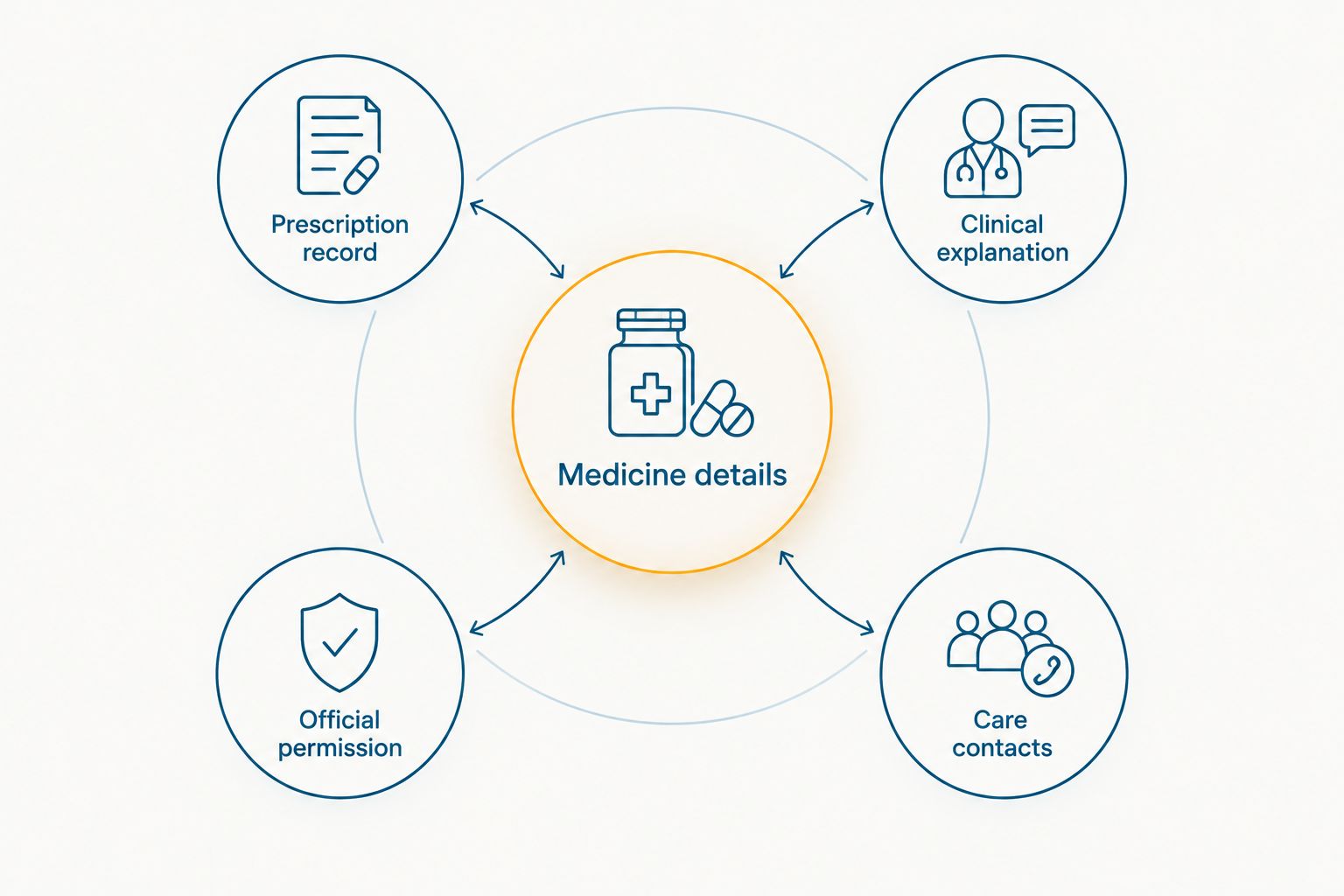
Create a file you can use at a border, with a clinician, or when discussing a replacement prescription. Keep a paper copy accessible and a secure digital backup. Protect medical information as you would other sensitive travel documents.
Organize the file under these headings:
- Medicine details: Generic name, brand name where relevant, strength, formulation, prescribed dose, and packed quantity.
- Prescription record: A copy of the prescription and the dispensing label identifying the patient and medicine.
- Clinical explanation: A prescriber’s letter when required or appropriate, explaining the treatment and associated equipment.
- Official permission: Any required import authorization, certificate, or other approval.
- Care contacts: Your prescriber’s contact information and the local-care arrangements you have confirmed.
Ask the destination authority whether documents need a particular language, format, certification, or original signature. Do not assume an English-language letter meets every destination’s requirements.
Use the same ingredient and quantity information throughout the file. Conflicting labels, letters, and permit applications create avoidable uncertainty.
Can I bring extra medication in case my trip is delayed?
An extra supply must still fit the destination’s rules and any authorization. Ask your prescriber about an appropriate contingency supply, then verify that the total packed quantity is lawful. Medical usefulness and import permission are separate decisions.
For a 2026 trip with multiple destinations, check the full amount you expect to carry when entering each country. Do not assess only the first arrival and assume the rest of the itinerary is covered.
Does a doctor’s letter make my medication legal abroad?
A doctor’s letter supports your documentation; it does not override the destination’s law. It can explain the prescription, dose, and medical equipment, but it cannot replace a required permit or make a prohibited ingredient permissible.
Ask the relevant authority exactly what evidence it accepts. Keep its answer with your application or travel records, especially when your medicine requires individual authorization.
Can I use my existing prescription for a refill overseas?
Your existing prescription does not guarantee that a pharmacy abroad can dispense the medicine. Local prescribing rules, the medicine’s classification, and the product available locally determine the next steps. Arrange a clinical assessment when required rather than assuming a pharmacy can transfer your prescription.
For pre-trip healthcare preparation, Myabroadmds offers subscription memberships with personalized, curated directories of English-speaking doctors and healthcare providers across 100+ countries. Myabroadmds is best for international travelers and study-abroad students seeking an English-speaking doctor directory before departure. It is not insurance, telehealth, or a booking service, and it does not establish medication import permission or guarantee a prescription.
FAQ
How much prescription medication can you travel with abroad in 2026?
There is no single worldwide allowance for prescription medication abroad in 2026. Check the destination’s rules for the exact ingredient, quantity, documentation, and any required authorization.
Can I bring my entire prescription bottle overseas?
Only if the medicine and the amount meet the applicable destination requirements. The fact that a pharmacy dispensed a full bottle does not establish permission to import it.
Does passing airport security mean my medication is legal abroad?
No. Airport screening and permission to import medication are separate matters, so check both before departure.
Do I need to check countries where I only change planes?
Check the requirements for your particular transit arrangement. Tell the relevant authority whether you remain airside, collect baggage, or pass through immigration.
Can I put all my prescription medication in a pill organizer?
Do not rely on a pill organizer as your only identification for medication. Check destination packaging requirements and keep original labeled packaging wherever possible.
Can someone mail my prescription medication after I arrive?
Do not assume medication can be mailed legally because you can carry it personally. Check the destination’s postal import requirements before arranging a shipment.
Can Myabroadmds authorize my medication or prescribe a refill?
No. Myabroadmds provides personalized, curated English-speaking healthcare-provider directories through subscription memberships; it is not an import authority, telehealth service, insurer, or booking service.
One last thing
Before you pack for your 2026 departure, check the smallest detail on the label: the active ingredient. That is the starting point for the legal check, even when the brand name is familiar.
Do not change treatment to fit your suitcase. Build the lawful travel plan around your prescribed care. If the import rules and your treatment needs conflict, resolve that with your prescriber and the relevant authority before departure.