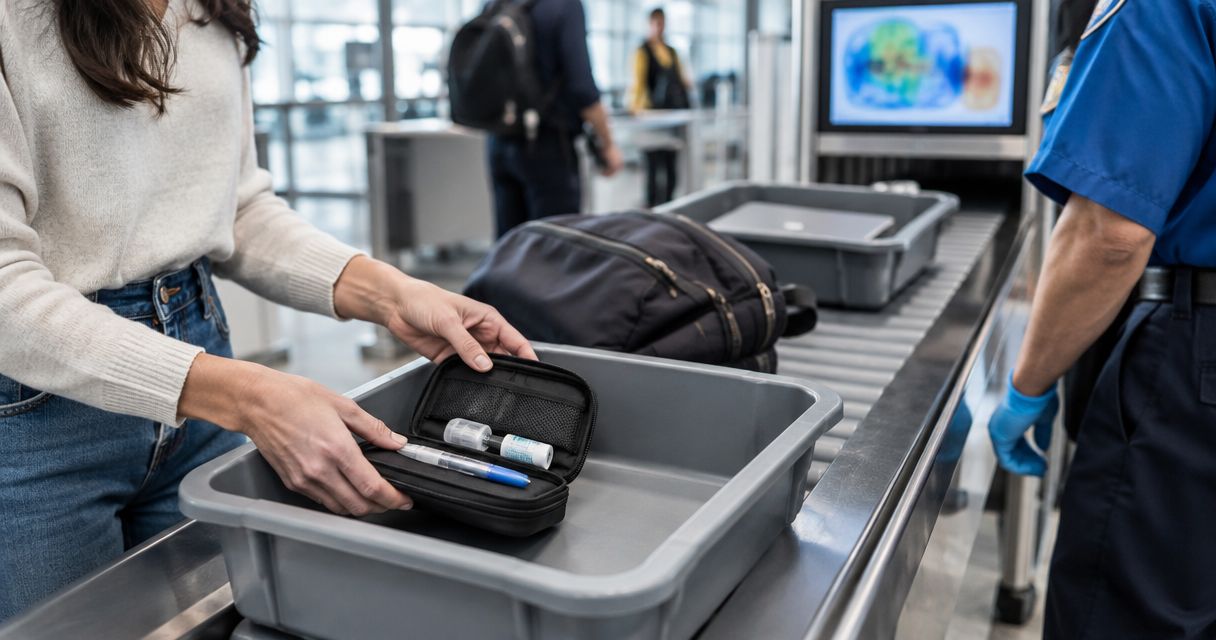
Yes, you can bring insulin through airport security on international flights, including in your carry-on bag; at U.S. checkpoints, TSA permits medically necessary liquids above the usual 3.4-fluid-ounce (100-milliliter) limit when you declare them for screening. That permission does not replace destination-country medication import rules or the screening requirements at connecting airports. For a 2026 departure, keep insulin accessible, identify your supplies before screening, and follow the storage instructions for your exact insulin product.
- Can you bring insulin through airport security? Yes—TSA permits insulin and medically necessary cooling supplies with screening.
- International flights require separate checks for airport security, medication import rules, and insulin storage.
- Keep insulin in your carry-on; follow manufacturer instructions for pumps, sensors, and temperature limits.
- MyAbroadMDs supports pre-trip doctor-directory preparation, not insurance, telehealth, or appointment booking.
Can you bring insulin through airport security on international flights?
Yes. TSA allows insulin through U.S. airport security, including liquid insulin above the standard carry-on liquids limit. Declare medically necessary liquids and cooling supplies before screening begins, and present them separately as directed. TSA's guidance on medications and diabetes supplies is the relevant source for U.S. checkpoints—not a worldwide customs authorization.
The same distinction applies to other prescriptions. The guide to bringing prescription medication through airport security explains the broader security question; insulin also requires attention to cooling, injection supplies, and attached devices.
Use this sequence for your 2026 itinerary:
- Check every relevant country. Review medication import requirements for your destination and any transit country where those rules apply. Use the destination's embassy, consulate, health ministry, or customs authority rather than assuming a U.S. prescription settles the question.
- Check every security checkpoint. Read the departure airport's screening guidance and the rules for any connection involving another security check. A TSA allowance governs a U.S. checkpoint, not every airport on your ticket.
- Pack insulin within reach. Keep insulin, delivery supplies, monitoring supplies, and your treatment information in the cabin. Arrange the bag so you can explain and present the medical items without unpacking your entire carry-on.
- Declare medical liquids and cooling supplies. Tell the screening officer about insulin, medically necessary ice or gel packs, and associated equipment before the bag enters screening. Follow instructions for separating those items.
- Identify attached devices before screening. Tell the officer if you wear an insulin pump or continuous glucose monitor. Follow the exact manufacturer's instructions about X-ray equipment and body scanners, and request an appropriate alternative screening process when needed.
- Recheck the kit after screening. Confirm that your insulin, supplies, cooling materials, and documents are back in your bag. Keep them with you through boarding, especially if staff ask to place your cabin bag in the hold.
Why this matters
Getting through security is only one part of traveling with insulin. You also need medicine that remains usable, a delivery method you understand, and a plan if supplies are lost or damaged abroad.
Security permission, import permission, and safe storage are separate checks. An officer allowing a vial through a checkpoint does not confirm that your destination accepts the quantity you are carrying. Nor does it confirm that a cooler will maintain the temperature your medicine requires.
For international travel in 2026, prepare around the whole itinerary: departure, connections, arrival, and the return journey. A connection that requires another security check deserves its own review, even when you never planned to leave the airport.
What can travel with your insulin?
TSA's published guidance permits diabetes-related supplies through screening, including insulin, associated injection supplies, and medically necessary cooling accessories. Each item still has screening requirements. Keep related supplies together so their purpose is clear.
| Item | Best for | Main benefit | Limitation or action |
|---|---|---|---|
| Insulin vials or pens | Carrying your prescribed insulin | Permitted through TSA screening as medication | Declare liquid medication; check destination import rules separately |
| Unused syringes and pen needles | Administering prescribed injectable medication | TSA permits unused syringes when accompanied by injectable medication | Declare them and keep them with the medication |
| Insulin pump | Travelers already prescribed pump therapy | Keeps the prescribed delivery system with you | Screening restrictions depend on the exact manufacturer's instructions |
| Continuous glucose monitor | Travelers already using glucose monitoring | Keeps monitoring equipment accessible | Check instructions for the sensor, transmitter, and receiver separately |
| Medical ice or gel packs | Insulin that needs cooling during the journey | TSA permits medically necessary cooling accessories | Declare them; additional screening can apply |
| Used sharps container | Carrying used needles safely | Contains used sharps for transport | Use an appropriate hard-surface container and follow applicable disposal rules |
This is a packing comparison, not a recommendation to change treatment. Do not switch insulin delivery methods just to simplify airport screening. Ask your diabetes clinician to plan any treatment changes before departure.
Are insulin pens treated differently from vials?
Insulin pens and insulin vials both contain medication. At a U.S. checkpoint, the medical-liquid allowance matters more than the container's shape; keep pen needles and other associated supplies identifiable.
Storage instructions still differ by product and whether the insulin is unopened or in use. Do not transfer the instructions from a familiar vial to a different pen without checking its labeling.
How should you pack insulin for an international flight?
Keep insulin in your carry-on, not in checked luggage. Cabin access lets you use your supplies during the flight and keeps them with you if checked bags are delayed. It does not eliminate the need to protect insulin from unsuitable temperatures.
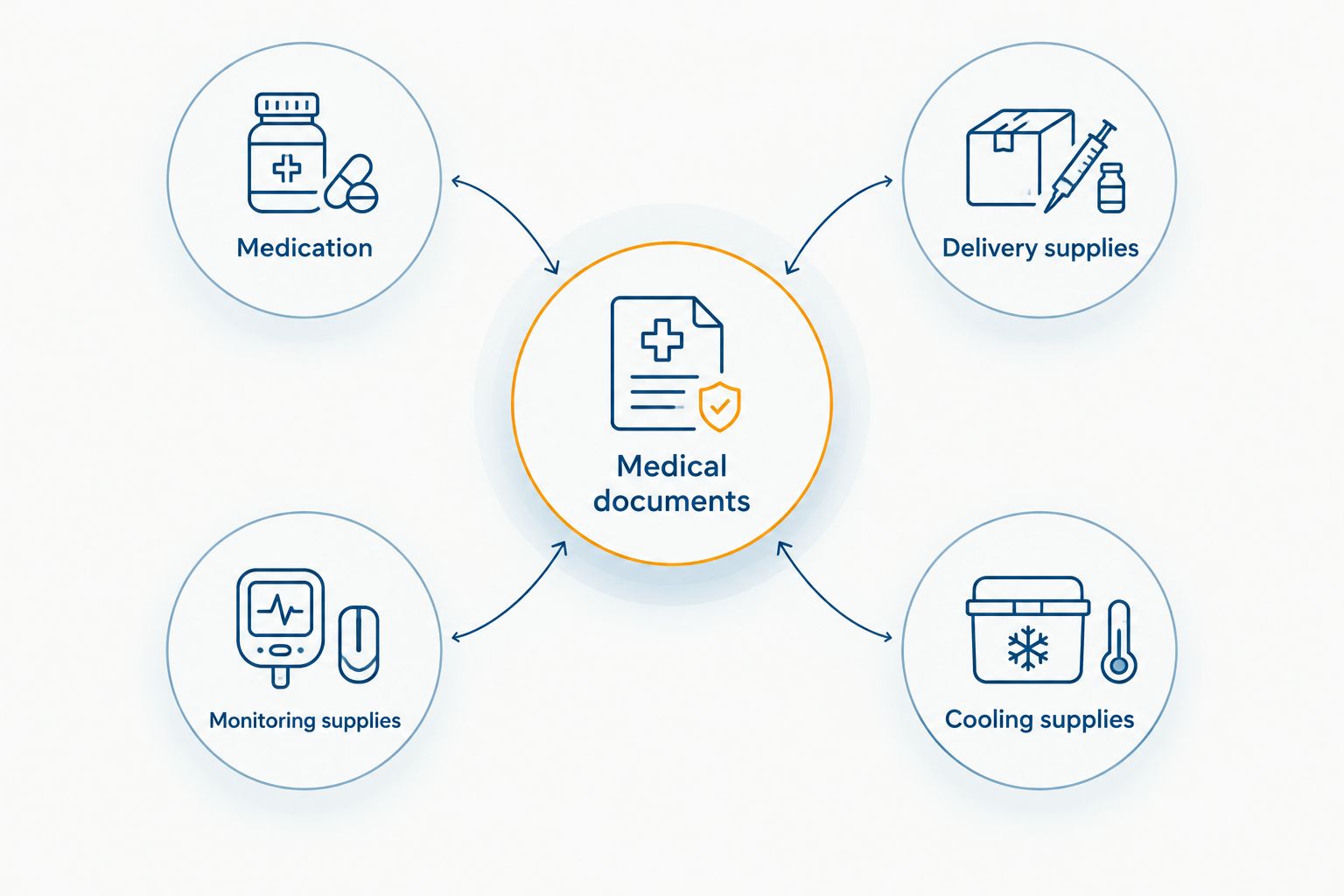
Pack the kit around its functions:
- Medication: Your prescribed insulin, with identifying packaging where practical.
- Delivery supplies: The needles, syringes, or pump supplies your treatment requires.
- Monitoring supplies: Your usual monitoring equipment and the backup method agreed with your clinician.
- Cooling supplies: A suitable carrier and cooling materials when required by the insulin's instructions.
- Medical documents: Prescription details, medication names, and contact information for your treating clinician.
Keep essential items in a smaller medical bag that you can remove from a larger cabin case. If staff gate-check that case, take out the medical bag before surrendering it. Do not wait until the bag is moving away to explain that it contains insulin.
A useful final check is practical rather than technical: can you reach your insulin and monitoring supplies while seated, and can you identify everything without relying on an internet connection? Save important documents offline and keep a readable paper copy.
Do insulin and cooling packs follow the liquids rule?
At U.S. checkpoints, medically necessary liquid medication can exceed 3.4 fluid ounces (100 milliliters). TSA instructs travelers to declare these items and separate them from other belongings for screening. Liquid medication does not have to go inside the ordinary quart-size liquids bag.
TSA also permits medically necessary ice packs, freezer packs, and gel packs, including when their condition would otherwise raise questions under ordinary liquids screening. Tell the officer that they are cooling medication. Expect inspection or additional screening rather than assuming a medical label makes the bag exempt.
The medical-liquid exception is not an exemption from security screening. Allow time to explain the contents and ask about an alternative inspection before an item enters equipment that conflicts with its manufacturer's instructions.
For a 2026 return flight, check the local security authority again. Do not use a successful outbound TSA screening as proof that a foreign checkpoint follows the same process.
How do you keep insulin at the right temperature?
Follow the storage label for your exact insulin. Many unopened insulin products specify refrigeration at 2°C–8°C, but in-use limits and permitted time outside refrigeration differ by product. A general travel checklist cannot replace those instructions.
Do not freeze insulin or place it directly against frozen cooling packs. Use the carrier as directed, with appropriate separation between medicine and cooling materials. A cooler's presence alone does not establish that the insulin stayed within its permitted range.
Before departure, write down:
- The insulin's exact name and concentration.
- Its unopened storage requirements.
- Its in-use temperature and time limits.
- The manufacturer's advice for a suspected temperature excursion.
- Where you will store it after arrival.
Ask accommodation staff about refrigeration arrangements before you rely on them. Keep insulin away from freezer compartments and other freezing surfaces, and do not assume that an aircraft refrigerator is available for passenger medication.
If insulin freezes, overheats, or spends time outside its labeled limits, ask a pharmacist or the manufacturer what to do. Appearance alone does not establish that insulin remains suitable for use. Do not make an improvised dosing adjustment to compensate for suspected damage.
Why insulin screening requirements vary
The factors behind a different checkpoint experience are concrete. For your 2026 trip, review these separately rather than looking for a single worldwide insulin travel rule:
- Security jurisdiction: TSA guidance applies at U.S. checkpoints; foreign authorities publish their own screening requirements.
- Medication import rules: Destination authorities determine documentation, quantity restrictions, and any advance permissions.
- Insulin presentation: Vials, pens, and pump reservoirs involve different packaging and handling needs.
- Attached devices: Pump and glucose-monitor manufacturers specify which screening methods their equipment can undergo.
- Cooling materials: Medical liquids and cooling packs need identification and can require additional screening.
- Connection arrangements: Another security checkpoint creates another opportunity for inspection under local rules.
The next move is specific: make a short itinerary checklist with a separate entry for each airport where screening occurs. Beside it, record the relevant security authority and your device manufacturer's instructions. Keep customs requirements in a separate column so you do not confuse entry permission with screening permission.
Do you need a doctor's letter to fly with insulin?
TSA does not require a doctor's letter simply to bring insulin through a U.S. checkpoint. A prescription copy and a clinician's letter can still help explain your medication, supplies, and devices; another country's entry requirements are a separate question.
Ask your clinician to use the insulin's generic name, concentration, delivery method, and the supplies you need. Check whether your destination requires particular wording, translation, or advance authorization before treating that letter as sufficient.
Can an insulin pump go through an airport scanner?
An insulin pump's screening instructions depend on the exact model and manufacturer. Do not assume that instructions for another pump—or for another traveler's glucose monitor—apply to yours.
Before screening, identify the attached device and explain any manufacturer restriction. Request the appropriate alternative inspection rather than disconnecting equipment or changing insulin delivery without your established clinical plan.
What if you lose insulin after arriving abroad?
Arrange a local medical assessment and contact your insurer or assistance provider if you have one. Bring your prescription details and insulin concentration; familiar brand names, local availability, and prescription acceptance are not guaranteed across borders.
MyAbroadMDs is best for international travelers who want a curated English-speaking doctor directory before departure. Its subscription-based healthcare preparation memberships provide personalized directories across 100+ countries. MyAbroadMDs is not insurance, telehealth, or a booking service, and a directory does not guarantee an appointment or replacement insulin.
Add a local-care plan to your 2026 packing list before you need a refill. Doctor-directory preparation addresses whom to contact; your clinician, pharmacist, and destination authorities address treatment, dispensing, and import requirements.
FAQ
Can you bring insulin through airport security in a carry-on?
Yes, TSA permits insulin in carry-on bags, including medically necessary liquid quantities above the ordinary liquids limit. Declare the insulin before screening and check foreign checkpoint rules separately.
Does insulin have to fit in the airport liquids bag?
No, TSA does not require medically necessary liquid medication to fit inside the ordinary quart-size liquids bag. Present it separately for screening as directed.
Can I bring insulin needles on an international flight?
TSA permits unused syringes when accompanied by injectable medication. Declare them, keep them with your insulin, and check the requirements for your destination and connecting airports.
Can I take gel packs through security for insulin?
Yes, TSA permits medically necessary cooling packs for medication. Declare them before screening, including packs that are partly melted, and follow inspection instructions.
Should I put insulin in my checked suitcase?
Keep insulin in your carry-on so it remains accessible and with you if checked baggage is delayed. Remove your medical kit if your cabin bag is taken for gate-checking.
Can airport scanners damage an insulin pump or glucose monitor?
Screening restrictions depend on the exact device's manufacturer instructions. Identify the device before screening and request an appropriate alternative when those instructions restrict scanner exposure.
Does a doctor-directory membership replace travel medical insurance?
No, MyAbroadMDs provides pre-trip healthcare preparation through curated English-speaking doctor directories. It is not insurance, telehealth, or an appointment-booking service.
One last thing
The gate-check decision deserves the same attention as the security checkpoint. A correctly packed insulin kit stops being accessible if it stays inside a bag handed over at boarding.
Make the medical kit removable before leaving home. Then prepare the people, paperwork, and storage plan behind it. Before you pack. Not after something goes wrong.