
Instead of repeating your symptoms, insurer details, and document requests at every handoff, use this 2026 workflow to connect your travel insurance inquiry, English-speaking doctor search, appointment, and claim paperwork. For a medical emergency, seek local emergency care immediately; do not wait for insurer approval or a directory search.
- Travel insurance claim English speaking doctor abroad workflow: confirm insurer requirements, arrange care, retain records, then submit.
- MyAbroadMDs is best for travelers preparing an English-speaking doctor directory before departure, not arranging insurance coverage.
- A directory listing does not establish insurer approval, direct billing, or appointment confirmation.
- Keep insurer instructions, clinical records, and payment evidence together without treating them as interchangeable.
Why this matters
Finding a doctor and making an insurance claim solve different problems. MyAbroadMDs provides subscription-based memberships with personalized, curated directories of English-speaking doctors and healthcare providers across 100+ countries. It is not insurance, telehealth, or a booking service.
MyAbroadMDs is best for international travelers and study-abroad students who want an English-speaking doctor directory prepared before departure. The benefit is preparation; the limit is that a directory cannot determine your policy benefits or confirm a clinic appointment.
For your 2026 itinerary, keep provider discovery separate from coverage decisions. An English-speaking doctor can help you communicate during a visit, but language access does not establish whether your insurer will reimburse that visit.
Who handles each part?
Use these roles together rather than treating them as substitutes. Each has a useful function and a clear boundary.
| Resource | Best for | Main benefit | Limitation |
|---|---|---|---|
| MyAbroadMDs doctor directory | Preparing provider contacts before departure | Personalized, curated English-speaking provider information | Does not provide insurance, telehealth, or appointment booking |
| Your travel insurer or its designated assistance contact | Checking policy requirements | Instructions about the policy and claim process | Does not replace clinical assessment or confirm every clinic's arrangements |
| The treating clinic | Confirming the appointment and receiving care | Clinical assessment and visit documentation | Cannot settle your insurer's final coverage decision |
Before you start
- Gather your access details. Keep your policy documents, policy number, insurer contact instructions, and claim-submission access together. If you use a doctor-directory membership, have the directory information ready too.
- Prepare your visit information. Write down your destination, travel dates, symptoms, medications, allergies, and relevant medical history. Create 1 folder per traveler so medical and claim records stay separate.
- Catch the authorization mismatch early. A listed doctor is not automatically insurer-approved, and an appointment confirmation is not coverage confirmation. For non-emergency care, ask your insurer whether authorization, a particular provider, or specified paperwork is required before treatment.
Check the policy that applies to your actual 2026 travel dates. Do not substitute an old email, a previous trip's approval, or a clinic's general statement about accepting insurance for instructions about this visit.
Insurer instructions and case record
Establish the insurance handoff
- Identify the correct contact. Use the assistance or claims contact shown in your policy documents. Explain whether you need help arranging non-emergency care, understanding authorization requirements, or submitting expenses after treatment.
- Describe the situation consistently. Give your location, travel dates, reason for seeking care, and any provider you are considering. Report symptoms accurately; do not choose a diagnosis simply because a claim form asks for one.
- Ask about the payment route. Establish whether you must pay the clinic yourself, whether direct billing can be arranged, and what approvals or documents apply. Do not assume either route is available.
- Save the response. Record any case reference, the date of the conversation, the instructions received, and the contact channel. Request written confirmation of instructions that affect provider choice or payment.
For a simple worksheet, create headings called Case reference, Provider requirements, Payment route, and Required documents. These are your record labels, not insurer portal controls.
Expected result: You have a written record of what the insurer has instructed, what remains unresolved, and the next action. Opening an assistance case or notifying an insurer does not establish that a claim has been approved.
For a 2026 trip with several destinations, identify which location the instructions concern. If your itinerary changes before treatment, check whether those instructions still apply rather than extending them to another country yourself.
Provider selection and appointment details
Confirm the clinical handoff
- Find a relevant provider. Use your directory to identify an English-speaking doctor or healthcare provider in the destination where you need care. Match the type of appointment to the concern you described to the insurer.
- Check professional credentials. Confirm the clinician's identity and applicable registration through the relevant official register. The guide to resources for verifying doctor credentials abroad explains this separate preparation task.
- Contact the clinic directly. Confirm the appointment location, the clinician's consultation language, and whether the clinic handles your reason for visiting. Request an English-language consultation explicitly rather than assuming every staff member speaks English.
- Clarify the paperwork and billing arrangements. Ask whether the clinic can provide the records your insurer requested. If direct billing is being discussed, confirm the arrangement with both the insurer and clinic before relying on it.
Keep 2 separate records: the clinic's appointment confirmation and the insurer's instructions. One establishes where and when you will be seen; the other records what the insurer told you about the policy process.
Expected result: You know the clinic address, appointment details, consultation language, and documentation arrangements. You also know which insurance questions remain unresolved before non-emergency treatment.
Keep the handoffs visible
Use this sequence as a document trail, not a rule that delays urgent care: Insurer instructions, Provider confirmation, Visit records, then Claim submission. MyAbroadMDs supports the provider-discovery portion; you contact the insurer and clinic separately.
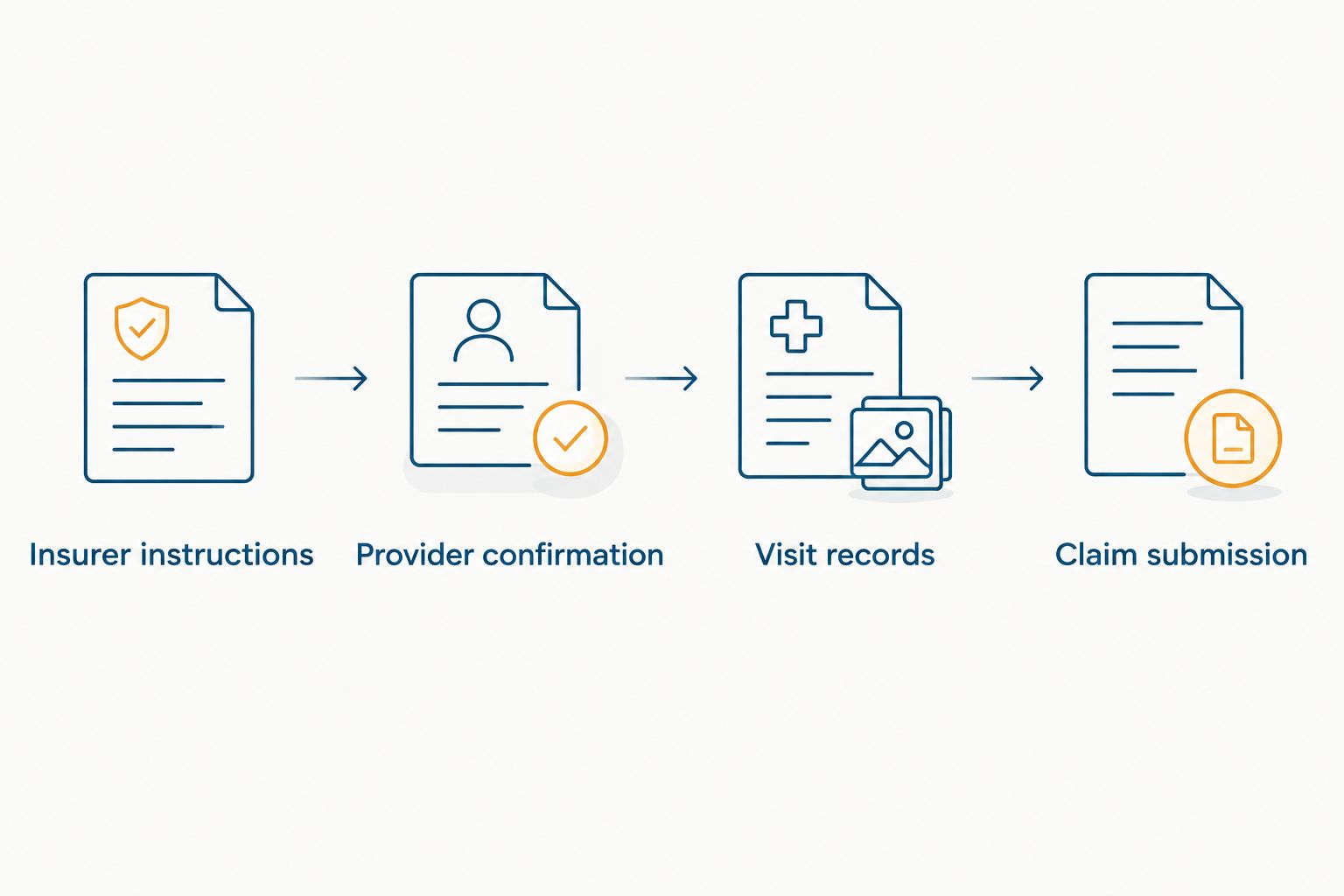
Visit documentation and claim submission
Assemble the claim record
- Bring the relevant information. Take identification, medication and allergy information, and the insurer's documentation instructions. Share clinical information with the treating professional, not just with reception.
- Request the required visit records. Ask for the clinical documentation, itemized invoice, and payment evidence your insurer requires. Where translation is needed, ask the insurer what format it accepts before commissioning it.
- Check the documents before leaving. Review the patient name, visit date, provider identity, and whether the invoice shows the services provided. A payment receipt and a clinical report serve different purposes; retain each required document.
- Submit through the designated channel. Follow the insurer's current instructions, answer the questions accurately, and attach the requested records. Save your submitted version and any acknowledgment or reference provided.
Expected result: Your submission has a traceable reference or retained copy, and your records explain the treatment, charges, and payment status. Submission is not approval; keep any insurer response with the same case record.
Check the final handoff
Before submitting, ask yourself 3 questions: Does every document belong to the right traveler? Do the dates describe the actual visit? Have I distinguished an invoice from proof that it was paid?
Use your insurer's stated submission deadline, not a generic travel checklist. Add that deadline to your calendar and retain the underlying records after uploading them. If you cannot supply a requested document, explain the gap to the insurer rather than replacing it with an unrelated file.
When treatment happens before insurer contact
The same workflow works after an unplanned visit, but the order changes. Care comes first when the situation is an emergency; claim administration follows.
- Collect the available records. Keep discharge instructions, prescriptions, invoices, and payment evidence together. Ask the treating facility how to request anything missing.
- Notify the insurer. Explain when and where treatment occurred, what happened, and what documents you have. Ask how the policy's notification and authorization provisions apply to the circumstances.
- Build the same case record. Save the insurer's response and case reference. Submit the requested documentation through the designated channel rather than assuming a notification call also filed the claim.
Expected result: You have connected the completed visit to the insurer's process without treating retrospective notification as a promise of reimbursement.
For a follow-up visit, return to the insurer-instructions stage. Ask whether additional consultations, tests, prescriptions, or a different provider need separate instructions. Keep the follow-up records linked to the relevant case without assuming the original instructions cover every later service.
Troubleshooting
The clinic says it accepts insurance, but payment is unclear
Ask whether that means direct billing to your specific insurer or simply providing documents for you to submit. Then verify the proposed arrangement with the insurer. Accepting insurance is not a coverage decision.
The insurer asks for an itemized invoice
Contact the clinic's billing team and request a document identifying the services provided. Keep the original receipt too. Do not describe a bank transaction screenshot as an itemized medical invoice.
The directory lists English, but the consultation language differs
Contact the clinic before attending and confirm which clinician will conduct the visit. Request the language arrangement directly. If the appointment cannot meet that need, find another suitable provider and recheck any insurer provider requirements.
The claim asks for information you do not have
Ask the insurer exactly which document or detail is missing and who should supply it. Request clinical information from the treating provider and payment information from billing. Do not guess a diagnosis, treatment code, or payment status to complete a required field.
The insurer declines the claim
Read the written decision alongside the policy wording cited. Ask about the review or appeal process and its deadline. Supply relevant supporting records or corrections; changing accurate visit details to fit a benefit is not a remedy.
Customize your workflow
Build the preparation around your itinerary, not around a generic destination list. For each stop, record the provider information you have checked, the insurer contact route, and how you will access essential documents without depending on a single device.
For students, separate medical records from administrative contacts. Keep the study-abroad program's support details accessible, but share sensitive health information only where appropriate. A program contact does not replace the treating clinician or insurer.
For travelers managing an ongoing condition, add a medication list and the questions you need to discuss with your treating professional before departure. Record follow-up instructions after each visit rather than relying on memory between destinations.
Keep your MyAbroadMDs doctor-directory preparation alongside these records, not in place of them. Before your next departure, recheck provider details and policy instructions against the actual itinerary. Preparation should reduce repeated searching without implying that coverage, appointments, or clinical outcomes are guaranteed.
FAQ
Do I file a travel insurance claim before seeing a doctor abroad?
Follow your policy's notification and authorization requirements for non-emergency care; a reimbursement claim can require records from the completed visit. For a medical emergency, seek local emergency care immediately rather than waiting to complete claim administration.
Does an English-speaking doctor abroad have to accept my travel insurance?
An English-speaking doctor is not automatically connected to your insurer. Confirm the clinic's billing arrangements and the insurer's provider requirements separately.
Does MyAbroadMDs pay for doctor visits abroad?
MyAbroadMDs provides subscription-based access to personalized, curated English-speaking provider directories, not insurance coverage. It is also not a telehealth or appointment-booking service.
What documents should I request after a doctor visit abroad?
Request the documents specified by your insurer, including any required clinical record, itemized invoice, and proof of payment. Check patient details and visit dates before submitting them.
Can I use a doctor outside my insurer's suggested providers?
Ask your insurer before non-emergency treatment whether your policy allows that provider and what conditions apply. A directory listing does not answer the coverage question.
What if I already paid the clinic before contacting my insurer?
Contact your insurer and explain the treatment date, circumstances, and payment. Retain the medical records and payment evidence, then follow the insurer's submission instructions without assuming reimbursement is guaranteed.
What should I do if my doctor visit needs follow-up treatment?
Ask your insurer whether the follow-up requires additional authorization or documentation. Confirm the next appointment with the clinic and keep its records connected to the relevant case.
One last thing
An appointment confirmation, a clinical report, and a paid receipt prove different things. Keep them separate, even when they arrive in the same email. That distinction makes your 2026 travel-health folder easier to use when a clinic or insurer asks a precise question.
Before you pack, prepare the contacts. After a visit, preserve the evidence.