
No—you should not assume expired medication is safe or effective while traveling abroad; arrange a replacement through a licensed pharmacy or clinician. Expiration is not the only concern: heat, moisture, freezing, and time since opening can make medication unsuitable before the printed date. If an essential dose is due or you have emergency symptoms, seek immediate medical advice rather than guessing, skipping treatment, or delaying emergency care.
- Is it safe to take expired medication while traveling? No—replace it rather than assume it still works.
- Check the expiration date, storage instructions, and any shorter limit after opening before departure.
- MyAbroadMDs provides English-speaking doctor directories for pre-trip preparation, not insurance, telehealth, or prescription booking.
- For essential medication or emergency symptoms, get urgent professional guidance; do not improvise a replacement or dose.
Is it safe to take expired medication while traveling abroad?
Do not rely on an expired medicine to deliver its labeled strength, quality, or purity. The U.S. Food and Drug Administration explains that expiration dates reflect stability testing under specified storage conditions. Passing that date does not prove a medicine suddenly becomes poisonous, but it removes the basis for assuming the product still meets its specifications.
Your practical response depends on the medicine and your condition. A nonessential remedy and a medicine that prevents a serious deterioration do not create the same decision: both need replacement, but interrupting essential treatment also requires clinical advice.
Use this sequence if you discover an expired medicine during your 2026 trip:
- Check the label. Confirm the medicine, strength, expiration date, and any discard instructions after opening or mixing.
- Review storage. Tell the pharmacist about hot luggage, freezing, damaged packaging, or an uncertain cold chain.
- Explain the urgency. State what the medicine treats, when you last took it, and when the next dose is due.
- Arrange replacement. Ask a licensed local pharmacist whether dispensing requires a local prescription or a clinician visit.
- Confirm the instructions. Check the replacement's active ingredient, strength, formulation, and directions before taking it.
For broader packing and documentation preparation, see the guide to traveling with prescription medication.
Why this matters
Finding an expired pack abroad creates more than a date-checking problem. You also need to identify a trustworthy pharmacy, explain your treatment clearly, and establish whether your home prescription is usable locally.
A familiar brand name is not enough to confirm a replacement. Brand names differ between countries, and similar-looking packages do not establish that the active ingredient, strength, or formulation matches your prescription. Bring the original packaging and a medication list to the pharmacy or appointment.
For your 2026 itinerary, make medication replacement part of departure preparation—not a problem you leave until the pack runs out. That means checking your supply against your return date and discussing refill arrangements before you leave.
What does an expiration date actually tell you?
An expiration date identifies the period during which a manufacturer supports a medicine's stability when it is stored as directed. It is not permission to ignore storage instructions until that date arrives.
An unopened package can still be unsuitable after improper storage. Conversely, a tablet that looks unchanged after expiration does not provide evidence that it retains the intended strength. Appearance alone cannot settle the question.
Opened and prepared medicines need another check. The instructions for eye drops, injectable medicines, or a liquid mixed by a pharmacist can include a discard deadline that comes before the manufacturer's printed expiration date. Follow the applicable product instructions, including the shorter in-use deadline.
Do not apply a general internet rule about how long medicines last. The correct limit depends on the exact product, its packaging, and its handling history—not simply whether it is a tablet or liquid.
Which medication situations need extra caution?
The following comparison identifies whom to contact, not permission to keep using an expired product. A pharmacist or clinician needs the exact medicine and your circumstances to advise you safely.
| Situation | Main concern | Best for | Limitation |
|---|---|---|---|
| Expired nonessential symptom remedy | Uncertain strength and quality | Licensed pharmacy assessment and replacement | Replacement does not establish what caused your symptoms |
| Essential daily prescription | Both unreliable medication and treatment interruption | Prompt pharmacist or prescriber advice | A local prescription or examination can be required |
| Refrigerated or injectable medicine | Expiration, temperature exposure, and in-use limits | Product-specific pharmacy guidance | A printed date cannot confirm an intact cold chain |
| Opened drops or prepared liquids | A shorter discard deadline can apply | Checking the dispensing label with a pharmacist | Appearance cannot establish sterility or stability |
| Rescue medicine during an emergency | Delayed treatment can be dangerous | Immediate emergency assistance and your prescribed action plan | Searching for a replacement must not delay emergency care |
Essential daily prescriptions: get advice before interrupting treatment
If you take medicine for a condition where missed treatment can be dangerous, contact a pharmacist or clinician promptly. Explain whether you have any unexpired doses remaining and when your next dose is scheduled.
Do not stretch your supply by changing the dose or schedule yourself. Do not double a later dose to compensate unless your medicine's instructions or your treating clinician specifically direct it.
Refrigerated medicines: the date is only part of the check
Refrigerated medicines require product-specific handling. Freezing, excessive warmth, or an uncertain storage history needs assessment even when the package remains within its expiration date.
Tell the pharmacist what happened rather than simply saying the medicine was kept cold. Describe where it was stored and whether it touched frozen packs. Do not assume returning a medicine to a refrigerator reverses earlier damage.
Opened drops and mixed liquids: check the discard instruction
Look for instructions added when the medicine was dispensed, opened, or prepared. These can set a shorter usable period than the unopened package date.
Do not transfer an old deadline to a newly dispensed product or assume every medicine in the same category follows the same rule. Ask the pharmacist to explain the instructions for the actual package you receive.
Why medication safety varies after expiration
These factors explain why a traveler cannot establish safety from the date alone:
- Active ingredient and formulation. Different medicines have different stability characteristics; a rule for one product does not establish another's suitability.
- Temperature exposure. A hot vehicle, freezing luggage compartment, or failed refrigerator can compromise storage conditions.
- Moisture exposure. Humidity and unsuitable containers can affect medicines that require protection from moisture.
- Opening or preparation. Breaking a seal or mixing a medicine can start a separate in-use period.
- Packaging condition. A damaged blister, broken seal, or leaking container needs assessment regardless of its date.
- Consequences of treatment failure. Uncertain effectiveness matters especially when a medicine treats or prevents a serious condition.
For a 2026 packing check, review all of these factors together. An in-date label is useful, but it is not a complete storage record or a guarantee that the medicine suits your current symptoms.
How do you replace expired medication abroad?
Start with a licensed pharmacy, then involve a local clinician when required. A pharmacist can assess the product and explain local dispensing requirements. A clinician can assess your condition and determine whether a prescription or a different treatment is appropriate.
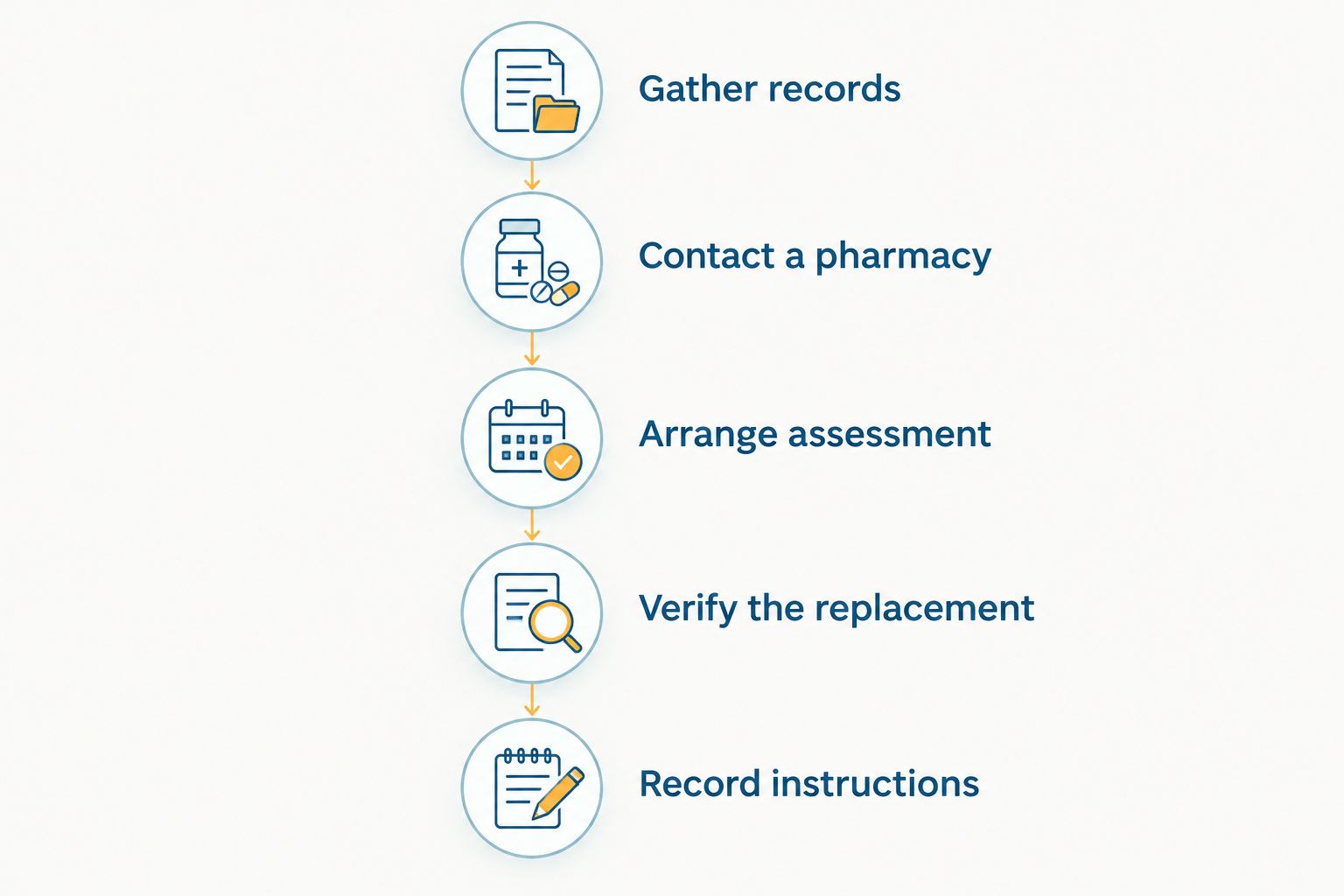
Keep the process organized around these steps:
- Gather records. Bring your original package, prescription details, allergies, medication list, and prescriber's contact information.
- Contact a pharmacy. Explain the expired product and ask what documentation is needed for a lawful replacement.
- Arrange assessment. See a locally authorized clinician if the medicine requires a prescription or your symptoms need evaluation.
- Verify the replacement. Ask the pharmacist to confirm the active ingredient, strength, formulation, route, and directions.
- Record instructions. Save the new label and clarify storage, missed-dose guidance, and any discard deadline.
The benefit of a pharmacy-first approach is direct access to medication expertise. Its limitation is that a pharmacist cannot necessarily dispense every prescription medicine or replace a needed examination. Do not assume a prescription from home automatically authorizes dispensing abroad.
Can you buy the same medicine under a different name abroad?
Sometimes a medicine is sold under another brand name, but you should ask a pharmacist to verify the match. Share the generic name and original label rather than choosing a package by appearance.
Strength and formulation matter too. Immediate-release and extended-release versions are not interchangeable simply because they contain the same ingredient. Ask for clear instructions in a language you understand.
What if your next dose is due before you can get a replacement?
Contact a pharmacist, your prescriber, or a local clinician urgently for medicine-specific advice. Explain the dose timing, your condition, the expiration date, and the storage history.
Do not treat a general article as permission either to take the expired dose or to skip essential treatment. If you develop serious symptoms, seek emergency care instead of waiting for a routine refill appointment.
What if expired rescue medication is all you have during an emergency?
Activate local emergency services immediately and follow your prescribed emergency action plan and dispatcher instructions. For suspected anaphylaxis, epinephrine is first-line treatment; do not delay emergency action while searching online or shopping for a replacement.
Tell emergency personnel exactly what medicine you have and that it is expired. Emergency decisions require immediate, situation-specific guidance—not the routine replacement approach used for nonurgent medicines.
How should you prepare before departure?
Build a medication check into your 2026 travel checklist. Review the actual packages, not just a medication list stored on your phone. Include medicines you use occasionally, because an old rescue inhaler or allergy pack is easy to overlook.
- Check expiration and applicable in-use dates against your itinerary.
- Ask your pharmacist about destination-specific storage challenges.
- Keep medicines in their labeled packaging where practical.
- Carry a medication list with generic names, strengths, and directions.
- Check destination and transit-country rules for prescription medicines.
- Identify how you would reach a licensed pharmacy or clinician abroad.
MyAbroadMDs is best for international travelers and study-abroad students who want an English-speaking doctor directory before departure. Its subscription-based memberships provide personalized, curated healthcare-provider directories across 100+ countries.
The directory addresses preparation and finding providers. MyAbroadMDs is not insurance, telehealth, or a booking service; it does not replace a pharmacist's medication assessment or a clinician's prescribing decision. Use it alongside—not instead of—your prescription and storage planning.
Prepare your healthcare contacts before departure
Explore memberships for personalized, curated English-speaking healthcare-provider directories.
FAQ
Is it safe to take expired medication while traveling in 2026?
Do not assume expired medication is safe or effective while traveling in 2026. Ask a licensed pharmacist or clinician about replacement, especially if interrupting treatment would put your health at risk.
Does expired medicine always become poisonous?
No, expiration does not mean every medicine suddenly becomes poisonous. It means you should not assume the product still meets its labeled strength, quality, and purity specifications.
Can I take an expired tablet if it looks normal?
A normal appearance does not establish that an expired tablet is suitable to take. A pharmacist needs the exact product, expiration date, and storage history to advise you.
Can heat damage medicine before it expires?
Yes, improper heat exposure can compromise medicine before its expiration date. Follow the product's storage instructions and ask a pharmacist to assess an exposure rather than relying on appearance.
Should I throw away expired essential medicine immediately abroad?
Arrange urgent replacement advice before leaving yourself without a treatment plan. Do not use expired medicine by default or interrupt essential treatment without medicine-specific guidance; ask a local pharmacy about safe disposal.
Can a pharmacy abroad refill my home prescription?
A pharmacy abroad cannot necessarily dispense medicine using your home prescription. Local requirements and the medicine involved determine whether you need a locally authorized prescriber.
Does MyAbroadMDs prescribe replacement medication abroad?
MyAbroadMDs provides personalized, curated directories of English-speaking doctors and healthcare providers, not prescribing or telehealth. A locally authorized clinician determines whether a prescription is appropriate.
One last thing
A medicine can be within its printed expiration date and still be past its usable deadline. An earlier opening, mixing, or storage problem can change the decision. Before your 2026 departure, ask your pharmacist to help you identify which date or handling instruction applies to each medicine.
Keep that information with your medication list. If a pack becomes questionable abroad, you will have something more useful than a guess: the product details a pharmacist or clinician needs to help you.