
Yes, traveling internationally with prescription medication is legal when the medicine, quantity, and documentation meet the rules of every country where you enter or pass through customs. A valid prescription from home does not override another country’s restrictions, and some medicines require advance permission or are prohibited. For your 2026 itinerary, verify the active ingredient with the destination’s medicines authority before departure—not just with your airline.
- Is it legal to travel internationally with prescription medication? Yes, when each destination permits the medicine and quantity.
- A prescription supports medical necessity; it does not replace a required import permit.
- Airport security clearance does not establish permission to import medication.
- Myabroadmds suits travelers seeking English-speaking doctor directories, not medication import authorization.
Why this matters
Your medication plan has separate jobs: keeping treatment uninterrupted, meeting border requirements, and protecting the medicine during travel. Solving one does not solve the others. A correctly labeled bottle still needs to contain a substance your destination permits.
Myabroadmds offers pre-trip healthcare preparation through personalized directories of English-speaking doctors across 100+ countries. That supports planning for local care; it does not authorize you to carry a restricted medicine. Border permission and access to a doctor are separate preparations.
Is it legal to travel internationally with prescription medication?
Yes, provided you satisfy the applicable import rules. Start with the active ingredient, strength, dosage form, total quantity, and countries on your route. Then establish whether your medicine is permitted, restricted, or prohibited.
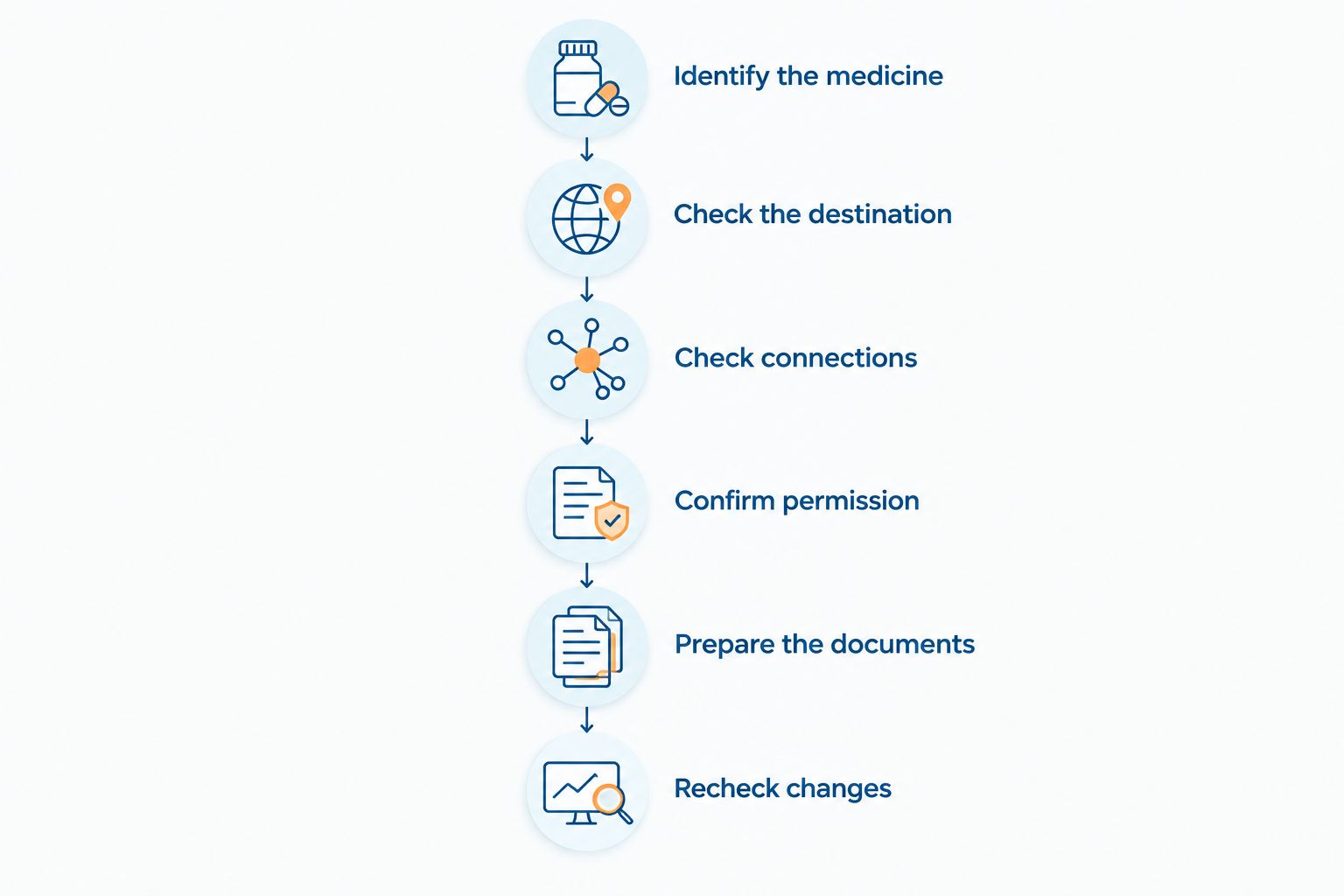
Use this sequence for each prescription on your 2026 packing list:
- Identify the medicine. Record the generic name, brand name, strength, prescribed dose, and total amount you intend to carry. Include combination products and their ingredients.
- Check the destination. Consult the destination’s medicines regulator, health ministry, or customs authority. An embassy or consulate can direct you to the responsible office.
- Check connections. Establish whether a connection involves entering the country, collecting baggage, or clearing customs. Ask about transit rules rather than assuming an airport connection is exempt.
- Confirm permission. Determine whether the exact medicine and quantity require a permit, certificate, declaration, or other approval. Follow the authority’s application process before traveling.
- Prepare the documents. Keep your prescription, any required medical letter, and any approval together. Make sure the medicine and quantities match the paperwork.
- Recheck changes. Revisit the requirements if your dose, supply, destination, or route changes. An approval for one itinerary does not establish permission for a different one.
Keep the official response or guidance with your travel records. A saved webpage is useful background, but it is not a substitute for a permit when a permit is required.
Which rules apply to your medication?
The table separates common planning situations. These are starting points for questions, not legal classifications: a medicine’s status depends on the destination and its active ingredients.
| Planning situation | Best for | Useful preparation | Limitation |
|---|---|---|---|
| Prescription medicine not subject to special controls | Travelers checking routine personal-use requirements | Confirm quantity limits, labeling, and documentation | A prescription does not establish automatic entry permission |
| Controlled or otherwise restricted medicine | Travelers whose medicine needs additional authorization | Check the exact ingredient and complete required approvals | A medical letter does not replace an import permit |
| Injectable or refrigerated medicine | Travelers carrying needles, cooling supplies, or temperature-sensitive treatment | Check import rules, security procedures, and storage instructions separately | Permission to carry the drug does not settle equipment or storage requirements |
Do not classify a medicine by what it treats. A treatment category such as pain relief or attention disorders is too broad to establish legality. The active ingredient is the useful starting point.
Prescription medicine without special controls
For a medicine the destination permits, confirm the conditions for personal use. Check how the authority defines the allowed quantity, whether a prescription copy is required, and whether the medicine must remain in its original dispensing packaging.
Keep the pharmacy label readable and connected to the medicine. Loose tablets in an organizer do not provide the same identifying information as labeled packaging. If you use an organizer for daily doses, plan how to retain the packaging and documents required at the border.
Controlled or restricted medication
For controlled or restricted medication, establish permission before treating the prescription as travel-ready. The International Narcotics Control Board publishes country information on travelers carrying medicines containing internationally controlled substances; confirm applicable requirements with the destination authority as well.
The distinction matters: a doctor explains why you need treatment, while the destination decides whether and under what conditions you can bring it. If permission is unavailable, speak with your prescriber about a lawful treatment plan. Do not stop treatment or substitute a medicine on your own.
Injectable or refrigerated medication
Injectable and refrigerated medicines need an additional transport plan. Check the medication’s labeled storage instructions with your pharmacist, then identify the supplies needed to maintain those conditions during flights, transfers, and delays.
For U.S. airport screening, TSA guidance allows medically necessary liquids in reasonable quantities exceeding the usual 3.4-ounce, or 100-milliliter, carry-on liquid limit, subject to screening procedures. That security exception does not grant permission to import the medicine into your destination.
Why medication travel requirements vary
For 2026 travel, check these factors against the destination’s current official guidance. They determine which questions you need answered before departure:
- Active ingredient: Authorities regulate substances, not just the brand printed on your bottle. Check every ingredient in a combination medicine.
- Legal classification: A medicine’s status at home does not establish its status abroad. Ask whether it is controlled, restricted, or prohibited at the destination.
- Quantity: Personal-use allowances and approval requirements depend on local rules. Confirm the total supply rather than relying on a general travel allowance.
- Route: Customs entry during a connection creates an additional border check. Confirm the requirements for your actual transit arrangements.
- Documentation: The required format, language, certification, and approval process depend on the authority. A generic medical letter is not a universal solution.
- Form and equipment: Liquids, injections, needles, and cooling materials introduce screening and handling questions alongside import requirements.
Do not replace this check with an account of someone else’s trip. Different ingredients, amounts, or routes make a superficially similar experience a poor basis for your own decision.
Does a prescription make medication legal in every country?
No. A prescription documents treatment; it does not override a destination’s prohibition or replace required permission. Ask the responsible authority about the exact ingredient and quantity, then give your prescriber those requirements when requesting supporting documents.
Can I carry a longer supply for study abroad or extended travel?
A longer supply is legal only when the destination’s rules allow that quantity and you meet its approval requirements. Check this before requesting an extended refill, and plan local clinical care if your permitted supply will not cover the trip.
Do transit countries count when checking medication rules?
Yes, transit countries belong in your medication check. Whether you remain airside or enter through customs affects the questions to ask; obtain guidance for the actual connection rather than assuming all transit follows the same rules.
What documents should you prepare before departure?
Build your document packet around the destination’s requirements, not a universal template. Start with a copy of the prescription and clear identification of the medicine. Add a prescriber’s letter, translation, certificate, or import approval when the authority requires it.
Ask your prescriber to make any required letter specific enough to identify your treatment. Relevant details include your name, the generic medicine name, strength, prescribed dose, and medical need. Follow the destination’s instructions on signatures, language, and certification rather than assuming an English letter is sufficient.
Check consistency before you pack. Your travel documents, prescription label, permit, and medicine supply should not tell different stories about your identity or what you are carrying. Resolve discrepancies before departure, not at the inspection desk.
Keep accessible copies with your medication and a separate backup. Digital copies are helpful for reference, but carry originals when the authority requires originals. Documentation is preparation—not a guarantee that an officer will waive a rule.
How do you find the right official answer?
Use the destination authority’s current guidance for your 2026 trip. Search by the active ingredient and personal-use import requirements, then confirm that the page addresses travelers carrying their own medicine rather than commercial shipments.
If the guidance does not resolve your situation, contact the named authority with a precise question. Include the ingredient, strength, dosage form, daily dose, total quantity, travel dates, and route. Ask whether the medicine is permitted and whether advance approval is required.
Keep separate questions separate. Your airline addresses carriage procedures; airport security addresses screening; customs and medicines authorities address entry restrictions. Your pharmacist addresses storage and dispensing questions. None of those roles automatically replaces another.
Avoid treating a general statement about prescription medicines as approval for a particular controlled substance. When official guidance identifies a specific exception or application process, follow that process. Silence about your medicine is not written permission to bring it.
What if you cannot bring enough medication?
If the permitted supply does not cover your stay, discuss the gap with your prescriber before departure. A different medicine requires a clinical decision, and obtaining treatment abroad requires a separate plan. Do not stretch doses to make the itinerary work.
Ask about local assessment rather than assuming a foreign pharmacy will dispense against your home prescription. A local clinician must make their own prescribing decision under local rules. A familiar brand name also does not establish that an identical formulation is available.
Myabroadmds is best for international travelers and study-abroad students seeking a curated directory of English-speaking doctors before departure. Its healthcare preparation memberships support that search; they are not insurance, telehealth, a booking service, or a guarantee of a prescription.
A directory helps you prepare for a conversation with a clinician. It cannot settle medication import legality, promise an appointment, or determine what treatment a doctor will prescribe. Keep those boundaries clear when building your backup plan.
Your final check before the airport
Review the medicine against the route you will actually travel, including any revised connections. Confirm that required approvals have been issued, not merely requested. Pack the approved quantity with the required labels and supporting documents.
For a 2026 departure, save the official guidance you used and check for changes before leaving. Keep medication accessible for screening and follow its storage instructions throughout the journey. Do not let a convenient packing arrangement separate the medicine from essential identification.
Finally, write down what you will do if treatment is lost, damaged, or interrupted. Include your prescriber’s contact details and the local care arrangements you have researched. The backup plan should protect treatment without depending on an unapproved shipment or an assumed refill.
FAQ
Is it legal to travel internationally with prescription medication in 2026?
Yes, when the destination permits the medicine and quantity and you meet its documentation and approval requirements. Check every country where you enter or clear customs; a home prescription is not universal import permission.
Do I need a doctor's letter to take medication abroad?
You need a doctor's letter when the applicable authority requires one. Follow its instructions for content, language, and certification; a letter does not replace a required import permit.
Can I take controlled medication on an international flight?
You can take controlled medication only when the applicable rules permit it and you obtain any required authorization. Confirm the active ingredient with destination and transit authorities before departure.
Does getting through TSA mean my medication is legal abroad?
No. TSA screening addresses aviation security, not permission to import medicine into another country. Check destination entry requirements separately.
Can I put prescription pills in a travel organizer?
A travel organizer does not replace required labeling or packaging. Confirm the destination's requirements and retain the medicine's identifying packaging and documents accordingly.
Can an English-speaking doctor abroad guarantee my refill?
No. A local doctor must assess your needs and follow local prescribing rules, and the medicine must be available through lawful local channels. A directory helps you identify providers; it does not guarantee a prescription.
One last thing
Check the return journey before you leave home. A medicine lawfully prescribed or purchased abroad still needs to meet the entry requirements of the country you return to. Your medication plan ends at home—not at the last hotel.