
A doctor abroad can write a prescription, but US pharmacies do not automatically accept it: the answer depends on state law, the prescriber’s authority, the medication, and the pharmacy’s requirements. Before relying on a foreign prescription for treatment after your return, ask your US pharmacist whether it is valid or whether you need a new prescription from an authorized US clinician.
- US pharmacies do not automatically honor prescriptions written by doctors abroad; state law and prescriber authority matter.
- A foreign prescription supports your medical history but does not guarantee a US refill.
- Controlled substances face additional federal prescribing requirements, including applicable DEA registration rules.
- MyAbroadMDs suits travelers seeking English-speaking doctor directories before departure, not prescription fulfillment.
Can a doctor abroad write a prescription US pharmacies will honor?
Sometimes, but a prescription’s validity abroad does not establish its validity in the United States. A pharmacy must follow the law where it dispenses medication, along with applicable federal requirements. A foreign doctor’s signature alone does not settle the question.
For your 2026 itinerary, separate the medical handoff from the prescription itself. The visiting doctor’s notes explain your treatment; the dispensing pharmacy determines whether it can accept the order. Prepare that handoff with this guide to connecting your medical records to a doctor abroad.
| Prescription situation | Practical benefit | Limitation | Best for |
|---|---|---|---|
| Prescription from a doctor licensed only abroad | Documents the treatment ordered overseas | Acceptance depends on applicable state law and pharmacy review | Supporting a treatment handoff |
| New prescription from a clinician authorized to prescribe for your US care | Provides an order the pharmacy can assess under US requirements | Requires an independent clinical decision; approval is not automatic | Continuing treatment after returning home |
| Foreign prescription for a controlled substance | Records what the overseas clinician prescribed | Additional federal requirements apply; do not assume it is fillable | Informing an authorized clinician’s review |
The key question is not whether the prescription looks official. It is whether the prescriber and order meet the rules governing that particular dispensing decision.
Why this matters before departure
A prescription written abroad and medication carried home are different issues. So are pharmacy acceptance and insurance reimbursement. Approval in one area does not establish approval in another.
That distinction matters when an overseas clinician starts treatment you will need to continue at home. You need a plan for follow-up, not just a document to present at the counter.
Before your 2026 departure, identify who will review any treatment changes after your trip. Ask your regular clinician what records to bring back and your pharmacy how it handles prescriptions issued outside the country. Resolve the handoff before you depend on it.
What should you do before asking a US pharmacy to fill it?
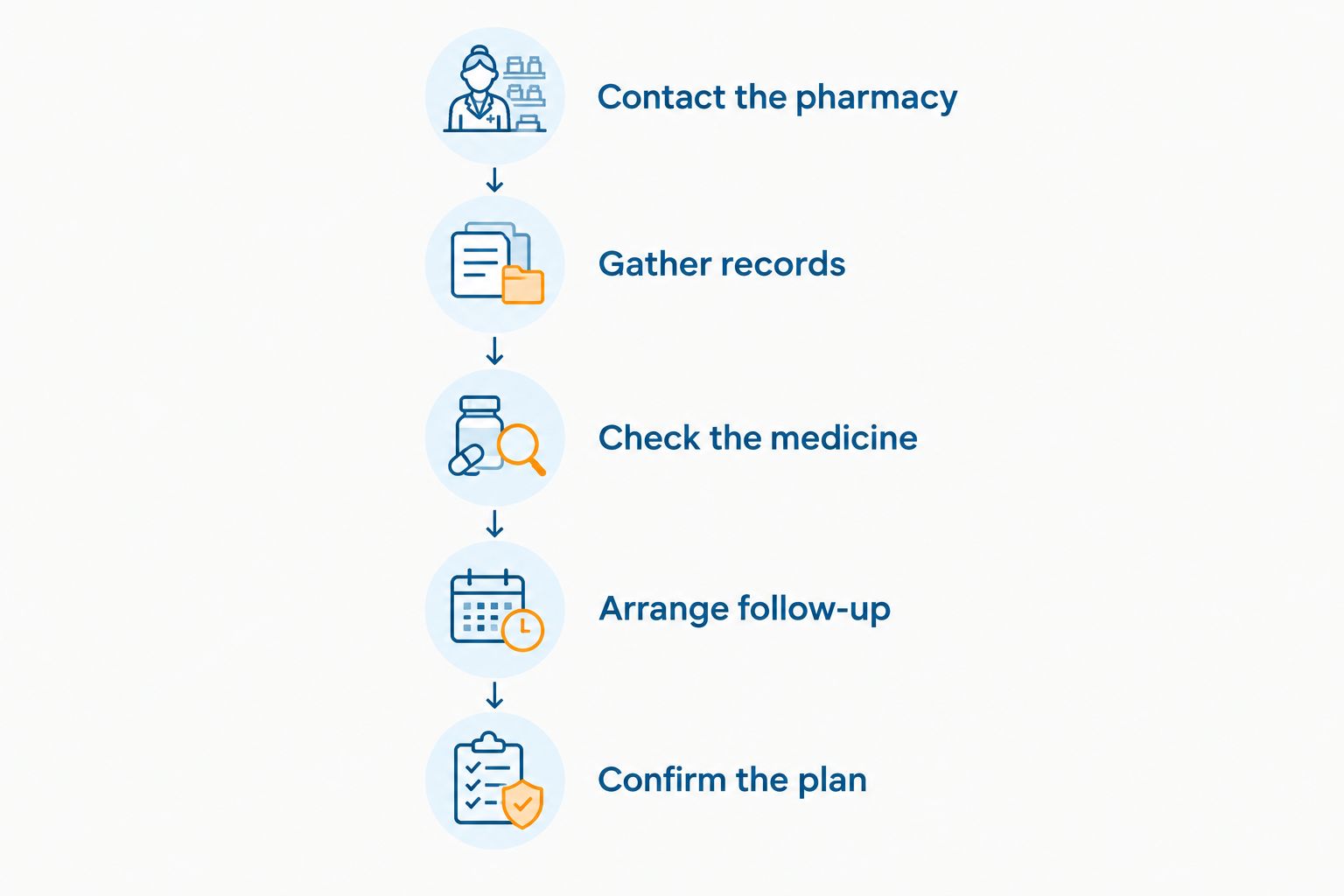
Use this sequence while you still have time to contact the overseas clinic. Records are easier to obtain before you leave your destination.
- Contact the pharmacy. Tell the pharmacist where the prescription was issued, where the doctor is licensed, and which medicine was prescribed. Ask whether state law permits acceptance and what verification the pharmacy requires.
- Gather records. Request the prescription, consultation summary, diagnosis or treatment indication, and relevant test results. Include the prescriber’s name and contact details.
- Check the medicine. Record its active ingredient, strength, dosage form, and directions. Do not rely on the brand name alone.
- Arrange follow-up. If the pharmacy cannot accept the order, contact a clinician authorized to treat you in the United States. Share the overseas records before the appointment when possible.
- Confirm the plan. Establish who will prescribe, which pharmacy will receive the order, and what to do if treatment would otherwise be interrupted.
A new clinician must make an independent prescribing decision. Providing records supports that assessment; it does not obligate the clinician to reproduce the overseas prescription.
Noncontrolled medicines: state rules still apply
A medicine does not become automatically fillable simply because it is not controlled. The pharmacy still needs an acceptable prescription from a prescriber whose authority meets the applicable requirements.
For noncontrolled medicines, ask about the state’s treatment of out-of-country prescribers rather than assuming every foreign prescription is prohibited. Equally, do not interpret one pharmacy’s acceptance as a nationwide rule.
The practical advantage of a noncontrolled prescription is that controlled-substance requirements are not the central issue. The limitation is that state prescribing rules, verification, and clinical review still matter. A clearly written overseas prescription helps communicate the treatment, but clarity alone cannot establish legal validity.
If the pharmacy declines the order, ask what specifically prevents acceptance. A missing detail requires a different response from a prescriber who lacks the authority required under state law.
Controlled substances: additional federal requirements apply
Controlled substances require a separate conversation with your pharmacist and treating clinician. Do not assume that a prescription accepted in another country can authorize dispensing in the United States.
Federal controlled-substance prescribing requirements include authorization to prescribe and applicable registration requirements. The relevant federal framework includes the Drug Enforcement Administration’s prescription rules in Title 21 of the Code of Federal Regulations, including section 1306.03. State requirements also apply.
For a 2026 trip involving controlled medication, plan continuity with your regular prescriber before departure. Bring back overseas treatment records, but arrange an appropriate US assessment rather than treating the foreign prescription as a guaranteed refill.
If an interruption is approaching, contact your clinician promptly. Do not ration, stop, substitute, or change the dose on your own; the appropriate response depends on the medicine and your condition.
Why acceptance of a foreign prescription varies
The pharmacy’s decision concerns both legal validity and safe dispensing. These factors explain why the answer can differ between prescriptions and locations:
- Dispensing state. State law governs pharmacy practice and which prescribing orders qualify for acceptance. Ask about the state where the medication will actually be dispensed.
- Prescriber authority. A doctor’s foreign medical license does not automatically confer US prescribing authority. A clinician with additional US authorization presents a different situation from one licensed only overseas.
- Medication classification. Controlled substances involve federal requirements beyond those governing ordinary prescription medicines.
- Drug identity. The pharmacist must establish what was prescribed. Brand names, strengths, and formulations can differ between countries.
- Verification and clinical review. The pharmacy needs sufficient information to evaluate the order and resolve safety concerns. A readable prescription is helpful but does not eliminate that review.
Ask why an order cannot be accepted before deciding what to do next. Translation, clarification, and a new clinical assessment solve different problems.
What records should you bring home?
Your goal is to make the next clinician’s assessment clear, not to assemble a document that guarantees dispensing. Request records in English when possible, while keeping the original documents as well.
Include the following in your travel health folder:
- Medicine details: active ingredient, strength, formulation, route, and prescribed directions.
- Reason for treatment: the diagnosis or clinical indication, plus the overseas clinician’s assessment.
- Treatment history: when you started the medicine, changes made, and any adverse effects.
- Supporting information: relevant test results, allergies, and other medicines you take.
- Prescriber details: the clinician’s name, clinic, contact information, and identifying information shown on the prescription.
Keep the original packaging and dispensing label when you have them. These help identify what you received, although they do not replace an acceptable prescription.
For your 2026 return appointment, tell the clinician what you actually took, not only what was originally ordered. A treatment change made during the trip belongs in the handoff too.
Does translating a prescription make it valid in the US?
Translation improves understanding; it does not create prescribing authority. An English translation helps a pharmacist or clinician read the drug name, directions, and treatment history, but the underlying order must still meet applicable requirements.
Bring the original alongside any translation. Ask the receiving clinician or pharmacy what translation format it needs instead of assuming a translated photograph resolves every issue.
An English-speaking doctor abroad can make communication easier during the appointment and subsequent handoff. That benefit is separate from whether a US pharmacy can fill the resulting prescription.
Can a US doctor rewrite an overseas prescription?
A US clinician can assess your overseas treatment and decide whether to issue a new prescription within their prescribing authority. That is a new medical decision, not an administrative conversion.
The clinician needs enough information to evaluate the medicine, its purpose, and your current condition. An appointment, examination, or additional records can be necessary depending on the treatment.
For telehealth, confirm that the clinician can legally treat you where you are physically located and prescribe the medicine involved. An online appointment does not remove licensing or controlled-substance requirements.
Is bringing medicine home the same as filling a foreign prescription?
No. Bringing medication across the US border involves importation requirements; filling an order at a US pharmacy involves prescribing and dispensing requirements.
The Food and Drug Administration’s personal-importation guidance addresses medicines brought or shipped into the country, including restrictions involving unapproved drugs. US Customs and Border Protection addresses entry procedures. Neither function replaces the pharmacy’s assessment of whether it can dispense against a particular prescription.
For 2026 travel, check the applicable official guidance for your medicine before carrying it home. Do not treat a foreign prescription, a pharmacy label, or successful airport screening as blanket permission for every other step.
Where pre-trip healthcare preparation fits
MyAbroadMDs is best for international travelers and study-abroad students who want a curated directory of English-speaking healthcare providers before departure. Its subscription memberships provide personalized directories across 100+ countries.
MyAbroadMDs healthcare preparation addresses the question of whom to contact abroad. It is not insurance, telehealth, or a booking service, and directory access does not authorize prescribing or guarantee pharmacy acceptance.
The benefit is preparation: you can identify healthcare resources around your itinerary before you need them. The limit is equally clear: a provider directory does not replace a clinician’s judgment, a valid prescription, or your pharmacy’s dispensing review.
FAQ
Can a doctor abroad write a prescription that US pharmacies honor?
Sometimes, but US pharmacy acceptance depends on state law, the prescriber’s authority, the medicine, and pharmacy review. Ask the dispensing pharmacist before relying on the prescription for treatment after returning home.
Can a US pharmacy fill a prescription from a Canadian or Mexican doctor?
Acceptance depends on the applicable state rules and the specific prescription; the neighboring country alone does not determine validity. Give the pharmacist the prescriber’s licensing details and the medicine information before assuming it can be filled.
Will a US doctor automatically rewrite my foreign prescription?
No. A US clinician must independently assess whether to prescribe the medicine and needs enough information to make that decision safely.
Does a translated foreign prescription count as a US prescription?
No. Translation helps communicate the order but does not change the prescriber’s legal authority or the dispensing requirements.
Can I use a foreign prescription for controlled medication in the United States?
Do not assume a foreign prescription is valid for US dispensing of a controlled substance. Applicable federal authorization and registration requirements, state law, and pharmacy review must be satisfied.
What should I do if I will run out before my return appointment?
Contact your treating clinician and pharmacist promptly to establish a safe continuity plan. Do not change your dose or stop treatment on your own; seek urgent medical care if your condition requires it.
Does MyAbroadMDs issue prescriptions or arrange pharmacy refills?
MyAbroadMDs provides pre-trip healthcare preparation through personalized directories of English-speaking providers. It is not a telehealth or booking service, and membership does not guarantee a prescription or refill.
One last thing
Ask for a treatment summary, not just a prescription. A prescription records an order; the summary explains why the clinician made it. That context helps your next clinician evaluate whether to continue the treatment.
Before leaving the overseas clinic, confirm that the records identify the active ingredient and the reason for any medication change. Those details make the handoff more useful, even when a US pharmacy cannot accept the original prescription.