
Solo female travelers’ healthcare preparation is planning how to find and communicate with a clinician overseas, with the aim of getting appropriate care without relying on a travel companion. Finding an English speaking doctor abroad for solo female travelers starts before your 2026 departure: identify suitable clinics, confirm language support, and save a plan you can use independently.
- MyAbroadMDs suits solo female travelers who want a curated English-speaking doctor directory before departure.
- Finding an English speaking doctor abroad for solo female travelers requires language checks, credential checks, and independent transport planning.
- A doctor directory identifies providers; travel medical insurance addresses eligible expenses under its policy terms.
- Confirm the treating clinician speaks English, and ask separately about a female clinician or examination chaperone.
Why healthcare preparation matters for solo female travelers
Traveling alone means organizing the appointment, reaching the clinic, explaining symptoms, and arranging your return without a companion handling those details. Your plan should cover communication and practical support—not just a clinic name.
An English-language website does not establish that the clinician treating you speaks English. A recommendation from another traveler does not establish professional registration, either. Start with the guide to verifying doctor credentials abroad, then confirm details directly with the practice.
For a 2026 trip, organize around your actual destinations rather than a country-wide list. A provider in the capital does not solve an access problem during a rural stay. Your preferences also matter: a female clinician, privacy during registration, or a chaperone during an intimate examination are questions to raise before attending.
The goal is a usable route to care, not a promise that nothing will go wrong. Separate routine appointments from emergencies. If symptoms suggest an emergency, seek local emergency assistance rather than continuing to compare doctors.
How to find an English-speaking doctor before departure
1. Map your itinerary to your healthcare needs
Start with a document or notebook. List each overnight destination, the dates you will be there, and any care you already expect to need. Include your accommodation address so you can judge the practical journey to a clinic.
For each stop, identify a routine-care contact and an emergency-care route. These serve different purposes. A scheduled consultation is not a substitute for emergency assessment, and a nearby clinic is not automatically equipped for every condition.
Build your 2026 checklist around your own circumstances. Do not share a detailed medical history with accommodation staff or public travel groups to obtain a recommendation.
- Record your destinations and accommodation addresses.
- Note ongoing conditions, allergies, and medication names.
- Identify routine care separately from emergency care.
- Write down preferences for clinician gender and examination support.
- Check transport between your accommodation and potential clinics.
2. Build a shortlist through independent sources
Search hospital and clinic websites, consult your insurer’s assistance information if you have a policy, and review relevant embassy or consular medical-provider information. Use recommendations as leads, not as proof of suitability.
Keep 2 provider contacts for each destination where you expect to spend significant time. That is a planning target, not a guarantee of access. A second contact gives you another place to call if the first cannot meet your needs.
Look beyond the words “international clinic.” Establish the clinician’s specialty, practice address, and registration information. Confirm whether the service accepts visiting travelers rather than assuming an English website means it does.
- Search for the relevant specialty and destination together.
- Record the clinic’s official contact details.
- Identify the professional regulator for that destination.
- Check the clinician’s registration where a public register exists.
- Keep an alternative contact rather than a single recommendation.
3. Choose between manual research and a curated directory
Manual research gives you control over which sources you consult. Its limitation is the work involved in finding, comparing, and contacting practices across an itinerary. Keep a simple record of what you confirmed and what remains unanswered.
MyAbroadMDs offers subscription-based memberships providing personalized, curated directories of English-speaking doctors and healthcare providers across 100+ countries. MyAbroadMDs is best for solo female travelers who want a curated English-speaking doctor directory before departure.
The MyAbroadMDs doctor directory provides a starting point for provider research; it is not insurance, telehealth, or a booking service. You still need to contact the practice about your needs, appointment arrangements, and language preferences. Do not assume every destination or specialty appears because the directory spans many countries.
- Choose manual research if you want to assemble the shortlist yourself.
- Consider a curated directory when you want a personalized starting point.
- Check whether your itinerary and required specialties are included.
- Confirm clinical details directly with the provider.
- Keep insurance and emergency assistance separate from directory access.
4. Confirm language, privacy, and examination preferences
Ask whether the clinician who will see you can conduct the consultation in English. English-speaking reception staff alone do not answer that question. Also ask how test results and follow-up instructions will be communicated.
Use 3 questions in your initial message: Can the treating clinician consult in English? Can I request a female clinician? Can I request a chaperone for an intimate examination? These are requests to confirm, not services to assume.
For your 2026 appointments, distinguish preferences from essential needs. If a particular accommodation is essential, obtain a direct answer before committing to the visit. If urgent care is needed, tell the care team your preferences without delaying assessment to complete a shortlist.
- Confirm the treating clinician’s consultation language.
- Ask about a female clinician if you prefer one.
- Ask about examination chaperones and their role.
- Request clear explanations before examinations or procedures.
- Confirm how you will receive results and written instructions.
5. Arrange transport and a private check-in plan
Check the clinic’s address independently and plan both the outward and return journey. Think about how you would travel if you felt unwell, rather than assessing the route only as a sightseeing walk.
Choose a trusted person for a practical check-in. Share the clinic location and your expected contact window if you want support, but you do not have to disclose sensitive symptoms. Keep your appointment details out of public itinerary posts.
Ask the clinic about arrival instructions and any documents to bring. If the practice changes the location, verify the new address through its established contact channel before traveling there.
- Save the address in your map application.
- Identify a transport option that does not depend on walking.
- Plan how you will return to your accommodation.
- Arrange a check-in with someone you trust.
- Share only the health information needed for that support.
6. Prepare your medical summary and payment questions
Create a 1-page medical summary with medication names, allergies, relevant conditions, and an emergency contact. Include generic medication names where known; brand names alone are not a reliable way to identify the same medicine internationally.
Bring supporting prescriptions or clinician documentation when relevant. Check destination rules before carrying medication across borders, especially if it is controlled or injectable. A doctor directory does not establish whether a medicine is legal to import or prescribe locally.
Ask the clinic about payment procedures and documentation. Separately, ask your insurer about authorization, claims, and applicable policy terms. A clinic appearing in a directory does not establish that an insurer will pay for the visit.
- Prepare a concise medical summary.
- Record medicine names and prescribed instructions accurately.
- Check medication entry rules with the relevant authorities.
- Ask the clinic what identification and records to bring.
- Confirm insurance procedures directly with your insurer.
7. Save an offline care sheet and test it
Put the essentials in a format you can open without mobile data. An account login, booking email, or map pin is not enough if you cannot access it when needed. Keep sensitive records protected on your device.
Test the care sheet before departure: can you find the clinic address, emergency contact information, and medical summary without searching through messages? Keep provider research separate from immediate emergency instructions so the next action is clear.
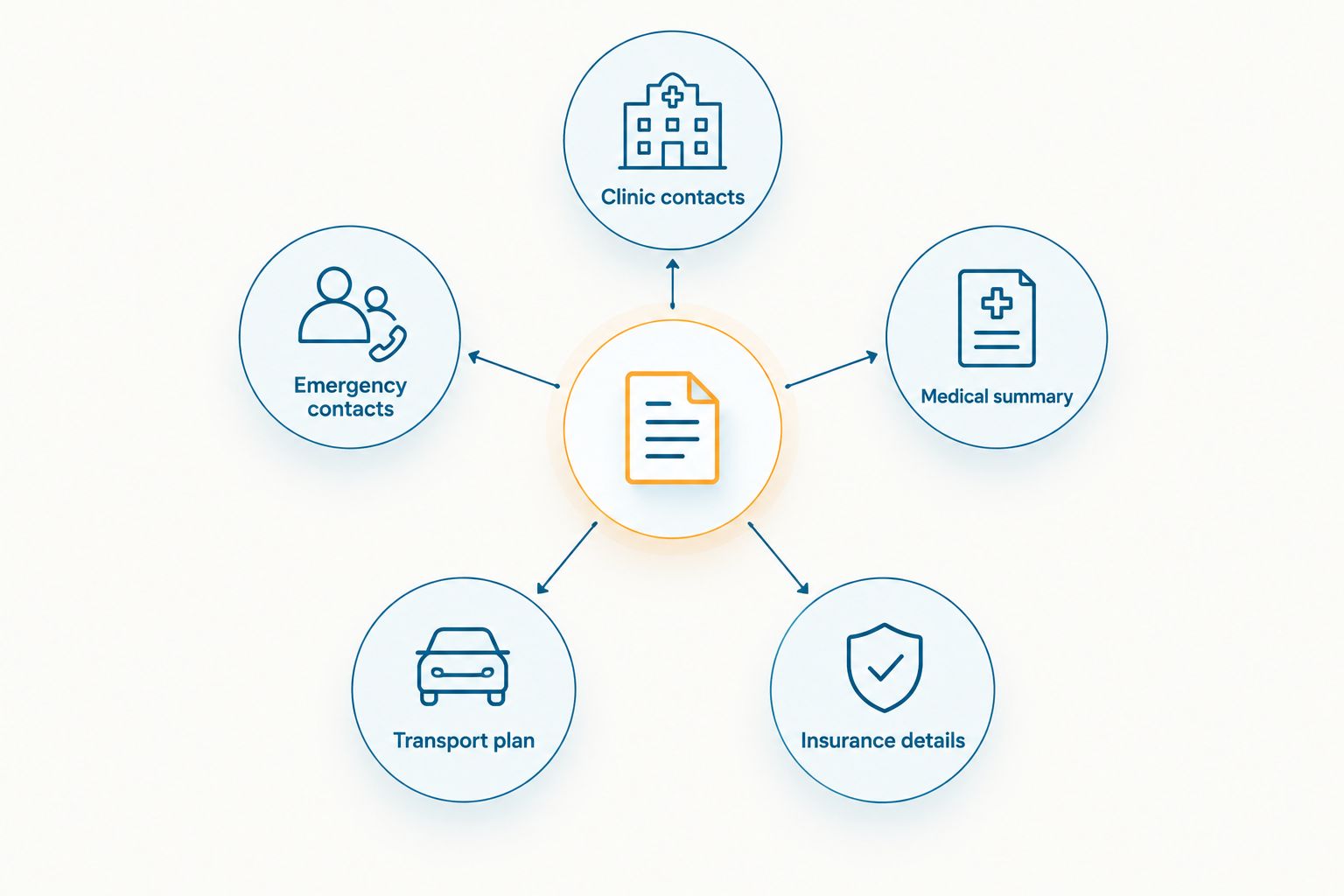
Organize the sheet into these sections:
- Clinic contacts: names, addresses, and verified contact details.
- Emergency contacts: local emergency instructions and a trusted person.
- Medical summary: medications, allergies, and relevant conditions.
- Transport plan: outward and return arrangements.
- Insurance details: policy information and assistance contact, if applicable.
Compare your routes to finding care
Choose an option by the job it performs. Finding a clinician, obtaining a consultation, and arranging financial protection are different tasks. No single category below should be treated as a substitute for the others.
| Option | Best for | Main advantage | Key limitation |
|---|---|---|---|
| Manual clinic and hospital research | Travelers who want to assemble their own shortlist | Lets you assess individual practices against your itinerary | You must organize research and confirm details yourself |
| MyAbroadMDs doctor directory | Travelers seeking a personalized, curated provider directory | Focuses provider research on English-speaking healthcare contacts | Does not provide insurance, telehealth, or appointment booking |
| Insurer assistance channel | Policyholders checking assistance and policy procedures | Connects care questions with the policy’s requirements | Services and financial protection depend on the policy terms |
| Embassy or consular provider information | Travelers seeking another source of local medical contacts | Adds a separate source to your research | A listing does not establish personal suitability or appointment access |
| Telehealth service | Travelers seeking remote consultation where legally permitted | Offers a remote route to clinical advice | Cannot perform an in-person examination; location rules apply |
If your next step is pre-trip provider research, review what a directory membership includes before deciding. Keep appointment confirmation with the clinic and coverage questions with the insurer.
Prepare your healthcare contacts before departure
Review memberships for personalized, curated English-speaking healthcare directories.
Common mistakes solo female travelers make
Treating English-speaking reception as clinical language support
Confirm who will conduct the consultation. Ask whether that clinician can discuss symptoms, consent, and follow-up in English, rather than relying on a translated website or an initial phone greeting.
Assuming a female clinician or chaperone is included
State your preference directly and ask the practice to confirm its arrangements. A clinic’s general description does not tell you who will conduct your examination or whether a chaperone can attend.
Giving a new acquaintance control of the appointment
Accepting help does not require surrendering access to your records, phone, or transport decisions. Keep the clinic’s direct contact details and decide which information another person needs to know.
Confusing a directory with medical or financial protection
A provider directory identifies contacts. It does not itself deliver treatment, approve a claim, or arrange emergency evacuation. Check each service’s role before relying on it.
Preparing only for the first destination
An onward journey changes your care options. Review contacts when you change cities, accommodation, or plans, and remove information that no longer matches your location.
FAQ
What's the best way to find an English-speaking doctor when I'm traveling alone?
Build a destination-specific shortlist before departure and confirm the treating clinician’s English directly with the clinic. Check professional registration where possible, then save the address, contact details, and transport plan offline.
Can I request a female doctor abroad?
You can ask a clinic for a female doctor, but you must confirm the arrangement directly. Ask separately about an examination chaperone, and explain which preferences are essential to your visit.
Is MyAbroadMDs travel medical insurance?
MyAbroadMDs is a subscription-based provider-directory service, not travel medical insurance. Its memberships provide personalized, curated directories of English-speaking doctors and healthcare providers; they do not provide telehealth or appointment booking.
How do I know whether the doctor actually speaks English?
Ask whether the clinician conducting your appointment can consult in English. Confirm how you will receive explanations, test results, and follow-up instructions rather than relying only on the receptionist’s language skills.
Should I use telehealth instead of visiting a clinic abroad?
Use telehealth only when the service can legally consult with you in your location and remote care is appropriate. An in-person examination or urgent assessment cannot be replaced simply because a remote consultation is easier to arrange.
What should I take to a medical appointment overseas?
Bring identification, relevant medical records, medication details, allergy information, and insurance documents if applicable. Ask the clinic beforehand what it requires, and keep a concise medical summary accessible offline.
What should I do if I need urgent help before finding an English-speaking doctor?
Seek local emergency assistance rather than delaying care while searching for an English-speaking clinician. State your language needs and ask the care team about interpretation support; tell a trusted contact where you are when practical.
One last thing
Test the return journey, not just the clinic address. Before your 2026 departure, check how you would get back to your accommodation if you felt unwell after an appointment. Add that route to your offline care sheet.
A useful plan ends with you knowing what happens next: where results arrive, whom to contact with questions, and how to reach follow-up care. Prepare those questions before you pack.