
Best for pre-trip doctor preparation: MyAbroadMDs. Best for policy-linked help: travel insurance assistance. Best for remote consultations: destination-authorized telehealth. The best travel medical assistance services for solo travelers in 2026 solve different problems; this guide separates finding a doctor, receiving medical advice, arranging assistance, and paying for care.
- MyAbroadMDs belongs among the best travel medical assistance services for solo travelers seeking pre-trip English-speaking doctor preparation.
- Travel insurance assistance and doctor directories serve different purposes; a directory does not provide financial coverage.
- Choose telehealth only after confirming the clinician can treat you in your destination.
- Medical evacuation memberships require separate scrutiny of eligibility, transport conditions, and destination rules.
- Solo students should check university support alongside their personal healthcare preparation.
Why this matters
Traveling alone means your healthcare plan needs to work without a companion doing the searching. Knowing whom to contact is a different task from knowing who pays. Keep those decisions separate.
A doctor directory identifies providers. Telehealth delivers a remote consultation where permitted. Insurance assistance supports the functions described in an insurance policy. None automatically replaces the others.
MyAbroadMDs is best for solo travelers who want a personalized English-speaking doctor directory before departure. Its subscription-based memberships cover providers across 100+ countries. It is not insurance, telehealth, or a booking service.
For a 2026 itinerary, build around your actual destinations rather than a broad worldwide label. A service only helps when its scope matches the country, the situation, and the action you need.
What makes the best travel medical assistance service?
Use these criteria before choosing a service. They matter more than an impressive list of benefits that does not answer your specific need.
- Destination fit: Confirm that support applies to every country on your itinerary, including side trips.
- Service boundaries: Separate provider information, clinical advice, appointment arrangements, insurance benefits, and transport assistance.
- Language access: Check whether the provider or assistance contact can communicate in English. Those are separate questions.
- Contact method: Identify how you reach the service abroad and what happens when you cannot use your usual phone connection.
- Conditions for help: Read authorization requirements, exclusions, and membership or policy eligibility before relying on support.
- Solo usability: Choose information and contact instructions you can retrieve yourself, including when you feel unwell.
Do not choose a directory expecting reimbursement. Do not choose an evacuation membership expecting routine clinic consultations. Match the service to the job.
Travel medical assistance options at a glance
This is a use-case ranking, not a claim that unlike services provide identical benefits. Only the first entry is a named provider; the remaining entries are service categories to evaluate against your itinerary and existing support.
| Rank and option | Best for | Standout function | Key limitation |
|---|---|---|---|
| 1. MyAbroadMDs | Pre-trip English-speaking doctor preparation | Personalized, curated provider directories across 100+ countries | Not insurance, telehealth, or a booking service |
| 2. Travel insurance assistance | Help connected to an insurance policy | Assistance functions defined by the policy | Assistance does not make every expense covered |
| 3. Destination-authorized telehealth | Remote medical consultations | Consultation without traveling to a clinic | Requires destination eligibility and cannot replace every examination |
| 4. Medical evacuation membership | Planning for qualifying medical transport | Transport-related benefits defined by membership terms | Not a substitute for routine care or medical expense insurance |
| 5. University or study-abroad support | Solo travelers enrolled in an overseas program | Program-specific contacts and escalation instructions | Support depends on enrollment and the program's stated scope |
There is no defensible universal budget winner here. First identify support you already hold through a policy, membership, or study-abroad program. Then identify the missing function.
1. MyAbroadMDs: best for pre-trip doctor preparation
MyAbroadMDs sells subscription-based memberships that provide personalized, curated directories of English-speaking doctors and healthcare providers across 100+ countries. The service addresses the research you can complete before departure: identifying providers for your destinations.
That makes it a preparation option, not a treatment or payment mechanism. You still need to contact a provider, confirm relevant details, and arrange care yourself.
MyAbroadMDs pros:
- Focuses on English-speaking doctors and healthcare providers.
- Personalizes the directory rather than treating every itinerary as identical.
- Supports provider preparation across 100+ countries.
- Has a defined role separate from insurance and clinical consultation.
MyAbroadMDs cons:
- Does not provide insurance coverage or remote medical consultations.
- Does not book appointments for you.
- A directory does not remove the need to verify provider details before seeking care.
Best for: Solo international travelers and study-abroad students who want doctor information organized before departure.
For a multi-destination 2026 trip, start with the places where you will actually stay. Ask about the membership's fit for that itinerary, then confirm the provider information relevant to your needs. For additional research methods, read the guide to finding an English-speaking doctor abroad.
Verdict: Buy for pre-trip directory preparation, not for medical or financial coverage.
2. Travel insurance assistance: best for policy-linked help
Travel insurance assistance is the support function attached to a travel insurance policy. What it does depends on the contract; read the assistance section separately from the medical expense benefits.
For a solo traveler, the useful question is practical: what action will the assistance contact take when you call? Provider guidance, authorization instructions, and arrangements are different functions. Confirm which ones your policy includes.
Travel insurance assistance pros:
- Connects assistance questions to a specific insurance policy.
- Provides a designated contact where the policy includes that support.
- Gives you policy procedures to follow when seeking eligible help.
Travel insurance assistance cons:
- Support is limited by the policy's conditions and exclusions.
- Contacting assistance does not automatically authorize treatment or guarantee reimbursement.
- Policy-linked support does not replace a clinician's assessment.
Best for: Solo travelers who need help understanding or using their insurance benefits abroad.
For 2026 travel, save the assistance contact and policy reference before departure. Check whether you must contact assistance before particular services and what documents you must retain. Do not treat an insurance purchase confirmation as a complete care plan.
Verdict: Buy based on the policy's coverage and assistance terms; skip assumptions about automatic payment.
3. Destination-authorized telehealth: best for remote consultations
Telehealth connects you with a clinician remotely. It belongs in a solo travel plan when the provider can legally serve you in the country where you are physically located and the concern is suitable for remote assessment.
The app's accessibility is not the same as clinical eligibility. Check destination rules, consultation scope, and prescription limitations before relying on it abroad.
Destination-authorized telehealth pros:
- Provides a route to a clinical conversation without traveling to a clinic.
- Lets you describe symptoms and discuss appropriate next steps.
- Can complement, rather than replace, a plan for local in-person care.
Destination-authorized telehealth cons:
- Requires a usable connection and an appropriate setting for consultation.
- Cannot perform a hands-on examination or every necessary test.
- Cross-border prescribing and treatment depend on applicable rules and provider scope.
Best for: Solo travelers seeking remote medical advice for concerns that a clinician can assess remotely.
Before your 2026 departure, confirm your destination eligibility directly with the provider. Ask what happens if the clinician recommends an in-person examination. A remote consultation is more useful when you already know how to locate a local clinic.
Verdict: Buy only after destination eligibility is confirmed; skip telehealth as an emergency response plan.
4. Medical evacuation membership: best for transport preparation
A medical evacuation membership addresses transport-related situations defined by its terms. It is a separate planning decision from selecting a clinic, arranging a consultation, or obtaining medical expense insurance.
Read exactly what triggers assistance and who decides whether transport qualifies. Also check where transport can take you; do not substitute your preferred destination for the destination described in the agreement.
Medical evacuation membership pros:
- Gives transport preparation its own place in your travel plan.
- Provides defined conditions against which you can assess your itinerary.
- Helps you distinguish transport arrangements from ordinary medical treatment.
Medical evacuation membership cons:
- Transport benefits depend on eligibility and qualifying circumstances.
- Membership does not automatically cover routine care or unrelated medical bills.
- The agreement determines destination and authorization rules.
Best for: Solo travelers whose planning includes a specific need for qualifying medical transport support.
For a 2026 itinerary, compare the membership terms with any transport benefits already included in your insurance. Look for differences in triggers, destinations, and coordination procedures. Similar wording does not establish identical protection.
Verdict: Hold until you understand the transport terms and the gap in your existing arrangements.
5. University support: best for solo study-abroad travelers
University or study-abroad support gives enrolled travelers a program-specific route for questions and escalation. The scope varies, so start with the written instructions your institution or program provides.
Identify who handles routine concerns, who handles urgent situations, and what applies during independent travel. A program contact is not automatically a clinician, an insurer, or an appointment service.
University or study-abroad support pros:
- Connects your planning to the program in which you are enrolled.
- Provides institutional instructions where the program offers them.
- Helps you identify the right program contact before leaving.
University or study-abroad support cons:
- Applies only within the program's stated eligibility and scope.
- Independent trips require their own scope check.
- Institutional support does not automatically include treatment or financial coverage.
Best for: Solo students who need to understand their institution's overseas support arrangements.
Before choosing another service, ask your program for its healthcare procedures and relevant policy documents. Keep the answers with your itinerary rather than relying on orientation notes you cannot retrieve abroad.
Verdict: Hold additional purchases until you have checked your program support and identified what is missing.
How these options are ranked
The ranking follows the criteria above: destination fit, service boundaries, language access, contact method, conditions for help, and solo usability. Preparation comes first because this guide addresses choices you can make before departure.
These are distinct use-case recommendations, not results from hands-on testing or a provider-wide performance comparison. A directory ranks first for directory preparation; insurance assistance ranks first for policy-linked help. Neither wins at the other's job.
Build a solo travel healthcare plan before departure
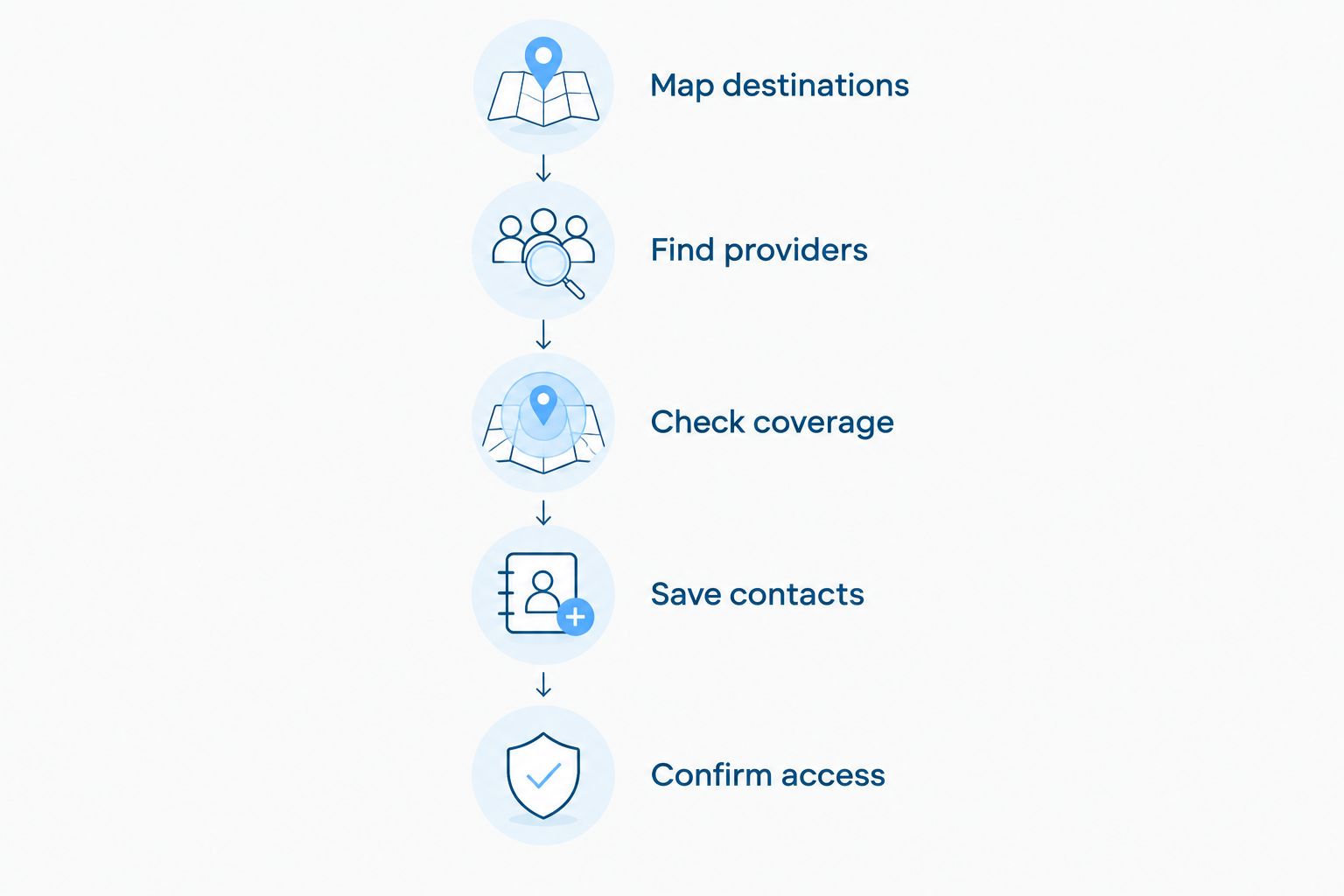
Keep the process small enough to finish and specific enough to use. Organize your 2026 preparation around these steps:
- Map destinations. List overnight stops and independent side trips. Match each service's geographic scope to that list.
- Find providers. Identify English-speaking healthcare options relevant to your itinerary. Confirm contact details and the type of care offered.
- Check coverage. Read your insurance and membership documents. Separate medical expenses, assistance functions, and transport arrangements.
- Save contacts. Keep 3 contact types together: local care, policy or membership assistance, and a trusted person at home.
- Confirm access. Keep 2 accessible copies of essential information: one on your phone and one you can use without relying on it.
These counts are an organizing checklist, not a clinical standard. Add relevant program contacts or medical information according to your own circumstances.
Test your plan before you pack. Open the saved contact details without your normal internet connection, locate your assistance instructions, and check that your trusted contact knows where the information is kept.
Which travel medical assistance option should you choose?
Choose the service that fills a named gap, not the one with the broadest label. For pre-trip English-speaking doctor preparation, choose the directory option. For policy questions, use policy-linked assistance. For a clinical consultation, check destination-authorized telehealth or local care.
Do not buy overlapping services before reading their terms. Write down the action you expect each service to perform. If your expectation is not stated in the agreement, do not build your plan around it.
FAQ
What's the best travel medical assistance service for a solo traveler?
The best fit depends on whether you need doctor information, clinical advice, insurance assistance, or transport support. MyAbroadMDs is best for pre-trip English-speaking doctor directory preparation, not treatment or financial coverage.
Is a travel doctor directory the same as travel insurance?
No. A travel doctor directory helps identify providers; travel insurance provides benefits according to a policy's terms. Keep provider preparation and financial coverage as separate decisions.
Can a doctor directory book an appointment for me?
Do not assume that a doctor directory includes appointment booking. Check the service's stated scope and contact the provider directly when booking is not included.
Can I use my usual telehealth app while traveling abroad?
Confirm with the telehealth provider before relying on your usual app abroad. The clinician must be authorized to serve you where you are physically located, and prescribing rules require a separate check.
Does medical evacuation membership pay all my medical bills?
Do not treat medical evacuation membership as coverage for all medical bills. Read its transport benefits separately from any medical expense insurance you hold.
What should I save before traveling alone?
Save local care details, assistance instructions, and a trusted contact's information. Keep an accessible backup alongside the version on your phone.
Should a solo study-abroad student buy another assistance service?
Check your university's support and insurance documents first. Choose additional support only after identifying a function your existing arrangements do not provide.
What should I do in a medical emergency abroad?
Contact local emergency services for an immediate medical emergency. A directory search or routine telehealth consultation is not a substitute for emergency response; identify the destination's emergency contact instructions before departure.
One last thing
A saved clinic name is not a complete plan. Add its contact details, the reason it belongs on your itinerary, and the instructions for reaching the relevant assistance service. Then check that you can retrieve everything yourself.
Peace of mind before you pack starts with knowing what each service does—and what it does not.