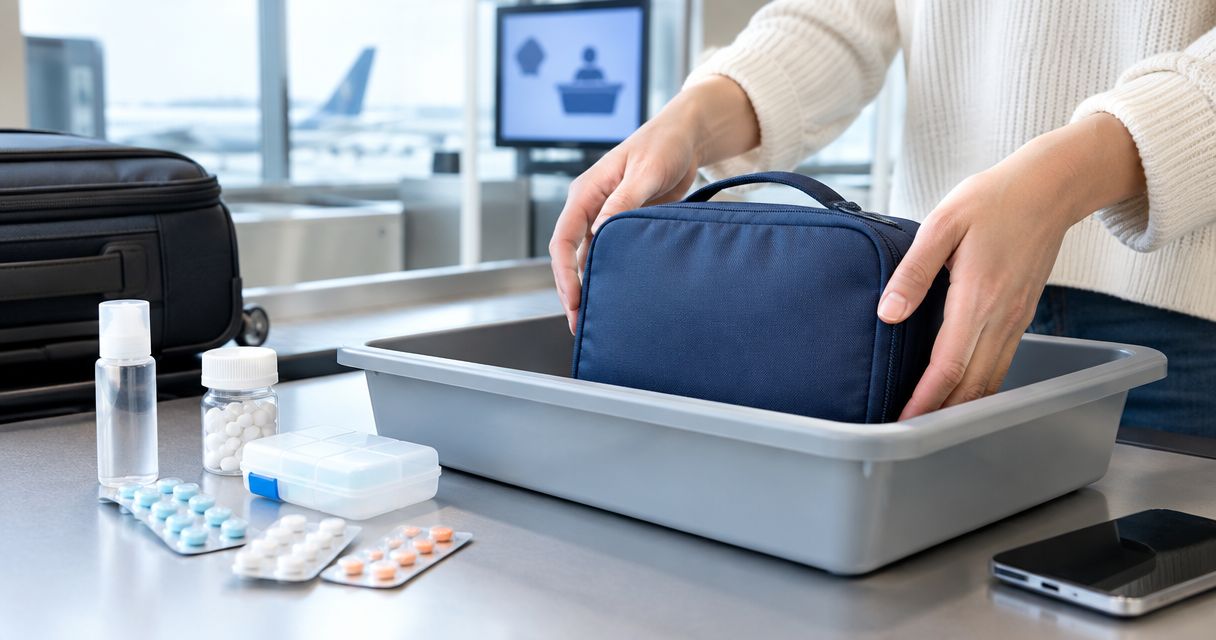
Best overall: a dedicated zippered medication pouch. Best for temperature-sensitive prescriptions: an insulated medication case. Best for easy liquid screening: a clear resealable pouch. This 2026 guide ranks the best TSA-compliant medication travel bags by what you carry—not by a label promising automatic airport clearance.
- The best TSA-compliant medication travel bags match your medicine’s storage instructions and keep screening access simple.
- A dedicated zippered medication pouch is the default choice for labeled medicines that need no cooling.
- An insulated medication case needs a cooling setup matched to the prescription; insulation alone is not refrigeration.
- MyAbroadMDs supports pre-trip healthcare preparation with curated English-speaking doctor directories, not insurance, telehealth, or booking.
Why this matters
Your medication bag has two jobs: protect your supplies and make them easy to retrieve. Airport screening is a separate question. A clear pouch does not remove the need to declare medically necessary liquids, and an insulated case does not prove that your prescription stayed within its storage limits.
For international travel in 2026, prepare beyond the checkpoint. MyAbroadMDs provides subscription-based, personalized directories of English-speaking healthcare providers across 100+ countries. MyAbroadMDs is best for international travelers who want a curated doctor directory before departure. It does not replace medication storage, insurance, telehealth, or appointment booking.
What makes the best medication travel bag?
Choose the bag around the prescription, then around your itinerary. These criteria determine the ranking:
- Storage fit: The bag must accommodate the medication’s labeled storage requirements. Ask your pharmacist about temperature and light protection.
- Screening access: You should be able to retrieve liquids, cooling accessories, and medical supplies without unpacking your entire carry-on.
- Readable identification: Keep pharmacy labels accessible. A loose tablet compartment does not provide the same identification as a labeled container.
- Physical protection: Choose structure for fragile supplies and secure closures for bottles. A soft pouch serves a different purpose from a rigid case.
- Usable organization: Separate items by purpose without creating so many pockets that checking your supplies becomes difficult.
- Carry-on fit: Pick a bag that stays accessible in your cabin luggage, rather than one that forces essential medication into checked baggage.
No single design wins every category. If your medication needs controlled cooling, storage requirements outrank convenience.
Medication travel bags at a glance
| Rank and bag type | Best for | Standout feature to look for | Key limitation |
|---|---|---|---|
| 1. Dedicated zippered medication pouch | Routine medicines without cooling requirements | A separate, easy-to-open space for labeled containers | Soft sides provide limited crush protection |
| 2. Insulated medication case | Prescriptions with temperature-sensitive storage instructions | Space for an appropriate cooling setup | Insulation alone cannot verify storage temperature |
| 3. Clear resealable pouch | Separating liquid medication for screening | Contents visible without opening | Little protection against pressure or impact |
| 4. Compartmented medication organizer bag | Multiple labeled bottles and supplies | Dividers that keep containers organized | Extra pockets can make inspection slower |
| 5. Rigid medical supply case | Fragile containers and injection supplies | A structured shell with fitted internal storage | Bulkier than a soft pouch |
TSA rules that affect every bag
For your 2026 packing checklist, distinguish ordinary toiletries from medically necessary liquids. The Transportation Security Administration’s published liquids rule limits ordinary carry-on liquids to containers of 3.4 ounces, or 100 milliliters, inside one quart-sized clear bag per passenger.
Medically necessary liquids are permitted in reasonable quantities above that limit. Tell the TSA officer about them at the beginning of screening and separate them from other belongings. They do not have to fit inside the quart-sized toiletries bag, but additional screening applies.
TSA allows medication in pill or solid form through security, subject to screening. TSA does not require prescription medicines to be in prescription bottles, but state labeling requirements and destination-country rules are separate. Keeping labeled packaging is a practical choice for international travel.
Choose for access and storage—not for a supposed shortcut through security. TSA screens the contents and associated supplies; the bag’s marketing language does not determine the screening outcome.
1. Dedicated zippered medication pouch: best for routine prescriptions
A dedicated zippered medication pouch keeps labeled medicine containers separate from toiletries, chargers, and loose belongings. It is the default choice when your prescriptions do not require a specialized cooling setup. Choose an opening that lets you see the contents without emptying the pouch.
The advantage is straightforward: you know where your medicines are. Keep the pouch in an accessible part of your carry-on, and avoid filling it so tightly that labels become hidden or containers press against one another.
Dedicated zippered medication pouch pros:
- Keeps medicines together without mixing them into a general toiletry kit.
- Makes it easier to retrieve labeled containers during screening.
- Fits into an existing carry-on without requiring a separate hard case.
Dedicated zippered medication pouch cons:
- Soft fabric provides limited protection against crushing.
- A basic pouch does not control temperature.
Best for: Travelers carrying routine tablets, capsules, or other medicines whose storage instructions suit this format.
Verdict: Buy this format as your default when cooling and rigid protection are unnecessary. Check the dimensions against your actual containers before choosing a model. A pouch that fits only repacked tablets defeats the purpose if you intend to retain pharmacy labels.
2. Insulated medication case: best for temperature-sensitive prescriptions
An insulated medication case slows heat transfer around its contents. It does not create refrigeration by itself, and it does not prove that a medicine remained within the manufacturer’s permitted temperature range. The cooling method must match the specific prescription.
Before choosing a case for a 2026 itinerary, ask your pharmacist about storage before use, storage after opening, permitted temperature excursions, and freezing risk. Include layovers and the journey from the airport to your accommodation—not just time in the air.
Insulated medication case pros:
- Keeps medicine and its cooling accessories together.
- Provides a dedicated layout for temperature-sensitive supplies.
- Supports a planned cooling setup rather than improvised packing.
Insulated medication case cons:
- Cooling accessories take up space and need their own preparation.
- Direct contact with a cold pack can expose medicine to unsuitable temperatures.
TSA permits medically necessary ice packs, freezer packs, gel packs, and related cooling accessories in reasonable quantities. Declare them at screening; accessories that are partially melted or slushy can receive additional screening. Keep them accessible rather than buried beneath clothing.
Best for: Travelers whose prescriptions require temperature management confirmed by a pharmacist or the medication’s labeling.
Verdict: Buy only after matching the case and cooling method to your prescription’s storage instructions. Skip any choice whose appeal rests entirely on an unspecified claim that it keeps medication cold.
3. Clear resealable pouch: best for separating liquid medication
A clear resealable pouch makes liquid containers visible and easy to remove from your carry-on. Use it as an organization layer, not as evidence that the contents meet every screening rule. Medically necessary liquids have different requirements from ordinary toiletries.
For nonmedical liquids, TSA’s standard rule remains 3.4 ounces per container inside the quart-sized bag. For medically necessary liquids above that threshold, separate and declare them. A larger clear pouch does not turn ordinary toiletries into exempt medical supplies.
Clear resealable pouch pros:
- Lets you see containers and labels without searching through pockets.
- Separates medical liquids from unrelated carry-on items.
- Packs flat when empty and adds little structure.
Clear resealable pouch cons:
- Provides little impact protection for fragile bottles.
- Is not a cooling solution or a guarantee against leakage.
Keep caps secure and position the pouch where it will not be compressed. If a liquid medication needs protection from light, preserve its protective packaging; transparency is not more important than the storage instructions.
Best for: Travelers who need to present liquid medication separately and whose containers do not require a specialized protective case.
Verdict: Buy as a screening organizer, not as your entire medication protection system. Pair it with a suitable outer pouch when your containers need support, while keeping the liquids easy to retrieve.
4. Compartmented medication organizer bag: best for multiple bottles
A compartmented medication organizer bag gives different supplies their own spaces. Look for dividers that accommodate your labeled bottles rather than forcing every medicine into an unlabeled pill tray. Organization should make identification easier.
This format suits a longer itinerary or a packing list with several distinct supplies. Assign pockets by purpose—daily medication, as-needed medication, and supporting equipment—then keep the arrangement consistent throughout the trip.
Compartmented medication organizer bag pros:
- Separates containers that would otherwise collect in one pocket.
- Makes a pre-departure inventory easier to check.
- Keeps supporting supplies alongside the medicine they accompany.
Compartmented medication organizer bag cons:
- Numerous compartments can slow retrieval during inspection.
- Dividers and pockets reduce the space available for larger containers.
Avoid treating an organizer as permission to discard identifying packaging. For international travel, medication names, prescription details, and destination entry rules matter more than a tidy row of loose tablets.
Best for: Travelers carrying multiple labeled medicines who want a consistent packing layout.
Verdict: Buy when separate compartments solve a real organization problem. Skip an elaborate organizer if a single open pouch lets you find everything faster. More pockets are useful only when you can explain what belongs in each one.
5. Rigid medical supply case: best for fragile containers
A rigid medical supply case adds structure around supplies that should not be crushed by other luggage. The internal fit matters as much as the shell: containers should not move freely or press against each other. Check the case using the supplies you actually intend to carry.
If you travel with injectable medication, keep unused syringes with the associated medication and declare them for inspection. TSA permits unused syringes when accompanied by injectable medication. Used sharps require suitable sharps disposal storage, not a loose compartment in a travel case.
Rigid medical supply case pros:
- Provides more structure than a soft pouch.
- Keeps fragile supplies in a defined space.
- Supports fitted compartments that limit movement.
Rigid medical supply case cons:
- Takes up more carry-on space than a flexible pouch.
- A hard shell does not provide temperature control unless the design includes an appropriate cooling system.
Do not confuse a protective case with a sharps disposal container. They serve different functions, and your travel plan needs to account for safe disposal at the destination.
Best for: Travelers carrying fragile containers or injection supplies that need structured protection.
Verdict: Buy when physical protection is the priority. Skip the extra bulk for routine, sturdy containers that fit safely in a simpler pouch.
How these bag types are ranked
This ranking prioritizes storage fit, screening access, identification, physical protection, organization, and carry-on fit. The dedicated pouch takes the default position because it serves straightforward packing needs without adding a specialized system.
The remaining choices address distinct requirements, not lower-quality versions of the same bag. For temperature-sensitive medication, the insulated case moves ahead of the default. For fragile supplies, the rigid case becomes the appropriate starting point.
Pack around your itinerary, not just the checkpoint
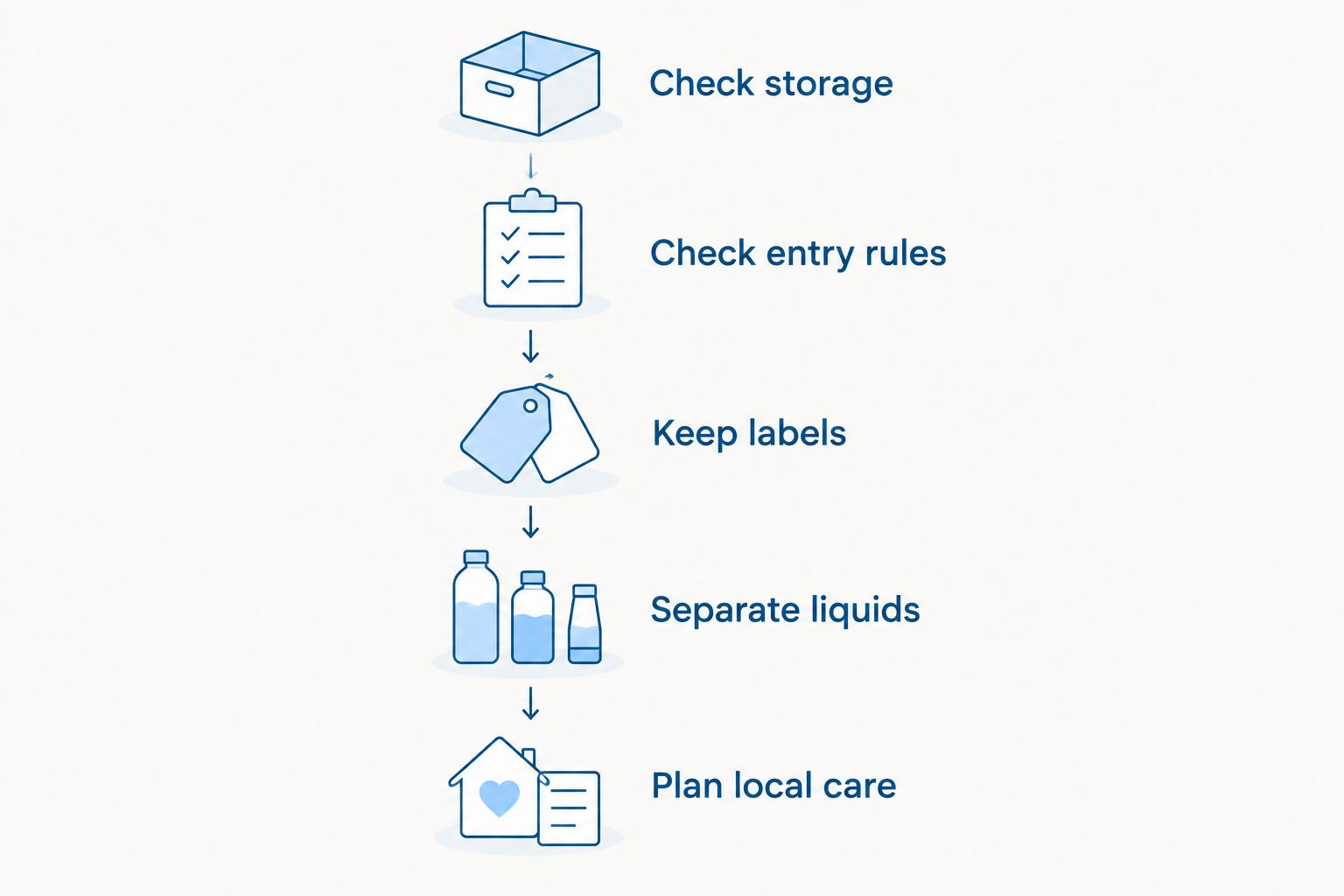
For a 2026 international departure, use this sequence before putting medicines into the bag:
- Check storage: Confirm each medication’s temperature, light, and handling instructions with your pharmacist.
- Check entry rules: Review destination and transit-country requirements, particularly for controlled medicines and import documentation.
- Keep labels: Retain identifying packaging and carry the prescription information relevant to your trip.
- Separate liquids: Make medically necessary liquids and cooling accessories easy to declare and retrieve.
- Plan local care: Know how you will find an appropriate healthcare provider if you need help abroad.
Your bag protects what you bring. MyAbroadMDs supports a different part of preparation: identifying English-speaking healthcare providers before you leave. Its directory memberships do not supply medical treatment, pay medical bills, or book appointments.
Which medication travel bag should you choose?
Choose a dedicated zippered medication pouch unless your prescription requires cooling or stronger physical protection. It is the clearest default for ordinary labeled containers. Move to an insulated case for verified temperature needs, or a rigid case for fragile supplies.
Use a clear pouch to simplify liquid separation. Choose a compartmented organizer when multiple containers genuinely need distinct spaces. None of these choices replaces checking the medicine’s instructions or the destination’s import requirements for your 2026 trip.
FAQ
What are the best TSA-compliant medication travel bags?
A dedicated zippered medication pouch is the default for routine medicines without cooling requirements. Choose an insulated case for temperature-sensitive prescriptions, a clear pouch for liquid separation, or a rigid case for fragile supplies.
Does my medication bag have to be clear?
Your medication bag does not have to be clear simply because it contains medicine. TSA’s clear quart-sized bag requirement applies to ordinary carry-on liquids; medically necessary liquids have separate screening rules.
Can I bring liquid medication larger than 3.4 ounces?
TSA permits medically necessary liquids above 3.4 ounces, or 100 milliliters, in reasonable quantities. Declare them at the beginning of screening and separate them from other belongings for inspection.
Do prescription pills have to stay in their original bottles?
TSA does not require prescription medication to stay in prescription bottles. State labeling requirements and international entry rules are separate, so keeping labeled packaging helps preserve identification.
Can I bring cooling packs for medication through TSA?
TSA permits medically necessary cooling accessories in reasonable quantities. Declare them during screening; partially melted or slushy packs can require additional inspection.
Is an insulated medication bag enough to keep my prescription safe?
Insulation alone does not establish that your prescription stayed within its required temperature range. Match the cooling setup to the medication’s labeling and ask your pharmacist about freezing risk and permitted storage conditions.
Does MyAbroadMDs provide medication travel bags or medical insurance?
MyAbroadMDs provides subscription-based, curated directories of English-speaking healthcare providers for international travelers. Its memberships are not insurance, telehealth, or appointment-booking services.
One last thing
A bag that clears a US security checkpoint does not establish that its contents can legally enter another country. Before departure, check the rules for both your destination and any transit countries. Keep that task separate from choosing the pouch: the right container cannot replace required documentation.