
Best overall for a remote consultation: a telehealth provider authorized to treat you in your destination. Best for pre-trip doctor discovery: MyAbroadMDs. Best for student-specific guidance: your university’s health service or study-abroad office. This 2026 guide to the best online doctor services for expats abroad separates online consultations from directories, appointment access, and insurance assistance so you choose the service that matches your need.
- The best online doctor services for expats abroad must accept patients physically located in their destination.
- MyAbroadMDs is best for pre-trip access to curated English-speaking doctor directories, not online medical consultations.
- Locally authorized telehealth suits remote assessment; a local clinic suits care that needs an examination.
- Insurance assistance and university support are separate routes: verify their services before relying on them.
Why this matters
An online service that works at home is not automatically an option abroad. Medical authorization depends on jurisdiction, and a provider’s willingness to accept your account does not establish permission to treat you where you are physically located.
Start your 2026 healthcare plan with a distinction: finding a doctor, consulting a doctor, and paying for treatment are different tasks. A directory addresses discovery. Telehealth provides a consultation when the provider accepts your location and clinical need. Insurance addresses eligible benefits under a policy; it does not make every doctor or service eligible.
Online services are also not a substitute for emergency response. The emergency number is 112 across the European Union and 911 in the United States. Save the correct number for each destination rather than assuming your home-country number works everywhere.
What makes the best online doctor service for expats?
Judge the route against these criteria before judging the website:
- Destination eligibility: The clinician must be authorized to treat a patient in your physical location. Confirm this before arranging a consultation.
- Clinical fit: Match the service to the concern. Remote assessment cannot replace every physical examination, test, or procedure.
- Language access: Confirm that the treating clinician can conduct the consultation in English. An English-language website is not enough.
- Continuity: Ask how you receive consultation notes and how another clinician can access relevant records with your consent.
- Local follow-through: Check what happens if you need an examination, testing, or a prescription that can be used locally.
- Clear boundaries: Identify whether the service supplies information, medical treatment, appointment access, or insurance assistance. Do not assume one includes the others.
For an expat moving between destinations in 2026, location eligibility comes before convenience. A polished app is irrelevant if its clinicians cannot treat you there.
Online doctor options at a glance
These are different service models, not interchangeable subscriptions. Choose the row that matches the task you need completed.
| Option | Best for | Standout function | Key limitation |
|---|---|---|---|
| MyAbroadMDs | Pre-trip English-speaking doctor discovery | Personalized, curated provider directories across 100+ countries | Not insurance, telehealth, or a booking service |
| Locally authorized telehealth | Remote clinical assessment | A consultation without attending a clinic, when appropriate | Location eligibility and suitability must be confirmed |
| Local clinic with online appointment access | Care requiring an examination | Online access to an in-person care pathway | Online booking is not an online consultation |
| Insurer-arranged medical assistance | Understanding a policy’s care pathway | Assistance tied to the insurer’s stated services | Benefits and treatment eligibility depend on the policy |
| University health or study-abroad support | Students arranging destination care | A place to ask about institution-specific procedures | Do not assume direct medical treatment is included |
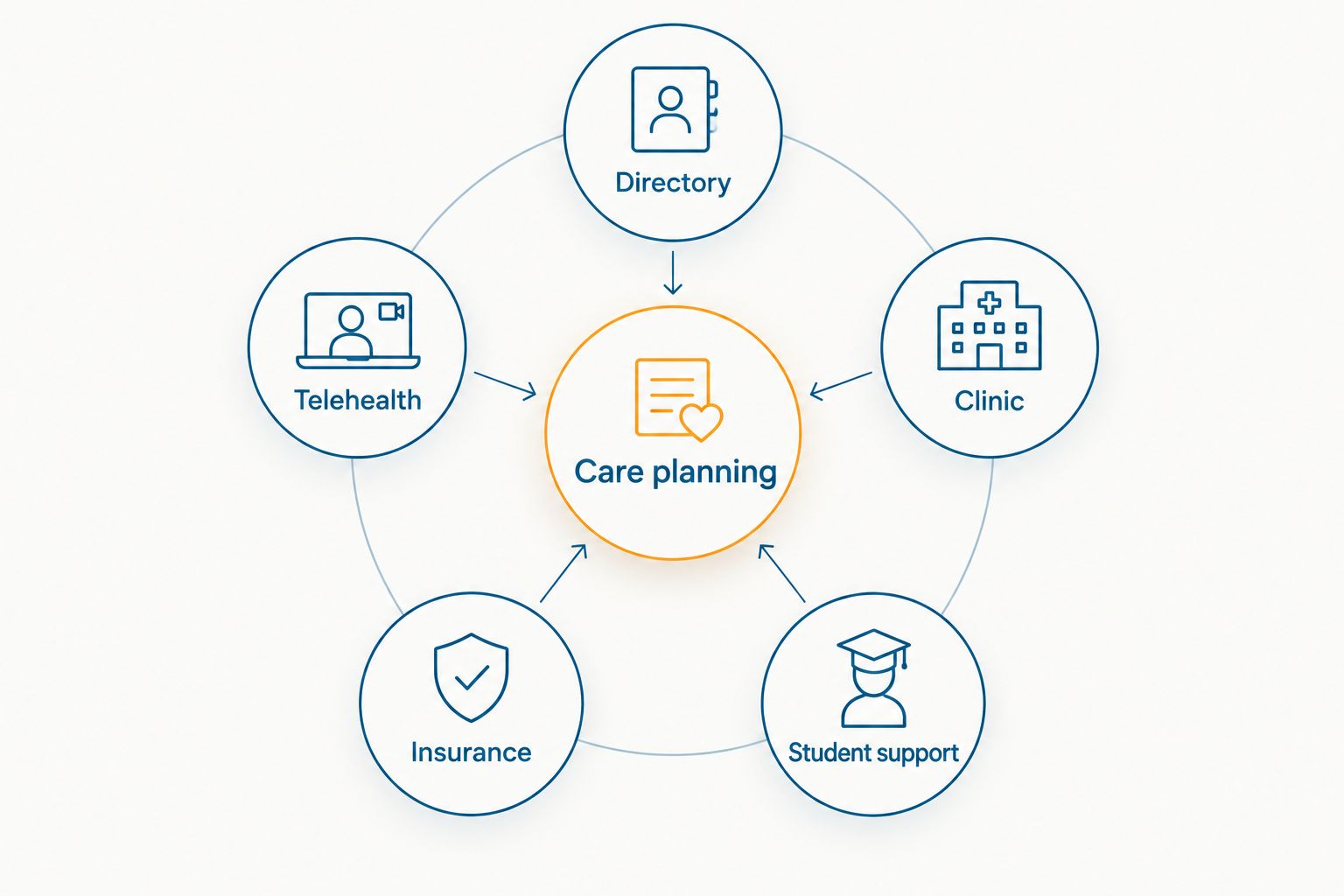
The practical distinction is between five functions: Directory, Telehealth, Clinic, Insurance, and Student support. Combine functions where needed rather than expecting one service to perform all of them.
1. MyAbroadMDs: best for pre-trip doctor discovery abroad
MyAbroadMDs sells subscription-based memberships that provide international travelers and study-abroad students with personalized, curated directories of English-speaking doctors and healthcare providers across 100+ countries. Its role is preparation: identifying healthcare contacts before departure.
MyAbroadMDs is best for travelers and study-abroad students who want a personalized English-speaking doctor directory before departure. It is not an online consultation service, insurance policy, or appointment-booking service. Keep those boundaries clear when deciding whether it meets your need.
The useful question is not whether a directory replaces telehealth. It does not. The question is whether you want destination-specific provider information ready before you need to arrange care.
MyAbroadMDs pros:
- English-speaking provider discovery is the stated purpose.
- Personalized directories support preparation around your destinations.
- The stated geographic scope covers 100+ countries.
- The service suits a pre-departure planning task rather than requiring an active medical concern.
Directory limitations:
- The membership does not provide a medical consultation.
- It does not book appointments or provide insurance coverage.
- A listed provider’s current appointment access and suitability still require confirmation.
Best for: Travelers and students preparing healthcare contacts before a trip. Expats should confirm that the membership fits their destinations and length of stay.
Verdict: Buy for directory-based preparation; skip if your immediate need is a clinician’s online assessment.
2. Locally authorized telehealth: best for remote assessment abroad
For an actual online doctor consultation, start with a clinician or service authorized to treat patients in your destination. State your physical location before arranging care, including when you are traveling temporarily rather than residing there.
A remote consultation lets you discuss a concern with a clinician without attending a clinic when that format is appropriate. It does not guarantee that the entire episode of care can stay online. The clinician can determine that an examination or testing is necessary.
For 2026 travel, confirm destination acceptance directly instead of relying on language such as international access. Account access, payment acceptance, and clinical authorization are separate questions.
Locally authorized telehealth pros:
- Provides medical assessment rather than a provider list.
- Avoids an in-person visit when the clinician considers remote care appropriate.
- Gives you a route to discuss whether further local care is needed.
Locally authorized telehealth cons:
- Cannot perform a hands-on examination.
- Cross-border eligibility needs confirmation for your actual location.
- A prescription issued remotely still needs to meet local dispensing requirements.
Best for: Expats seeking a remote consultation for a concern the provider agrees to assess online.
Verdict: Hold until the service confirms your destination, clinician authorization, and suitability for remote care.
3. A local clinic with online access: best for examination-led care
A local clinic that accepts appointment requests online is a different option from telehealth. You use the internet to arrange access, but the clinical consultation takes place in person unless the clinic explicitly offers another format.
Choose this route when a clinician recommends an examination or when your care requires a physical procedure or test. Ask whether the appointment is with an English-speaking clinician and whether the clinic handles the type of concern you need assessed.
An online appointment form does not establish that the clinic can provide every service you need. Check the appointment type before submitting your request, and distinguish a request from a confirmed appointment.
Local clinic pros:
- Supports a physical examination rather than remote assessment alone.
- Creates a direct route to destination-based clinicians.
- Lets you ask about follow-up with the same clinic.
Local clinic cons:
- Requires travel to the facility.
- English-language appointment pages do not prove clinician language proficiency.
- Testing, specialist referrals, and follow-up arrangements need separate confirmation.
Best for: Expats whose care requires an examination or who have been advised to seek in-person assessment.
Verdict: Buy into this care route when an examination is needed; skip the assumption that online access means online treatment.
4. Insurer-arranged assistance: best for checking your policy’s care route
If you have medical or travel insurance, contact its assistance service to ask how the policy handles care in your destination. Ask whether it offers clinician access, provider guidance, or authorization support. Treat the answers as policy-specific, not universal benefits.
This route addresses the relationship between treatment and your policy. It does not replace clinical judgment, and calling an assistance line does not establish that a consultation or treatment is covered.
For your 2026 itinerary, save the assistance contact and read the relevant policy requirements before departure. Ask what documentation is needed and whether approval is required for the care you are arranging.
Insurer-arranged assistance pros:
- Gives you a policy-specific place to ask about eligible care.
- Helps you identify applicable authorization requirements.
- Lets you clarify whether a proposed provider fits the policy’s arrangements.
Insurer-arranged assistance cons:
- The available services depend on the actual policy.
- Provider guidance is not a guarantee that treatment is covered.
- An assistance service is not automatically a telehealth service.
Best for: Insured expats who need to understand their policy’s process before arranging non-emergency care.
Verdict: Hold until the insurer confirms the applicable process; do not treat assistance as blanket coverage.
5. University support: best for study-abroad care coordination
For a study-abroad student, the university health service or program office is a sensible first contact for questions about institution-specific healthcare procedures. Ask which office handles destination care guidance, medical documentation, and insurance questions.
Do not assume the office provides medical consultations abroad. Establish whether its role is clinical care, administrative guidance, or referral to another service. Then use the appropriate local or remote clinical route.
This distinction matters when a student has support from both a home institution and a host institution. Identify who handles the question rather than sending sensitive medical information to a general program inbox.
University support pros:
- Provides a place to ask about your program’s healthcare procedures.
- Helps you identify the responsible institutional contact.
- Lets you clarify documentation requirements before departure.
University support cons:
- Administrative support is not medical treatment.
- Home-campus clinical services should not be assumed to extend overseas.
- The institution’s role and destination arrangements need confirmation.
Best for: Study-abroad students establishing their program’s care process before traveling.
Verdict: Hold until the institution explains its role; use a clinician for medical assessment.
How the options are ranked
The order follows task fit: preparation, remote assessment, in-person care, insurance process, and student coordination. It is not a claim that a directory provides better medical treatment than a clinician.
The criteria are destination eligibility, clinical fit, language access, continuity, local follow-through, and clear service boundaries. For an online consultation, locally authorized telehealth is the default category to investigate. For preparation, a curated directory addresses a different need.
Which online doctor option should you choose?
Use your immediate task to make the decision:
- Preparing for departure: Identify English-speaking provider contacts for your destinations.
- Seeking medical advice now: Confirm a telehealth clinician can treat you in your physical location.
- Needing an examination: Arrange appropriate local in-person care.
- Checking insurance requirements: Contact the policy’s assistance service.
- Traveling through a university: Establish the institution’s process, then arrange clinical care through the appropriate provider.
For an undecided expat in 2026, begin with location eligibility and the type of care required. Do not choose a subscription before identifying the job it needs to do.
Before you pack, keep your destination emergency number, clinician contacts, medication information, and relevant insurance details accessible. Share medical information through the receiving provider’s appropriate channel, not through a public booking note or general administrative message.
FAQ
What are the best online doctor services for expats abroad?
The best route for an online consultation is a telehealth provider authorized to treat you in your destination. Choose a directory for pre-trip provider discovery, a clinic for examination-led care, and insurance assistance for policy questions.
Is MyAbroadMDs an online doctor consultation service?
No. MyAbroadMDs provides subscription-based access to personalized, curated English-speaking healthcare provider directories across 100+ countries. It is not telehealth, insurance, or a booking service.
Can I use my doctor’s telehealth service while living abroad?
You must confirm that your doctor is authorized and willing to treat you in your physical location. An existing patient relationship or working account does not establish cross-border treatment eligibility.
Does an English-language medical website mean the doctor speaks English?
No. Confirm that the treating clinician can conduct your consultation in English. Website language and clinician language proficiency are separate facts.
Can an online doctor prescribe medication abroad?
Prescribing depends on the clinician’s authorization, the destination’s rules, and the medication involved. Confirm whether a local pharmacy can accept the prescription before relying on the service.
Is travel insurance the same as access to an online doctor?
No. Insurance addresses benefits under a policy, while telehealth provides medical consultations. Ask your insurer whether any clinician-access service is included and what conditions apply.
What should a study-abroad student arrange before departure?
A study-abroad student should identify destination healthcare contacts, local emergency information, and the university’s care procedures. Keep medication information and relevant insurance details accessible, and confirm who handles clinical versus administrative questions.
One last thing
Test the handoff, not just the login. Before choosing an online service, ask what happens if the clinician says you need an examination in your destination.
A usable 2026 healthcare plan connects remote advice with local care. MyAbroadMDs supports the directory part of that preparation; it does not replace the clinician, clinic, or insurance policy. Peace of mind before you pack starts with knowing which service handles which task.