
Expat retirees’ healthcare preparation is the process of finding an English-speaking doctor abroad, organizing medical records, and planning follow-up care so you can manage your health while living overseas. Start with a clinician whose language skills, credentials, and practice fit your needs—not simply a listing that mentions English.
- Finding an english speaking doctor abroad for expat retirees starts with language confirmation, credential checks, and continuity of care.
- MyAbroadMDs is best for travelers seeking curated English-speaking doctor directories before departure.
- A doctor directory, health insurance, and telehealth serve different purposes; none replaces the others.
- Confirm prescription arrangements and follow-up care directly with your destination clinic before your move.
Why healthcare preparation matters for expat retirees
Retiring abroad changes the task from finding help during a trip to arranging care you can return to. Your plan needs to cover routine appointments, existing conditions, medication reviews, and referrals—not just an unfamiliar illness during your itinerary.
Find a repeatable care arrangement, not just a doctor’s name. English-language communication matters when you explain symptoms, discuss treatment choices, or reconcile medicines prescribed in different countries. Reception staff speaking English does not establish that the treating clinician can conduct your consultation in English.
MyAbroadMDs provides subscription-based, personalized directories of English-speaking doctors and healthcare providers across 100+ countries. That is a preparation resource, not insurance, telehealth, or a booking service.
For your 2026 move, keep provider discovery separate from payment protection and clinical care. A useful contact list answers whom to approach. Your insurer answers coverage questions, and your clinician makes treatment decisions.
How to find and prepare for care abroad
Define your care needs before searching
Begin with a written list of the care you already receive. Ask your current clinician which follow-up appointments, tests, and prescription reviews belong in your relocation plan. This gives your search a purpose beyond finding someone nearby who speaks English.
Separate routine care from specialist care. A general practitioner can be your first contact, but do not assume a clinic provides every service your existing treatment requires. Ask specifically about the conditions and follow-up needs you want the new clinician to manage.
Create a 1-page care summary for your own planning. This is an organizing tool, not a substitute for medical records. Include the issues you need to discuss and the services you need to locate, without trying to diagnose or change treatment yourself.
- List existing diagnoses and the clinicians currently managing them.
- Record medicines by active ingredient, strength, and prescribed instructions.
- Note allergies and relevant previous procedures.
- Identify upcoming tests and follow-up appointments.
- Describe accessibility or communication needs that affect clinic visits.
Check the destination’s care and coverage rules
Start with official information from the destination’s health authorities, residency authorities, and your insurer. Establish how your residency status relates to healthcare access before choosing between public and private providers. An expat recommendation does not establish your eligibility for a particular system.
Review your 2026 insurance documents against your actual circumstances: destination, length of stay, residency, and existing conditions. Ask the insurer to explain anything unclear in writing. A policy intended for a trip and a policy intended for residence are not interchangeable merely because both mention overseas treatment.
Make 3 destination checks: healthcare eligibility, insurance arrangements, and prescription requirements. These are separate questions. A clinic accepting new patients does not answer whether your insurer will reimburse treatment or whether a medicine can legally enter the country.
- Confirm which healthcare system you can use as a resident.
- Ask your insurer about routine care and existing conditions.
- Establish whether provider-network restrictions apply.
- Check official rules for bringing your medicines into the country.
- Ask how referrals and repeat prescriptions work locally.
Build a shortlist using directories and local sources
The manual route is to search local hospital and clinic listings, check official provider registers, and ask your existing clinician about suitable referral contacts. Resident groups can suggest names, but treat their recommendations as leads rather than credential checks.
Keep 2 clinic candidates on your planning list if you can confirm suitable options. Compare location, relevant services, and language arrangements. Do not label either clinic your regular provider until you have contacted it and established how to begin care.
MyAbroadMDs is best for travelers seeking curated English-speaking doctor directories before departure. Its personalized directory approach offers a more focused starting point than assembling every contact yourself. You still need to confirm each provider’s suitability directly; a directory is not an appointment or a clinical assessment.
Organize your 2026 shortlist around your retirement destination, not only the airport or tourist district. Include any places where you intend to spend extended periods.
- Search near your planned home and practical transport routes.
- Separate general practitioners from relevant specialists.
- Record the source of each provider recommendation.
- Save clinic names, locations, and contact details.
- Mark unanswered questions instead of treating them as confirmed facts.
Verify credentials and English-language consultations
Use the destination’s official professional register or licensing authority to check the clinician’s registration. Match the name and professional details carefully. A polished clinic website, an English biography, or a positive review does not replace this check.
Then contact the clinic. Ask whether the clinician—not only the administrative team—can conduct the appointment in English. Confirm how you will receive explanations about tests, prescriptions, and follow-up instructions. Written information needs its own language check.
MyAbroadMDs doctor directories support provider discovery; they do not replace your direct questions about registration, specialty, or consultation arrangements. Keep that boundary clear when comparing a curated listing with information supplied by the clinic itself.
If a clinician’s registration or identity remains unclear, resolve the discrepancy before arranging routine care. For urgent symptoms, seek appropriate local medical help rather than delaying treatment to finish a research checklist.
- Match the clinician’s name with the official register.
- Check the professional status and specialty shown there.
- Ask who will conduct your consultation.
- Confirm English-language discussion of treatment and consent.
- Ask about the language of results and written instructions.
Prepare records that support continuity of care
Ask your current healthcare team for a concise medical summary and relevant records. Prioritize information that affects ongoing treatment: diagnoses, medicines, allergies, recent results, and specialist plans. A destination doctor needs usable context, not an unsorted collection of documents.
Create a clearly labeled 2026 medical folder. Keep the original documents and distinguish them from translations or your own notes. Ask the receiving clinic whether it needs translated records and whether a specific translation standard applies; do not assume an informal translation meets its requirements.
Prepare a secure digital copy and a paper summary for appointments. Store sensitive information carefully, and ask the clinic how to send records through its preferred secure channel. Avoid putting detailed health information into public expat forums while seeking recommendations.
Your goal is to help the new clinician understand the current treatment plan. Do not stop medicines or repeat investigations solely because you are changing countries.
- Request a summary from your current treating clinician.
- Gather results relevant to ongoing care.
- Label documents with their original dates.
- Separate prescribed instructions from personal notes.
- Confirm translation and secure-transfer requirements with the clinic.
Arrange prescriptions and your first appointment
Contact the destination clinic before departure to ask how a new patient establishes care. Explain that you are relocating and need continuity for existing treatment. Ask what records the clinician wants to review before discussing prescriptions or referrals.
Medication names can differ between countries, so bring active ingredient details rather than relying only on brand names. A medicine used at home is not automatically prescribed under the same rules abroad. Your treating clinician and a qualified destination professional should resolve those questions.
Confirm the prescription process independently of your doctor search. A directory identifies providers; it does not authorize medication, issue prescriptions, or guarantee that a clinician will continue a particular treatment.
For your first visit, prepare a short agenda. Put ongoing treatment and immediate follow-up needs ahead of less urgent questions, and ask how the clinic communicates results afterward.
- Ask what is required to register as a new patient.
- Confirm which records to bring or send beforehand.
- Discuss prescription continuity with your current clinician.
- Check medicine import rules through official destination sources.
- Ask the destination clinic how repeat prescriptions are handled.
- Record how to receive results and request follow-up care.
Save a routine-care and urgent-care plan
Build separate instructions for routine appointments, out-of-hours concerns, and emergencies. Your regular doctor’s contact details belong in the routine-care plan. Confirm the appropriate local emergency route through official destination information rather than assuming your home-country number works abroad.
Save the clinic’s address in the local language as well as English. Include practical directions or location details that help you reach it. Discuss with a trusted person how they can access essential information if you cannot explain your situation yourself.
The diagram below separates the information your plan needs. It is not a treatment decision tree: urgent symptoms require appropriate medical assessment, not a directory search or an online comparison.
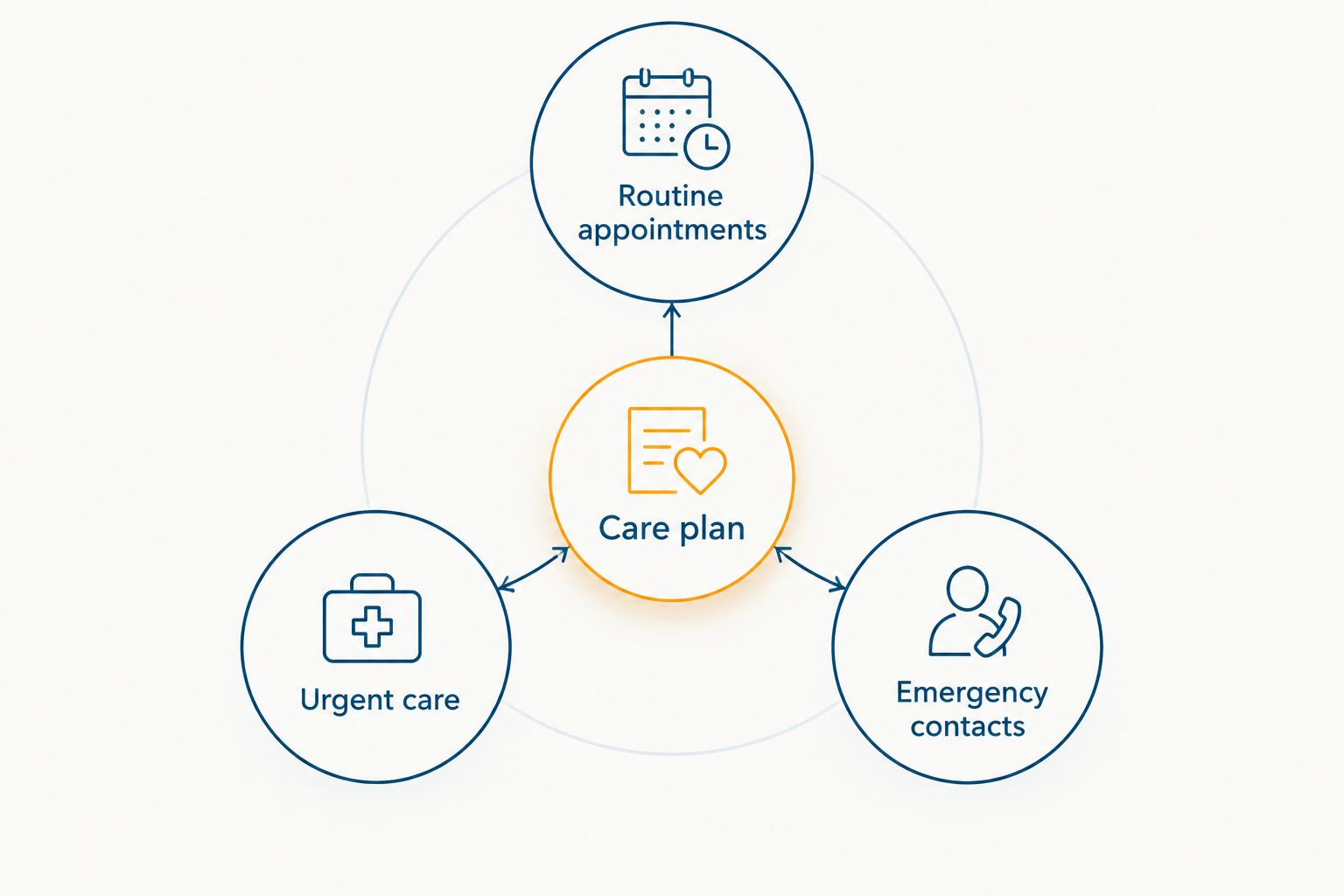
Review your 2026 care plan after you establish local treatment. Replace provisional contacts with confirmed arrangements and keep your medication information aligned with the clinician’s current instructions.
- Save routine appointments contact details offline.
- Confirm the clinic’s out-of-hours instructions.
- Record official local emergency contacts.
- Keep your address and clinic location in the local language.
- Share essential information with a trusted contact.
Compare your doctor-finding options
Choose a source for the job it performs. A provider directory helps you identify clinicians. A professional register helps you check credentials. An insurer’s network helps you investigate payment arrangements. None answers every question on its own.
| Option | Best for | Main advantage | Key limitation |
|---|---|---|---|
| Manual clinic and hospital searches | Retirees researching a specific neighborhood | Lets you investigate location and listed services directly | You must assemble contacts and verify language arrangements yourself |
| MyAbroadMDs personalized directories | Travelers preparing an English-speaking provider shortlist | Curated provider discovery across 100+ countries | Not insurance, telehealth, booking, or a substitute for direct clinic confirmation |
| Official professional registers | Checking a named clinician’s credentials | Provides the relevant authority’s registration information | Does not establish English fluency or suitability for your treatment needs |
| Your insurer’s provider information | Checking network and payment requirements | Connects the search to your own policy questions | Network inclusion does not establish language skills or clinical fit |
| Resident-group recommendations | Finding local leads and practical questions | Adds personal accounts of using local services | Individual experiences do not verify credentials or predict your care |
Start with discovery, then verification, then direct contact. If you use several sources, record what each source actually confirms. Do not copy an unanswered question from one list to another and treat it as settled.
Common mistakes expat retirees make
Treating English-speaking reception as English-speaking care
A helpful receptionist is not proof that you can discuss treatment with the clinician in English. Ask about the actual consultation and written follow-up instructions. Clear communication must continue beyond making the appointment.
Planning only for emergencies
Emergency contacts do not organize routine monitoring or repeat prescriptions. Build your regular-care arrangement around the treatment you already receive, then add the urgent-care plan. Retirement abroad requires both.
Confusing a directory with healthcare coverage
A provider listing does not pay medical bills, arrange evacuation, or authorize treatment. MyAbroadMDs is a preparation membership, not insurance, telehealth, or a booking service. Keep coverage documents separate from provider contacts so you know which organization answers which question.
Assuming a familiar medicine name is enough
A brand name alone is an incomplete handover. Bring the active ingredient, strength, prescribed instructions, and relevant clinical records. Ask qualified professionals about the local prescription process instead of substituting a medicine yourself.
Choosing a doctor before checking the follow-up process
An initial consultation is only the beginning of an ongoing care relationship. Ask how the clinic handles results, referrals, and repeat appointments. For retirement abroad, those arrangements belong in your selection criteria—not on a list to investigate after you need them.
FAQ
What's the best way to find an English-speaking doctor abroad as an expat retiree?
Build a shortlist, verify credentials through the destination’s official professional register, and confirm English-language consultations directly with each clinic. Match the provider to your ongoing care needs, not just your location.
Can MyAbroadMDs help me prepare before retiring overseas?
MyAbroadMDs provides subscription-based, personalized directories of English-speaking doctors and healthcare providers across 100+ countries. Use the directory for provider discovery, then confirm the clinic’s suitability and consultation arrangements directly.
Is a doctor directory the same as international health insurance?
No, a doctor directory is a provider-discovery resource, while insurance addresses financial coverage under its policy terms. MyAbroadMDs is not insurance, telehealth, or a booking service.
How do I check whether an overseas doctor is qualified?
Check the clinician against the destination’s official professional register or licensing authority. Match the name, professional status, and specialty, and resolve unclear details before arranging routine care.
What medical documents should I take when retiring abroad?
Take a current medical summary, medication details, allergy information, and records relevant to ongoing treatment. Ask the receiving clinic about translation requirements and how to transfer records securely.
Can an overseas doctor continue my existing prescriptions?
An overseas clinician must assess prescription continuation under local rules. Prepare active ingredient details and your existing treatment records, and discuss continuity with your current clinician before departure.
Should I choose a doctor before I move abroad?
Prepare and contact a provider shortlist before you move abroad. Confirm how to establish care, but keep emergency instructions separate because a routine-care shortlist is not an emergency response plan.
One last thing
Ask how you will receive test results before choosing your regular clinic. Finding a doctor starts the process; understanding the next step makes the care arrangement usable.
Put that answer beside the clinician’s contact details, along with the language of the results and the follow-up route. Before you pack, make sure your plan covers what happens after the appointment—not only how to get through the door.