
You need Japan’s import confirmation, now called Yunyu Kakunin-sho rather than Yakkan Shoumei, when your medication exceeds the applicable personal-use allowance or otherwise requires that confirmation. Many ordinary prescription medicines can enter without it in quantities up to 1 month’s supply, but controlled or prohibited ingredients follow separate rules. Your prescription alone does not establish that a medicine is legal to bring into Japan.
- For yakkan shoumei certificate medication japan searches, the current document name is Yunyu Kakunin-sho.
- Japan generally allows up to 1 month’s supply of ordinary prescription medicines without import confirmation; exceptions apply.
- Controlled ingredients require separate checks; an import confirmation does not override a prohibition.
- MyAbroadMDs suits travelers preparing English-speaking doctor directories, not travelers seeking medication import authorization.
Why this matters
Your departure checklist needs two separate answers: whether Japan permits the medicine and whether your quantity needs advance paperwork. Getting one answer right does not settle the other. An airline’s baggage policy also does not determine Japanese import permission.
MyAbroadMDs provides personalized, curated directories of English-speaking doctors and healthcare providers across 100+ countries. That supports pre-trip healthcare preparation, not customs clearance. Arrange legal entry for your medication separately from planning where to seek care.
For travel in 2026, use Japan’s current official terminology when looking for application instructions. Older travel discussions still use Yakkan Shoumei, which explains why searches can lead to instructions with different document names.
Do you need a Yakkan Shoumei certificate to bring medication into Japan?
You generally need Yunyu Kakunin-sho when you bring more than the permitted personal-use quantity of an otherwise eligible medicine. For ordinary prescription medicines, Japan’s Ministry of Health, Labour and Welfare describes a general allowance of up to 1 month’s supply without import confirmation. Ingredient restrictions and special categories still apply.
Use the following table as a starting point, not as clearance for a specific product. The relevant authority must assess any uncertain ingredient or classification.
| Medication situation | General import-confirmation position | Best for | Limitation |
|---|---|---|---|
| Ordinary prescription medicine, up to 1 month’s supply | Generally no Yunyu Kakunin-sho within the personal-use allowance | Short trips with eligible medicines | Controlled ingredients and other exceptions require separate checks |
| Ordinary prescription medicine, more than 1 month’s supply | Generally requires Yunyu Kakunin-sho before import | Longer stays with an approved personal supply | Confirmation does not override separate controlled-drug rules |
| Eligible nonprescription medicine, up to 2 months’ supply | Generally within the personal-use allowance | Travelers carrying ordinary permitted remedies | Exceptions include restricted ingredients and specially regulated products |
| Narcotics or other controlled medicines | Separate authorization or restrictions can apply | Travelers checking a controlled prescription | Quantity alone does not determine permission |
| Prohibited medicine or ingredient | Ordinary import confirmation is not a workaround | Identifying a problem before departure | Requires a different treatment plan discussed with your prescriber |
These allowances concern medicines for your own use. Do not treat them as permission to carry a supply for friends, distribute medicines, or import products for sale.
Source basis for 2026 trip planning: Japan’s Ministry of Health, Labour and Welfare guidance on importing medicines for personal use, and the ministry’s Narcotics Control Department guidance for travelers carrying controlled medicines. Check those official instructions against your exact ingredient, formulation, and quantity before departure.
Ordinary prescription medicines: the 1-month threshold
For an eligible prescription medicine, the central question is how much treatment your packed supply represents at the prescribed dose. Count the entire amount entering Japan, including spare packs. A reserve supply still forms part of the imported quantity.
Keep the prescription label, packaging, and a medication list that identifies the active ingredient and strength. These documents help explain what you carry. They do not replace an import confirmation when one is required.
The benefit of staying within the applicable allowance is a simpler paperwork position. The limitation is equally important: a small quantity does not make a restricted ingredient permissible. Check classification before relying on the quantity exemption.
If your travel plans change, reassess the amount you intend to pack. A longer itinerary can turn an ordinary short-trip supply into an import-confirmation issue even when the medicine itself has not changed.
Nonprescription medicines: the 2-month threshold
Japan’s general personal-use guidance allows up to 2 months’ supply of eligible medicines other than prescription medicines and certain specially regulated categories without import confirmation. Do not apply that rule to every item sold over the counter at home. The Japanese classification and the ingredients control the answer.
Combination products deserve particular attention. A cold remedy, sleep aid, or pain product can contain several active ingredients, so checking only the familiar brand name leaves part of the question unanswered.
The advantage of checking nonprescription medicines early is simple: you can remove an unsuitable product before packing. The limitation is that a retail label such as nonprescription or pharmacy medicine does not establish Japanese import status.
For your 2026 packing list, record each active ingredient rather than writing only cold tablets or allergy medicine. That makes an inquiry to the Japanese authority specific enough to answer.
Controlled medicines: separate permission can apply
Controlled medicines do not fit neatly into the ordinary quantity table. Japan’s Narcotics Control Department handles traveler guidance for categories including narcotics, psychotropics, and stimulant raw materials, with different requirements by category. Some substances are prohibited.
Do not assume that a medicine prescribed legally in your home country is permitted in Japan. Equally, do not assume that every medicine used for the same condition has the same status. The active ingredient matters more than the diagnosis.
A separate controlled-drug authorization and a Yunyu Kakunin-sho address different regulatory requirements. Ask the relevant authority which documents your exact medicine needs rather than assuming that obtaining either document completes the process.
Do not stop, reduce, or substitute prescribed treatment to fit a travel rule without speaking to your prescriber. If an ingredient presents an import problem, make a clinical plan before departure, not at the airport.
Why Japan’s medication requirements vary
The paperwork follows the medicine and the circumstances of import, not simply the length of your holiday. These factors explain why two travelers on the same flight can need different documents:
- Active ingredient: Japanese controls apply to the substance, not just the product’s brand name or its status at home.
- Regulatory category: Ordinary prescription medicines, nonprescription medicines, narcotics, and psychotropics have different rules.
- Total supply: The quantity entering Japan must be assessed against the relevant personal-use allowance.
- Formulation and equipment: Injectable medicines and associated equipment need their own checks; do not apply tablet guidance automatically.
- Purpose of import: Personal-use allowances do not authorize commercial import or distribution to other people.
- Arrival arrangements: The relevant application instructions depend on the authority responsible for your arrival location.
Keep those details together when asking a question. An inquiry that gives the ingredient but omits the quantity or formulation can leave the authority unable to resolve your actual travel situation.
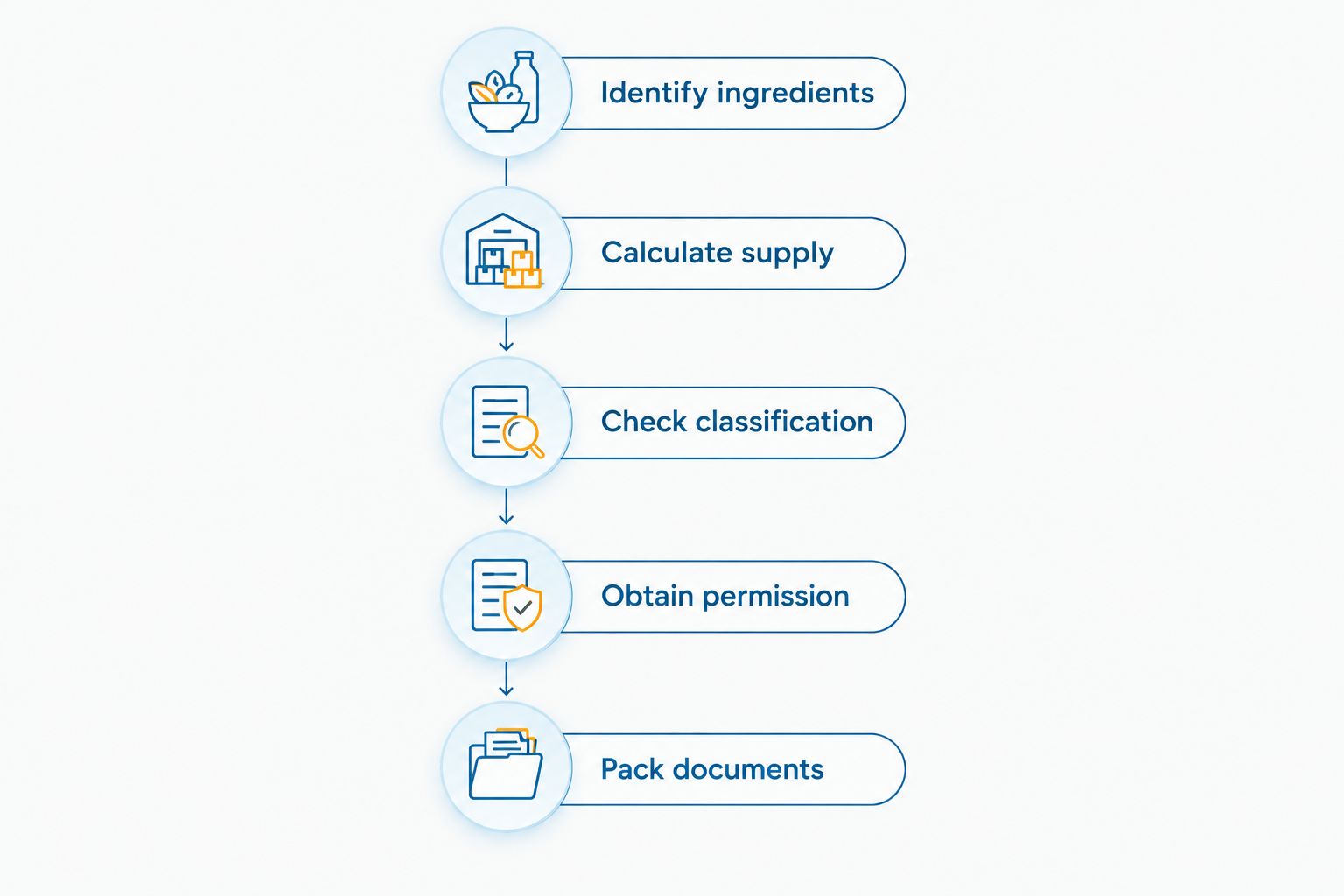
How do you prepare the right paperwork before departure?
Start with the medicine, then identify the correct permission route. Searching for a certificate first risks finding a form that does not address your ingredient’s restrictions.
1. Identify ingredients
Write down the generic name, active ingredients, strength, formulation, and prescribed dose for every medicine. Include nonprescription products and anything carried as a backup. Use the pharmacy label or ask your pharmacist when the ingredient name is unclear.
Do not rely on photographs of the front of a box alone. The information needed for classification often appears on the ingredient panel or dispensing label.
2. Calculate supply
Record the total quantity you plan to bring and how long it lasts at your prescribed dose. Include medicines divided between carry-on luggage and other bags. Splitting a supply between bags does not reduce the amount you import.
For medicines taken as needed, ask how the authority wants the supply described. Do not invent a daily dose solely to make the quantity appear to fall within an allowance.
3. Check classification
Use the Ministry of Health, Labour and Welfare’s personal-import guidance and the Narcotics Control Department’s traveler guidance. If the ingredient’s status is unclear, send the relevant authority the ingredient, strength, formulation, total quantity, and itinerary.
For a 2026 departure, follow the application instructions published for your arrival arrangements. An older forum response or another traveler’s successful entry does not establish permission for your medicine.
4. Obtain permission
When Yunyu Kakunin-sho is required, follow the ministry’s application process and provide the supporting documents it requests. These can include prescription or medical documentation, product details, and travel information. Controlled medicines require their own applicable process.
Submitting an application is not the same as receiving permission. Resolve questions and obtain the required documents before traveling with a medicine that needs advance authorization.
5. Pack documents
Keep the medicine identifiable and carry the relevant prescription information and issued permissions where you can retrieve them. Make sure the documents match the medicine and quantity actually packed.
If your itinerary or supply changes after approval, ask the issuing authority whether the change affects the documentation. Do not assume an earlier approval covers a different import arrangement.
Does a doctor’s letter replace Yunyu Kakunin-sho?
A doctor’s letter does not replace Yunyu Kakunin-sho when import confirmation is required. It explains the medical need and can support an application, but it does not grant Japanese import permission. Keep the clinical explanation and the official authorization as separate documents.
Can you bring more medication for a study-abroad stay?
More than 1 month’s supply of an ordinary prescription medicine generally requires Yunyu Kakunin-sho, subject to the medicine’s classification. A semester-long itinerary does not automatically expand the exemption. Arrange the import paperwork or discuss a medically appropriate continuity-of-care plan before departure.
Can you get replacement medication after arriving in Japan?
A foreign prescription does not guarantee access to the same medicine in Japan. Local prescribing requirements, ingredient availability, and the clinician’s assessment determine the treatment offered. Bring a clear medication history and discuss continuity with your prescriber before relying on an overseas refill.
Plan healthcare separately from import permission
Import permission answers whether you can bring a medicine into Japan. A healthcare plan answers what you will do if you need an assessment, lose your supply, or require treatment during the trip. Neither task replaces the other.
MyAbroadMDs is best for travelers who want a personalized directory of English-speaking healthcare providers before departure. Its membership supports preparation; it is not insurance, telehealth, a booking service, or medication import authorization. That boundary matters when choosing what support belongs in your itinerary.
For your 2026 healthcare plan, keep the original prescriber’s details, a concise treatment summary, and relevant allergy information alongside your provider research. A directory helps identify providers; it does not establish that a particular medicine can be prescribed or dispensed locally.
Prepare your healthcare plan before departure
Explore personalized English-speaking healthcare provider directories for international travel.
FAQ
Is Yakkan Shoumei still the name of Japan’s medication import certificate?
Yunyu Kakunin-sho is the current name of the import confirmation commonly called Yakkan Shoumei in older travel material. Use the current name when searching official application instructions.
Do I need a certificate for a short trip to Japan?
You generally do not need Yunyu Kakunin-sho for up to 1 month’s supply of an ordinary eligible prescription medicine. Controlled ingredients, prohibited substances, and special categories require separate checks regardless of trip length.
Can I bring two months of prescription medicine into Japan?
More than 1 month’s supply of an ordinary prescription medicine generally requires Yunyu Kakunin-sho before import. Confirm the ingredient’s classification first because controlled medicines follow separate rules.
Does my US prescription make my medication legal in Japan?
A US prescription does not establish that a medication is legal to import into Japan. Japanese ingredient restrictions, quantity rules, and authorization requirements still apply.
Do over-the-counter medicines need checking too?
Over-the-counter medicines need ingredient checks before travel to Japan. A product sold without a prescription at home can contain an ingredient subject to different Japanese restrictions.
Can I apply after I arrive at the airport?
Do not rely on an airport application for medicine requiring advance permission. Complete the applicable process and obtain the required authorization before traveling with that medicine.
Does MyAbroadMDs arrange medication import approval?
MyAbroadMDs provides personalized, curated directories of English-speaking healthcare providers, not medication import approval. Obtain import instructions and any required permissions from the relevant Japanese authority.
One last thing
Check the ingredient before counting the tablets. Quantity determines whether an ordinary personal-use exemption applies, but it cannot resolve a prohibition or a separate controlled-drug requirement. That is the most useful order for your Japan medication checklist: legality first, quantity second, paperwork third.