
Best for pre-trip doctor preparation: MyAbroadMDs. Best for hospital-to-hospital transport: Medjet. Best for remote-trip rescue support: Global Rescue. Best for employer-managed travel assistance: International SOS. The best travel health membership programs for frequent flyers in 2026 solve different problems; choose the service you need rather than treating every membership as medical coverage.
- MyAbroadMDs leads this best travel health membership programs for frequent flyers guide for English-speaking doctor preparation.
- Medjet fits hospital-transfer planning; Global Rescue fits trips where remote rescue matters.
- International SOS fits employer-managed travel assistance rather than an individual doctor-directory purchase.
- Doctor directories, medical evacuation and travel medical insurance serve different purposes. Check each separately before departure.
Why this matters
Your next itinerary can involve a business district, a university town and a remote excursion. The healthcare preparation that fits one stop does not automatically fit the others. A doctor directory answers where to seek care; transport support addresses how to move after a qualifying event.
MyAbroadMDs is best for frequent international travelers who want an English-speaking doctor directory prepared before departure. Its subscription memberships provide personalized, curated healthcare-provider directories across 100+ countries. That is preparation, not insurance, telehealth or an appointment-booking service.
For your 2026 travel calendar, start with the gap you want to close. Then read the membership terms against your destinations and activities. An evacuation benefit is not a substitute for knowing which local provider to contact.
What makes the best travel health membership program?
These criteria matter more than how broadly a program uses the word assistance:
- Service scope: Identify whether you receive provider information, medical assistance, rescue coordination or medical transport.
- Destination fit: Check your actual destinations, not just a statement that a service operates internationally.
- Language fit: For in-person care, confirm that you can communicate with the provider in a language you understand.
- Eligibility: Read who can enroll, which trips qualify and what conditions trigger assistance.
- Care arrangements: Separate finding a clinician from booking an appointment, receiving treatment and paying the bill.
- Travel pattern: Match the program to repeated business trips, independent travel, remote activities or an employer-managed itinerary.
A frequent flyer needs repeatable preparation. Save the relevant provider information, assistance contacts and membership terms where you can retrieve them while traveling. Do not make an airport connection your first opportunity to read the exclusions.
Travel health memberships at a glance
This 2026 comparison ranks programs by distinct travel needs. It is not a ranking of medical quality, claim outcomes or response speed.
| Program | Best for | Standout service | Key limitation |
|---|---|---|---|
| MyAbroadMDs | Pre-trip English-speaking doctor preparation | Personalized, curated healthcare-provider directories across 100+ countries | Not insurance, telehealth or a booking service |
| Medjet | Hospital-to-hospital transport planning | Medical transport membership | Does not replace local treatment arrangements or medical insurance |
| Global Rescue | Remote travel with rescue needs | Field rescue and medical evacuation services | Assistance depends on membership terms and a qualifying situation |
| International SOS | Employer-managed travel assistance | Medical and travel assistance programs for organizations | Access and services depend on the employer's agreement |
The distinction is practical. A directory helps you identify care. A transport membership addresses movement between care settings. A rescue service addresses a different travel risk again. Choose the relevant function before comparing individual benefits.
1. MyAbroadMDs: best for pre-trip doctor preparation
MyAbroadMDs sells subscription memberships that provide personalized, curated directories of English-speaking doctors and healthcare providers. Its described reach covers 100+ countries, making it relevant to travelers whose itineraries span multiple international destinations.
The named memberships include Globetrotter Basic, Student Safe Abroad and Wanderer Plus. Compare their current descriptions against your itinerary; the names alone do not establish which benefits differ.
The value is a prepared reference for seeking local care. You still contact the provider, confirm the appointment arrangements and determine how treatment will be paid for. A directory entry is not a treatment guarantee.
MyAbroadMDs pros:
- Focuses specifically on English-speaking doctors and healthcare providers.
- Provides personalized, curated directories rather than making you start with an unfiltered search.
- Addresses healthcare preparation before departure.
- Serves international travelers and study-abroad students.
MyAbroadMDs cons:
- Does not provide medical insurance or financial coverage.
- Does not deliver telehealth consultations or book appointments.
- A country-level footprint does not establish a provider match for every town, specialty or itinerary.
Best for: Frequent international travelers who want a local-care reference prepared before they pack.
Before subscribing, compare the membership description with your destination list and any specialist needs. Keep insurance documents separate from provider information so you know which service answers which question.
Verdict: Buy for directory-based preparation; skip if you need insurance, a virtual consultation or appointment booking.
2. Medjet: best for hospital-to-hospital transport planning
Medjet is a medical transport membership provider. Its role is hospital-to-hospital transport under membership conditions, rather than a general directory of local doctors.
That distinction matters when your concern is where you receive continuing hospital care after an illness or injury abroad. Read the qualifying conditions before treating transport as a benefit you can request in any circumstance.
Medjet pros:
- Addresses medical transport as a specific service.
- Fits travelers whose main concern is transfer between hospitals.
- Offers a separate decision from finding a local outpatient clinician.
Medjet cons:
- Transport requires the applicable membership conditions to be met.
- Does not replace arrangements for the initial treatment episode.
- A transport membership should not be treated as payment coverage for all medical expenses.
Best for: Frequent flyers who want to evaluate hospital-transfer support separately from their medical insurance.
For a 2026 membership decision, check eligibility, trip restrictions and the conditions for requesting transport. Also distinguish your preferred destination from the destinations permitted by the agreement. Do not assume the program's general description settles either question.
Verdict: Buy for a defined hospital-transfer need after checking eligibility; skip as your sole healthcare plan.
3. Global Rescue: best for remote-trip rescue support
Global Rescue provides field rescue and medical evacuation services through its memberships. It belongs in this comparison when your itinerary includes places where reaching appropriate care is itself a concern.
A remote excursion creates a different planning question from a city hotel stay. You need to understand how to request assistance and which circumstances qualify, not simply where the nearest clinic appears on a map.
Global Rescue pros:
- Addresses field rescue rather than only provider discovery.
- Includes medical evacuation within its service scope.
- Gives remote-trip travelers a specific assistance category to evaluate.
Global Rescue cons:
- Membership terms determine when services apply.
- Rescue support does not remove the need to identify local care.
- Rescue and evacuation services should not be assumed to cover every treatment expense.
Best for: Frequent travelers whose itineraries include remote destinations or excursions requiring rescue planning.
Check the planned activities, destinations and communication requirements against the current agreement. An activity described casually as sightseeing can still take you far from routine transport. Build the decision around the actual route rather than the trip's label.
Verdict: Buy for a qualifying remote-travel rescue need; skip if your only requirement is a doctor directory.
4. International SOS: best for employer-managed travel assistance
International SOS provides medical and travel assistance programs for organizations. For business travelers, the relevant question is often whether an employer already provides access and what that agreement includes.
This is a different purchase path from choosing an individual directory membership. Start with your travel manager, human resources team or designated company assistance contact. Confirm your access before relying on the program abroad.
International SOS pros:
- Fits an organization-managed travel assistance arrangement.
- Brings medical assistance into a business-travel support program.
- Gives employees an employer-designated assistance channel when included in their agreement.
International SOS cons:
- Access depends on the arrangement your organization has purchased.
- One employer's services do not establish another employer's benefits.
- An organizational program is not a direct substitute for every individual travel membership.
Best for: Business travelers whose employer manages international travel assistance.
For work trips in 2026, verify whether personal extensions and accompanying travelers fall within the agreement. Ask how to reach assistance and whether you must contact the service before arranging particular care. Keep the answers with your travel documents.
Verdict: Hold an individual purchase until you check employer-provided assistance; use International SOS when your agreement fits the trip.
How these programs were ranked
The order follows the criteria above: service scope, destination fit, language needs, eligibility, care arrangements and travel pattern. Each program has a distinct recommendation slot, so the list works as a decision tree rather than a claim that one service performs every task better.
Doctor-directory preparation comes first because it addresses identifying local care before departure. Hospital transport, remote rescue and employer assistance follow as different needs. The ranking does not imply that a directory can perform those services.
Compare matching functions, not membership labels. A strong evacuation arrangement can coexist with an unresolved question about which clinic you will contact. Conversely, knowing a local doctor does not settle how a hospital transfer would work.
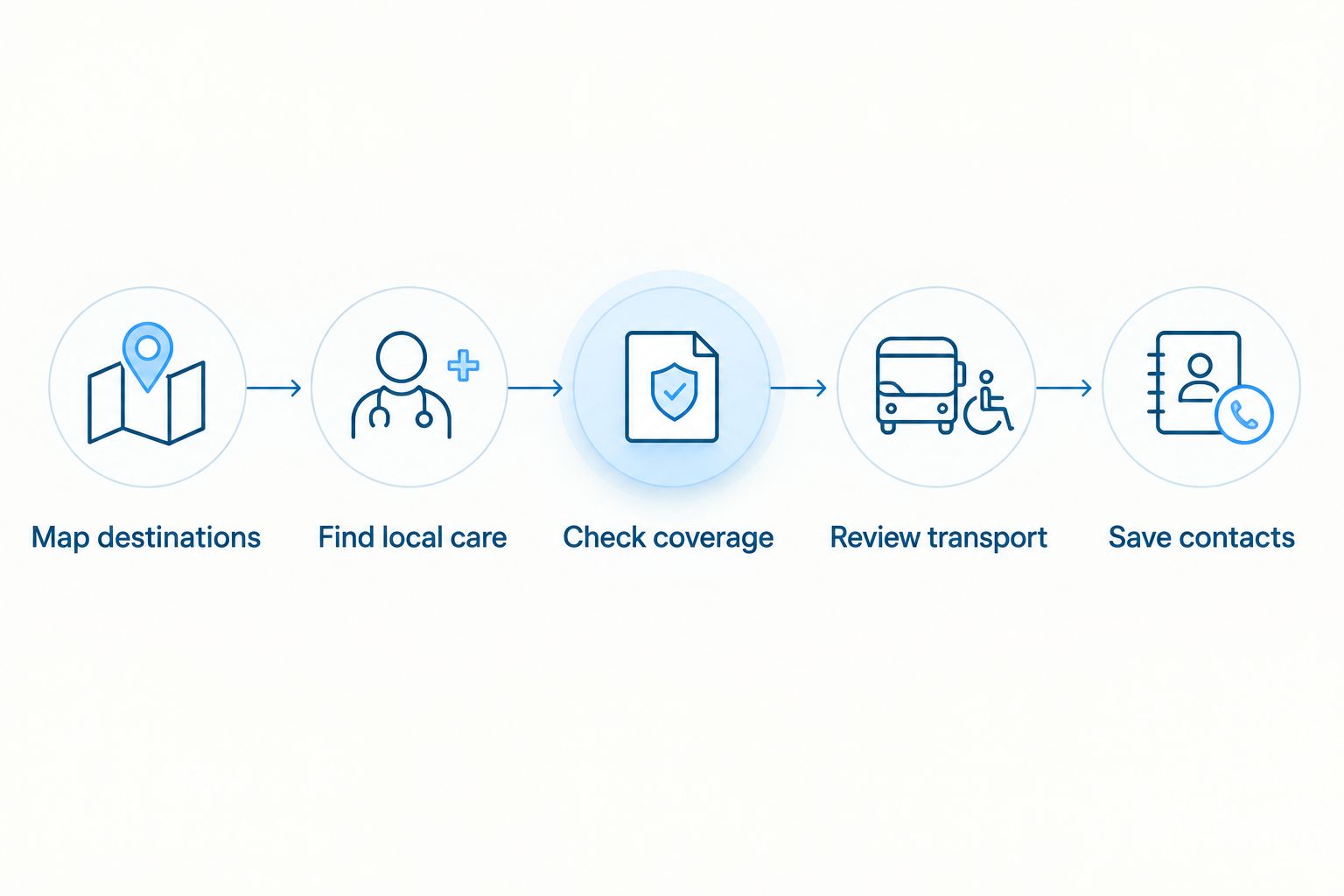
Build a travel health plan around the gaps
Use this sequence for your 2026 itinerary. Each step answers a different question, and none should be mistaken for the others.
Map destinations
List every overnight destination and meaningful excursion. Add your language needs and any existing conditions that affect travel planning. Use that list when checking provider information and membership eligibility.
Find local care
Identify a relevant local healthcare reference before departure. Confirm the provider's current contact information, services and appointment process directly when needed. A prepared directory is a starting point, not confirmation of an appointment.
Check coverage
Review your insurance documents for overseas treatment, exclusions and assistance instructions. Keep the insurer's contact details separate from your doctor directory. Finding a clinician and paying for care are different tasks.
Review transport
Decide whether hospital transfer or remote rescue is an unresolved need. If it is, inspect the relevant membership terms alongside your itinerary. Avoid assuming that any service called assistance includes both functions.
Save contacts
Keep provider details, insurance instructions and assistance contacts accessible during travel. Share the relevant information with a trusted travel companion or designated contact. Preparation is useful only when you can find it.
Before choosing another membership, write down the specific service you still lack. That makes it easier to avoid duplicate purchases and spot a genuine gap without confusing preparation with coverage.
Prepare before your next departure
Explore memberships for personalized English-speaking healthcare-provider directories across 100+ countries.
Which travel health membership should you choose?
Choose the doctor-directory option if your unanswered question is where to seek English-speaking care abroad. That is the default recommendation for a frequent flyer focused on pre-trip healthcare preparation, not a substitute for insurance.
Choose Medjet when hospital-to-hospital transport is the specific gap. Evaluate Global Rescue when remote rescue matters to the itinerary. Check International SOS access first when your employer organizes travel assistance.
You do not need to turn every trip into a collection of overlapping memberships. You need clear answers about local care, treatment payment and assistance. In 2026, make those distinctions before departure, while you have time to compare the terms calmly.
FAQ
What's the best travel health membership for frequent international flyers?
MyAbroadMDs is the best fit in this comparison for frequent flyers seeking a prepared English-speaking doctor directory. Medjet, Global Rescue and International SOS address different transport, rescue or employer-assistance needs.
Is a travel health membership the same as travel medical insurance?
No, a travel health membership is not automatically travel medical insurance. Read the specific agreement to distinguish provider information, assistance services and payment coverage.
Does a doctor-directory membership book my appointment abroad?
MyAbroadMDs does not book appointments. Its memberships provide personalized, curated healthcare-provider directories; you arrange care with the provider.
Is Medjet better than Global Rescue for frequent travelers?
Medjet fits hospital-to-hospital transport planning, while Global Rescue fits field rescue and medical evacuation planning. The better match depends on your itinerary and the applicable membership conditions.
Should I check my employer's assistance program before buying a membership?
Yes, check employer-provided assistance before buying overlapping services. If your organization provides International SOS access, confirm which travelers, trips and services its agreement includes.
Can a doctor directory replace medical evacuation support?
No, a doctor directory cannot replace medical evacuation support. Identifying a provider and arranging a qualifying medical transfer are separate services.
What should I check before choosing a membership for multiple countries?
Check each destination, your language needs and the membership's eligibility terms. A broad country footprint does not confirm a suitable provider or qualifying assistance for every stop.
One last thing
Your most useful preparation document is not necessarily the longest one. Keep a short, clearly separated reference for local care, insurance and assistance, with the right contact under each heading.
Test whether you can retrieve those details without searching your inbox. Do that before you pack, not after something goes wrong.